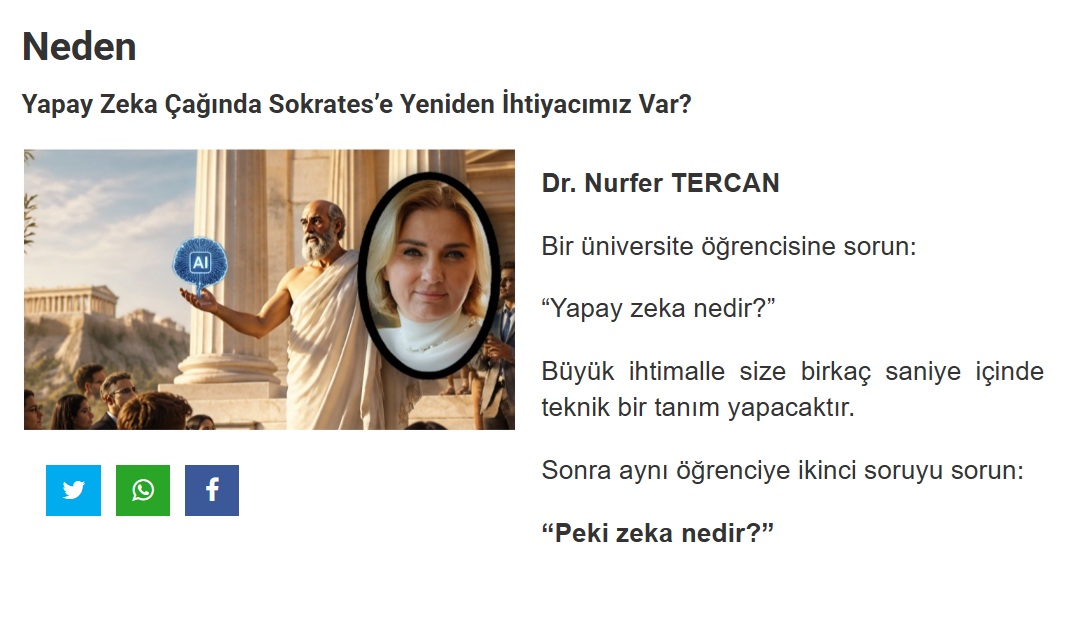
Do We Need Socrates Again in the Age of Artificial Intelligence?
Dr. Nurfer TERCAN
Ask a university student:
“What is artificial intelligence?”
In all likelihood he will give you a technical definition within a few seconds.
Then ask the same student a second question:
“And what is intelligence?”
This is exactly where the silence begins.
Because we have begun to teach technology; but we have forgotten to teach concepts.
Today the world is living through the greatest speed of knowledge production in history. Every minute millions of lines of text, images, analyses and commentary are produced. Artificial intelligence systems can process this information within seconds. But as information multiplies, something else is rapidly diminishing:
The courage to think!
What Socrates did in the streets of Athens some two thousand five hundred years ago was in fact far more modern than today’s artificial intelligence education.
He never gave answers.
He only asked questions.
Because real education is not making people memorise answers, but setting the mind in motion.
Artificial intelligence, however, carries the risk of doing exactly the opposite.
It presents us with the answer before we have even begun to think.
It is here that a new task appears before education systems:
To teach students not how to use artificial intelligence, but when to object to it.
This will perhaps be the most important academic skill of the future.
The artificial intelligence competency frameworks that UNESCO has published in recent years draw attention to exactly this point. The organisation lists among the fundamental aims of education not merely that students use artificial intelligence tools, but that they grasp human-centred thinking, ethical reasoning, critical inquiry and the limits of technology. Artificial intelligence is treated not as something that replaces the human being, but as a tool that supports the human capacity to think. (see)
Today “Prompt Writing Techniques” are being discussed at many universities.
Yet perhaps “Question Writing Techniques” should be taught first.
Because good answers are the children of good questions.
And not even the most advanced artificial intelligence can produce good answers to bad questions.
The real issue is not technology.
The real issue is the mind.
Because technology is an extension of the human being.
Whatever kind of mind we build, that is the kind of artificial intelligence we develop.
Societies that normalise violence produce aggressive algorithms.
Societies that live with prejudices develop discriminatory algorithms.
And societies that have lost their sense of justice build unjust automations.
The machine, in fact, imitates us.
For this reason, artificial intelligence studies are a matter for the human sciences before they are a matter for computer engineering.
Perhaps the most valuable laboratory of the future will be not the computer laboratory, but the ethics laboratory.
Perhaps the most important engineer of the future will be not the software engineer, but the engineer of conscience.
For this, the need arises for a new discipline at universities:
Philosophy and Artificial Intelligence.
This department will not train philosophers alone.
Engineers who question…
Jurists who think…
Doctors who exercise judgement…
Political scientists who oversee algorithms…
And most importantly, it will train technology leaders who do not forget the human being.
Because the competition of the next twenty years will rest on a question far more important than “Who will produce the more powerful artificial intelligence?”:
“Who will raise wiser human beings?”
Wisdom is the art of mastering knowledge.
Artificial intelligence is the speed of access to knowledge.
Speed and wisdom are not the same thing.
However fast a train may go, if it is on the wrong track it cannot reach its destination.
Humanity has today boarded what is perhaps the fastest train in history.
Now the real question is this:
Where is this train going?
Computer engineers cannot answer this question on their own.
The answer to this question will be sought at the common table of philosophy, law, sociology, psychology, theology and the experience of humanity.
Because the future will not be written by algorithms alone.
It will be written by the people who decide which values are to be taught to them.
And those people must first learn to ask themselves this question:
Not “What can artificial intelligence do?”, but “What must the human being not leave to artificial intelligence?”
This is the greatest philosophical question of the 21st century.
Now is exactly the time to think!
Notes from the Blue of the Windy City
https://www.5gvirusnews.com/yazarlar/neden-2-h1907.html
Translated from the Turkish original.