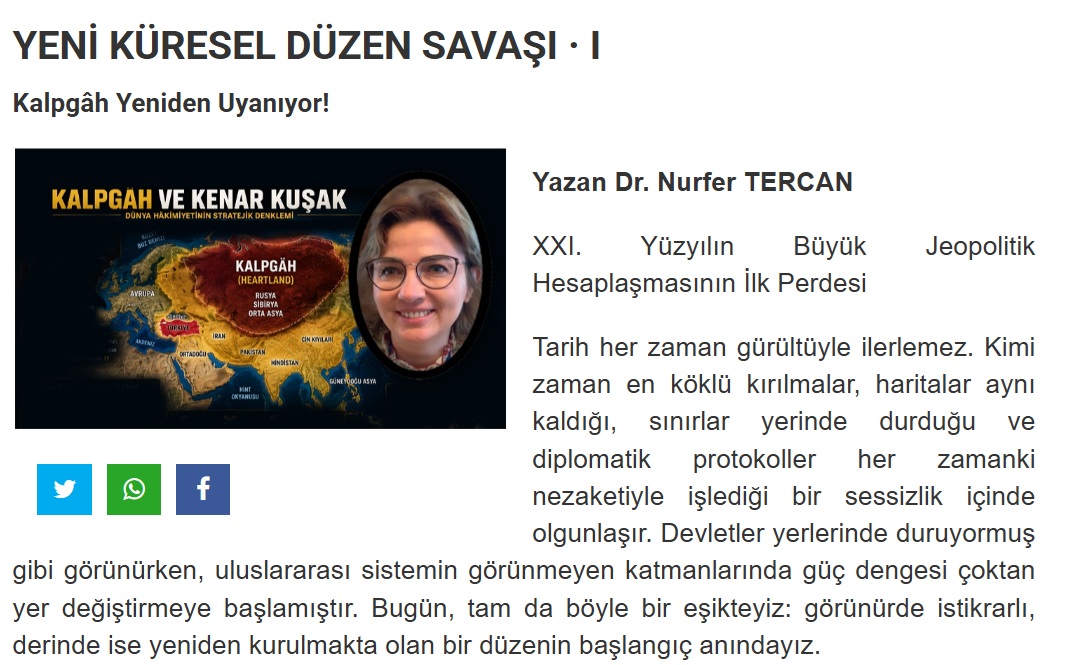
The Heartland Awakens Again!
By Dr. Nurfer TERCAN
The First Act of the Great Geopolitical Reckoning of the 21st Century
History does not always advance with noise. At times the most profound ruptures ripen in a silence in which the maps remain the same, the borders stay in place and diplomatic protocols function with their customary courtesy. While states appear to be standing still, in the unseen layers of the international system the balance of power has long since begun to shift. Today we are on exactly such a threshold: at the opening moment of an order that is stable on the surface and, in its depths, being built anew.
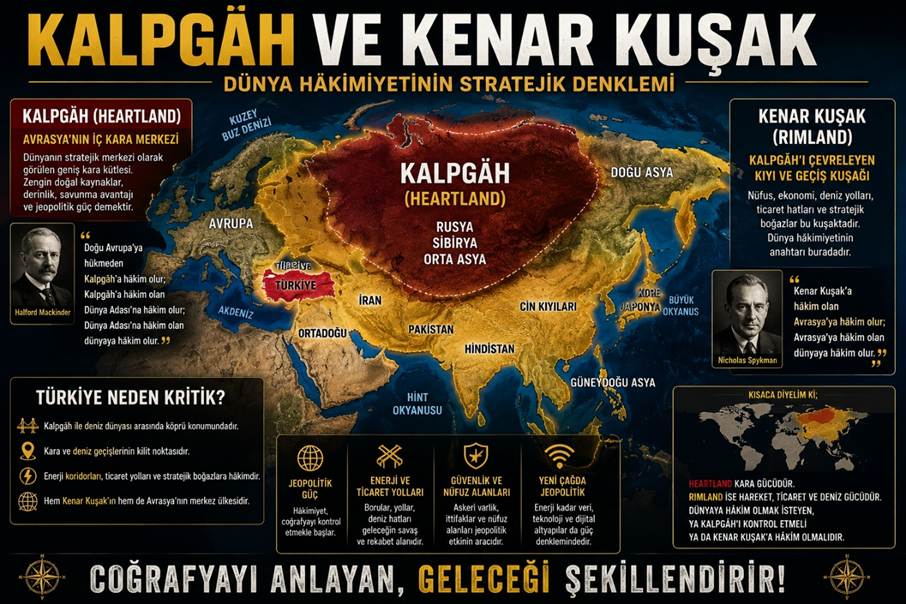
The matter we are facing is no ordinary crisis cycle of the international system. The very geopolitical logic on which it has been built for two centuries has been reopened to debate. That is why it is no coincidence that two concepts which have been waiting on the shelf in strategic circles for almost a century, the Heartland and the Rimland, have suddenly returned to the agenda. The study by Hal Brands and Michael Beckley published in the journal Foreign Affairs under the title “Heartland vs. Rimland: The Battle Lines in the War for the Next Global Order”1 places this classic debate once again at the very centre of contemporary great-power competition.
At first glance this may be read as a return to the past. Yet the matter is not nostalgia. The real matter is to be able to diagnose which ideas of history still retain their power to explain the future. For geopolitical theories are not like clothes that go out of fashion; sometimes they remain silent for a century, and then, when conditions ripen, they exercise their authority once more.
At the very beginning of the twentieth century, the British geographer Halford J. Mackinder put forward a groundbreaking claim in his famous 1904 paper “The Geographical Pivot of History”: the centre of gravity of world politics lay in the hard-to-reach inner continent of Eurasia.2 In 1919, in his work Democratic Ideals and Reality, Mackinder underlined this thesis once more with that famous aphorism: “Who rules East Europe commands the Heartland; who rules the Heartland commands the World-Island; who commands the World-Island rules the world.”3 It was the age of land power, and Mackinder was announcing the awakening of the continent to Britain, mistress of the seas. The strongest objection to this view came, in the middle of the Second World War, from the Dutch-born American strategist Nicholas J. Spykman. According to Spykman, what was decisive was not the inner core of Eurasia, but the coastal belt surrounding it like a crescent; that is, the Rimland, where population, industry and access to the sea were concentrated. In his 1944 work The Geography of the Peace he reversed the formula: “Who controls the Rimland rules Eurasia; who rules Eurasia holds the destiny of the world in his hands.”4
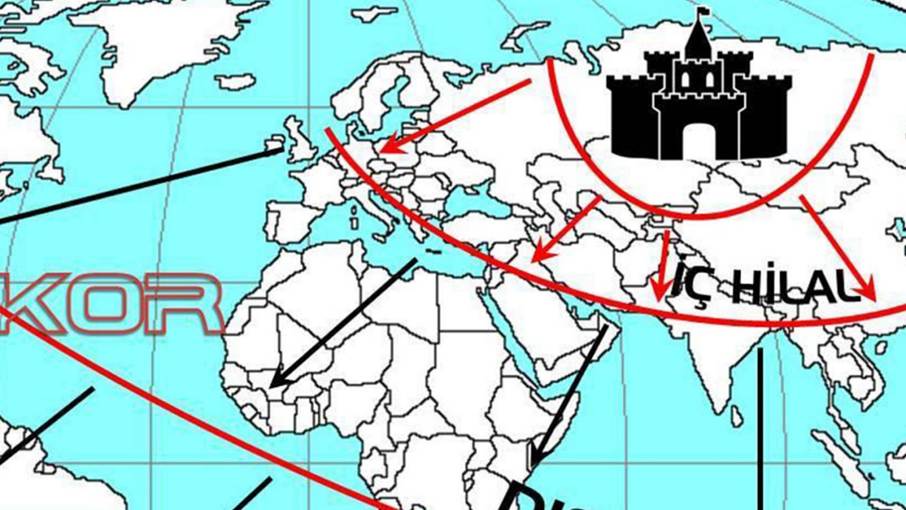
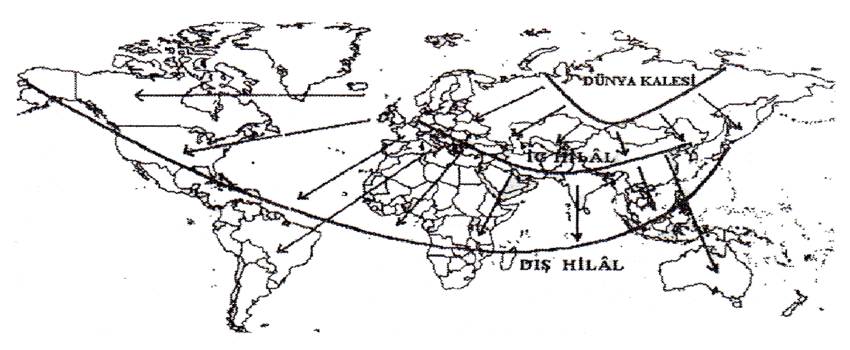
From the alliance architecture of the Second World War to the containment doctrine of the Cold War, American grand strategy silently bore the mark of this quarrel; the map of containment that George Kennan drew in 1947 was in fact the political translation of Spykman’s rimland.5 The point to which Brands and Beckley draw attention begins exactly here. According to them, today’s issue is neither solely the rise of China nor Russia’s challenge on its own. The real issue is that China, Russia, Iran and North Korea, positioned in the inner belt of Eurasia, converge, even though their goals, forms of regime and priorities differ, in the desire to erode and transform the existing liberal international order rather than to fortify it. The authors define these four states not as a single ideological empire, but as “a loose yet functional league of revisionists, clamped together by a common hostility towards liberal ideals and American power”.6 This is not the monolithic land empire that Mackinder imagined; it is a many-headed chain of power capable of producing coordinated pressure.
This diagnosis points to one of the quietest but deepest transformations of contemporary geopolitics. Throughout the Cold War, blocs were defined by ideologies; today blocs are defined by interests. States now meet in the same ranks not because they share the same worldview, but because they want to balance the same rival. This makes the system far more unpredictable. For ideological alliances become institutionalised over time and their patterns of behaviour become predictable. Partnerships of interest, by contrast, rapidly change shape as conditions change, dissolve and are formed anew. Unpredictability, in today’s order, is not a malfunction but a feature.
Even so, the most subtle finding of Brands and Beckley is hidden in the tension inside this bloc. According to the authors, this new Heartland is “at once both fierce and feeble”, that is, too weak to establish an economically and technologically sustainable superiority, yet dangerous enough to produce short-term crises and coercion.7
China’s technological and industrial capacity, Russia’s naked military power and nuclear legacy, Iran’s regional proxy networks and North Korea’s nuclear deterrent are read as pieces that complement one another. The picture that emerges is not a single-centred hegemony; but it is a distributed system of pressure that can probe the rimland at several points at the same time.
There is a second truth here that must not be overlooked: geopolitics is never pure geography. Geography acquires strategic value only when it is combined with the economic capacity, technological production, military power and, most important of all, political will that make it meaningful.
This is precisely what separates the 21st century from the age of Mackinder and Spykman. Today, as the interior regions of Eurasia regain weight, the struggle is no longer conducted solely over railways, pipelines or sea passages. Semiconductors, data infrastructures, artificial intelligence systems, submarine fibre-optic cables and financial clearing networks have also become inseparable fronts of the competition. Indeed, in his work The Eurasian Century, Brands addresses this multi-layered struggle within a framework that reads land, sea and the digital domain together as a single strategic chessboard.8 The rimland is no longer merely a coastal strip; it is at the same time a code, a protocol and a supply chain.
The question before us is not that simple question the headlines love:
“Has a new Cold War begun?” The real and more disturbing question is this: Can we still read the great-power competition of the 21st century with the concepts of the 20th century?
Do Mackinder’s land power, Spykman’s rimland and Kennan’s containment still show us the way; or are we obliged to draw, over these maps, the new borders of algorithms and supply chains? This series of articles will pursue exactly this question. Our aim is not to establish where states stand on the map; it is to understand why they act in this way, and how technology, economy and strategic geography reproduce one another.
For it is not only Eurasia that is stirring again today. What is stirring again is history itself.
Notes and Bibliography
1. Hal Brands & Michael Beckley, “Heartland vs. Rimland: The Battle Lines in the War for the Next Global Order,” Foreign Affairs, 24 Haziran 2026. https://www.foreignaffairs.com/china/heartland-vs-rimland-beckley-brands
2. Halford J. Mackinder, “The Geographical Pivot of History,” The Geographical Journal, Cilt 23, Sayı 4 (1904), s. 421–437.
3. Halford J. Mackinder, Democratic Ideals and Reality: A Study in the Politics of Reconstruction (Londra: Constable, 1919).
4. Nicholas J. Spykman, The Geography of the Peace (New York: Harcourt, Brace and Company,
1944); ayrıca bkz. America’s Strategy in World Politics (1942).
5. “X” [George F. Kennan], “The Sources of Soviet Conduct,” Foreign Affairs, Cilt 25, Sayı 4
(Temmuz 1947), s. 566–582.
6. Brands & Beckley, “Heartland vs. Rimland,” op. cit. (the authors’ characterisation “loose league of revisionists”
belongs to this article.)
7. For the bloc’s quality of being “at once both fierce and feeble”, see Brands & Beckley, op. cit. Cf. the AEI assessment: https://www.aei.org/op-eds/heartland-vs-rimland/
8. Hal Brands, The Eurasian Century: Hot Wars, Cold Wars, and the Making of the Modern World (New York: W. W. Norton, 2025
https://www.5gvirusnews.com/yazarlar/yeni-kuresel-duzen-savasi-i-h1920.html
Translated from the Turkish original.