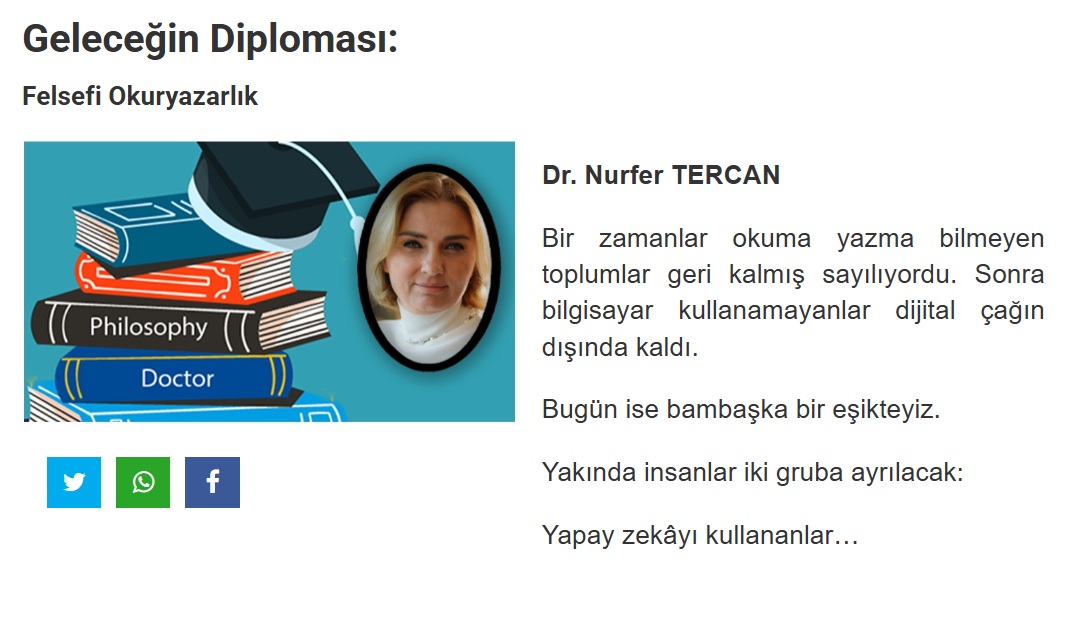
Philosophical Literacy
Dr. Nurfer TERCAN
Once, societies that could not read and write were considered backward. Later, those who could not use a computer were left outside the digital age.
Today we stand on an entirely different threshold.
Soon people will be divided into two groups:
Those who use artificial intelligence…
And those who are steered by artificial intelligence…
And what will determine the difference between them will be not knowledge of technology, but philosophical literacy.
Because artificial intelligence is the greatest knowledge machine that human history has produced.
But knowledge and wisdom are not the same thing.
Knowledge answers the question “What do I know?”
Wisdom asks the question “What should I do with this knowledge?”
This is the greatest test facing education systems.
Today many schools teach their students artificial intelligence applications.
This is of course important.
But a more important question is most often forgotten:
“Why is artificial intelligence suggesting this to me?”
If a person cannot ask this question, he becomes not one who commands technology, but a user steered by technology.
History gives us an important lesson. The invention of the printing press made access to knowledge easier. But the same press both printed the books of the scientific revolution and multiplied hate speech.
The internet connected people to one another. But at the same time it globalised misinformation.
Now artificial intelligence confronts us with the same dilemma in a far more powerful form.
Technology is never good or bad in itself. What determines its direction is the mind that uses it.
That is why the university of the future will not be merely an institution that trains engineers. It will at the same time be an institution that produces thought.
The engineer will develop the algorithm…
The philosopher will question the meaning of the algorithm…
The jurist will determine its limits…
The sociologist will examine its effect on society…
The psychologist will interpret the change in human behaviour…
And the educator will pass all of this on to the new generations.
Because artificial intelligence is no longer the subject of a single discipline.
It is the common concern of humanity.
Many higher education institutions around the world are redesigning their curricula in line with this reality. The debate no longer revolves solely around the question “How is artificial intelligence used?”; the question “How does the human being go on thinking alongside artificial intelligence?” is also settling at the centre of education policies. UNESCO’s recent work shows that no technology can take the place of the teacher’s pedagogical judgement and of human relationships, and that artificial intelligence can strengthen education only when it is human-centred and guided by ethical principles. (see) https://www.unesco.org/en/digital-education/ai-future-learning
Perhaps the time has come to write a new sentence on the entrance gates of universities:
“Here, not merely a profession is taught; a way of thinking is built.” Because in the future the value of diplomas will be measured not by the knowledge memorised, but by the questions produced.
Humanity’s new competition is not to produce machines that can think faster.
It is to raise human beings who can think more rightly.
The name of this is philosophical literacy.
And I believe that in the coming years one of the most prestigious departments of a university will be “Philosophy and Artificial Intelligence”.
Because the greatest capital of the future will not be data. The greatest capital will be the human being who can give meaning to data.
Artificial intelligence can offer us millions of answers. But no great civilisation that carried humanity forward began with answers.
They all began with a single question.
“Why?”
Perhaps the universities of the future should decide already now on the name of the most important course they will give their students:
The Art of Asking Questions.
Because in the age of artificial intelligence, giving answers will become commonplace.
But being able to ask the right question will remain the most distinguished quality of being human.
Now is exactly the time to think constructively!
Notes from the Blue of the Windy City
https://www.5gvirusnews.com/yazarlar/gelecegin-diplomasi-h1908.html
Translated from the Turkish original.