It was the best of times, it was the worst of times; it was the age of reason, and it was also an age in which the values possessed by that which makes a human being human were forgotten, in which masks were pulled tight over the eyes, in which we became unable to think and surrendered our beliefs to fear. Very little time remains until the days that Twenty Twenty-One will take over along with the doubts of Twenty Twenty.
2020 is a year in which all the opposites of good and evil can no longer hold together. A new age in which we have begun to lose justice, honesty, responsibility, self-sacrifice, struggling for someone else, and the courage to stand on the right side.
People have passed beyond anxiety and fear; they are in the streets in a state of frenzy… And the streets are burning with the fire of hell. Screams in which the yellow, the red and the black of the vests blend into one another, wildly. One more century that could be written among the ages of shame in the worn pages of history, in which reason and common sense are masked, which we cannot understand, and in which we have forgotten thinking at the very spot where we fell and froze…
Ah! This effort, without understanding, without listening, to strengthen with a comment the dirty world of the sticky social media in our hands… This being stuck in the age of fear, condemned to perish with the shadow plays of the TV hanging on the wall of our cave… The devaluation of human life and the attacks made directly on the minds of other people are a plain sign that thought is now exhausted.
Understanding, as intellection, is the function of the concept, and the concept is the absolutely essential unit of the faculty of thinking, its ultimate ground, because it rests on nothing else for its definition and requires only itself. The concept is the real possibility of meaning and of understanding. The loss of meaning, in turn, is alienation itself. Alienation is a conceptual corruption; it expresses not merely that certain concepts have not yet been acquired, but that what had been acquired has been lost. In order to understand, or to reckon, one must stop and think. Is the human being a creature that thinks? Or one that is on the verge of being able to bring out its capacity for thought?
From the language of the West, whose tongue has no bone in it, we picked out the most negative things one by one and pasted them onto our lives… If only we could also have learned the sides of it that remind us that we are HUMAN. In Western languages the verb to understand is rooted in the verb to stand. In German stehen means to stand, verstehen means to understand. In English standing means to stand, understanding means to understand…
And in our Turkish? Do we know, or do we remember, what the meaning of understanding is in our own mother tongue, which we have lost and about which we have been made to believe, hopelessly, that it can never be gathered up again? Had we not forgotten, could we ever have spoken and written in the language of hatred and violence?
In Old Uyghur they said “bilip katıp”. In the Zeynelarap epic, one of the Andelip epics among the historical texts, the verb kat- has been identified as ‘to understand’. Again, in the Kitabü’l İdrâk, which holds an important place among the dictionaries of Kipchak Turkic, the verb kaygur- “to explain”, recorded as Turkmen, has also, I think, opened out into our own day as “come, be a little concerned, think it over and understand”. The first of these is found in the Kö/ül Tėgin inscription: “tokuz oguz begleri bodunı bu sabımın edgüti eşid katıgtı tıŋla”, translated as “Lords and people of the Nine Oghuz, hear these words of mine well; listen with understanding, giving yourselves to it”. The second, found in the Altun Yaruk Sudur, “ürüg amıl tikisiz katıgtı sözlesün bo daranıg”, has been interpreted as “let him say it calmly/serenely and silently, understanding it well”. In short, here we may perhaps see the oldest roots from which the meaning of “let us stop a while and think” comes in the Turkish we assume we speak. And in addition, the meanings in other languages that may help us to stop and think, to look at ourselves: in Greek “sta/ste” “to stand”, “episteme” “to know, to understand”; and in Arabic “vakafa” “to stand”, “vakıf”, “vukuf” “to understand”…
Now is exactly the time to understand! We MUST UNDERSTAND that we have no chance other than to understand. We have some time, however little: at least as much as a night from which we may still wake, a morning in which we may pass into awakening! We must wake up to the fact that we do not have hours to while away on social media and television series, before the fire of the streets burning in flames leaps to the homes in which we stay. We must understand that we speak and write without thinking… We must know that the reflection of the false shadows on the wall of our cave is thoughts of ours that do not belong to us. We must at last become aware that none of the emotions, feelings and concepts belong to us. We must at last work out that what has been pasted on are falsehoods that never end, copy after copy.
The critical outlook and the power of tolerance, unable to withstand this crushing attitude in the worlds of the mind, running away… How long can we hold out in this world in which they have left their place to shadows that can give themselves meaning only through violence, by positioning themselves against external subjects?
Thinking minds have, of course, given a definition to this state that emerges in a person even though it is not part of the created nature of the Human Being: a state that cannot get its fill of rancour, hatred, revenge, grudge and anger, like an inferiority complex arising from one’s own existence. This psychological state (Ressentiment), the diagnosis of the “philistine” type of Human, is described by Schopenhauer as follows:
“A person who has no intellectual needs (the philistine) is always, and with very great seriousness, occupied with a reality that is in fact not real. Since it is not possible to taste real pleasures without real needs, it is not possible for the philistine, who has no intellectual needs, to take any intellectual pleasure. These pleasures, should he be forced to turn towards them, will seem to him a drudgery. For him the real pleasures are the sensual ones. The second characteristic of these people is that, where other human beings are concerned, since he has only physical and not intellectual needs, he seeks the company only of those who will satisfy this side of him. The very last thing he will expect of his friends is that they should possess any intellectual capacity; moreover, should such people come his way, they will at once arouse in him antipathy and even hatred. The reason for this is simply that in the presence of these people he is inwardly seized by that disagreeable feeling of inferiority, and that he feels in his heart a kind of envy towards them which he must carefully conceal even from himself; yet this envy, for this very reason, will at times grow, seething inwardly. But in spite of all this, it will never so much as cross his mind to give up regarding himself as valuable or superior according to the standards of his own peculiar judgements.”
Again Schopenhauer, pointing to “knowing”, felt the need to explain three types of human being in the following way, so that we might stop and think about them
- The “intelligent human being”, who sees the causal connections, is himself within them, and the most he will do is science.
- The “independently knowing human being”, the “creative human being” (the artist), who can form a bond with the world outside causality and can go beyond causality.
- The human being who not only passes beyond the causal connections and sees this, but succeeds in living independently outside causality, who sees that the world is, in its essence and ground, will, and who silences his willing throughout his whole life.
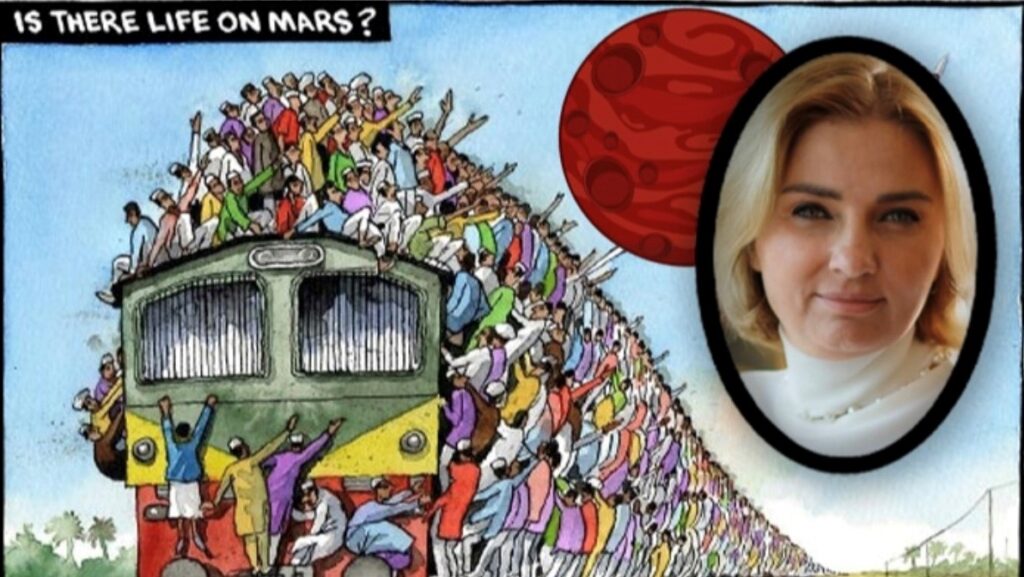
In conclusion: the HUMAN BEING who, in every situation and whatever the circumstances, wants to think, to investigate and to know may of course also want to learn about the energy sources on Mars. Scientists who investigate, think and work on analysis while imagining life on Mars may perhaps, with some incredible finding, make the world liveable again. Why not? Keywords: Knowledge, Reasoning, Stopping and Thinking, Imagining and Wondering, Being Left Astonished
With the wish that for all of us there may be Healthy Days on which we can stop and think…
Translated from the Turkish original.