Choosing the right staff is half the success of any business. At Rixos President Astana they know this, which is why they approach the staff selection process carefully and thoughtfully.
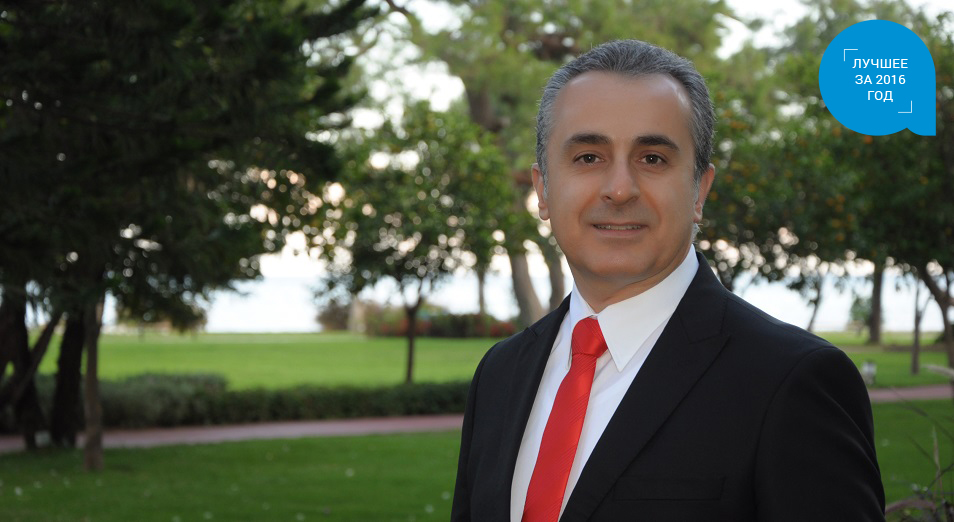
The hotel’s General Manager, Tansel Tercan, told abctv.kz why a university degree matters when applying for a job at a hotel and how many foreign languages receptionists should know.
He has been in tourism for 25 years, 12 of which he has devoted to working at Rixos. Before that he played professional volleyball for 16 years. What brought him into the hotel business, he admits, was a boundless love for people, without which it is impossible to succeed in the hospitality industry.
– Mr. Tansel, you started working in Astana recently. Before that you worked at Rixos Premium Belek and Rixos Beldibi, which are in Türkiye. Tell us, do you feel a difference in how well prepared the staff are there and here?
– You know, we look at people on the basis of their individual characteristics. We understand that each of them has a different education, upbringing, mentality, a different culture. People cannot all be the same, so I cannot talk about differences. But without question, all the staff, both here and in Antalya, are in keeping with the culture of our hotel.
– What do you mean by culture?
– The first rule of any hotel is hospitality. But quality and service differ everywhere, you will agree. We try to provide everything at the highest level. For us, “the customer is always right” is not just words. Our staff must be able to anticipate a guest’s wish, even if the guest does not voice it.
Besides this, we take into account the culture of the country in which our hotel is located. I myself arrived in Astana a month ago and immediately began studying what kind of people like what, what food, what lifestyle, what entertainment programme. When I have free time, I try to visit interesting places, I photograph everything, and then together with the team we come up with new ideas for our hotel. Our work is the work not of one person but of a whole team.
– Which matters more to you: your employees’ human qualities or their professional ones?
– They say there is no such profession as “a good person”. My task is to understand who my staff are, to choose the suitable people from a multitude of candidates. To build a career plan for them. It is like a film here, in which every employee, whether a bartender or a waiter, has to play their role well. The success of the film, and whether they will appear in the sequel, depends on the quality of their acting.
It often happens that we do not find the professional qualities in an employee, and that is when we look closely at the personal qualities. When I came here, I began observing the employees, who works how. I did not intend to change the staff. I simply watched how they react to changes, how they carry out their duties, and made notes for myself about what additional training was needed for managerial positions and for the staff. We hired a training company to give each of our managers this missing knowledge. I decided for myself that only after this would I decide whether a person is capable of working with us or not.
One has to understand that we cannot turn an apple into an orange, we cannot create one perfect model out of different people. We teach all our staff what we expect of them, and if they cope, understand and accept our culture, they stay with us for a long time
– Do you bring in Kazakhstani training companies to train your employees?
– Yes. This time we were choosing between two, and we chose the second. The first company’s thinking was more global, whereas the second company offered the training that we specifically needed. Their teaching systems are different too. With some it resembles school education, where you sit at a desk, you are taught, and then you are asked for what they want to hear. The aim of the other kind of training is to teach you to think, to make you understand that the main thing here is you and your idea. You will agree that in the second case employees will be more motivated to gain new knowledge.
– In your view, how important is it to motivate employees in the course of their work, and what should that motivation be?
– All over the world many companies operate under a dictatorial regime, under coercion, under constant pressure. But we are fortunate that tourism has a softer, freer system, since we provide service from person to person. It is very important to us that the day begins with personal contact with the employee, with wishing them a good day; even a touch gives a person a sense of belonging to the common system. I believe that human relationships of this kind at work motivate best of all. Twice a year we hold corporate evenings.
Besides this, every year we choose the best employee and give them a holiday trip abroad. We also send our employees for training to one of our hotels abroad. If our employees build a rapport with a guest and sell more services, they naturally receive bonuses. And we send the best employees to work in our hotels abroad. Some even stay there to live and start families.
– And how do you feel about fines, financial penalties?
– Any of us can make a mistake. That is human nature. The main thing is that the person understands and admits it, that they are not afraid to do so. The main thing is trust in one another. In that case we can solve any problem without fines as well.
To be honest, every day we receive comments from our guests, many of them positive, but there are negative ones too. Even then I never raise my voice at my employees. I think what matters more here is to find out how we arrived at this problem, how it arose, and how it can be solved at the root, so that all my guests who might have complained about this problem are happy.
– Tell us, how great is the difference between the requirements for a receptionist and for housekeeping?
– The difference is colossal, I would say. Working at reception requires knowledge of several languages, namely Kazakh, Russian and English, a university degree, preferably two of them or an international degree, and also proficiency in the computer system. Height, appearance and age play a huge role. It has to be a young, pleasant, presentable person under 30.
As for housekeeping, what matters more here are human qualities, courtesy, physical stamina. Although a degree is not a mandatory requirement for this position, it is good if the candidate has one. Housekeeping communicates with the guest, and if an employee makes a mistake in that communication, we risk losing that guest for good. Age is also important: it should be a woman between 30 and 40.
– How does the selection of candidates take place?
– In several stages. The first screening is done by the human resources department. They check applicants for language skills and for compliance with the requirements, and look at age and education. Then the candidate’s CV is passed directly to the department where an employee is needed. At this stage the manager screens the CVs once more, keeping the candidates who suit him. And at the third and final stage, I myself talk to the candidates, in English.
If we see from the CV and track record that an employee has enough experience, that they do not need an unpaid internship, we sign an official contract with them straight away. If we see that an employee does not have enough experience, we give them three days of unpaid internship, so that during that time they can show what they can do and we can test them in action. On the fourth day we make the decision as to whether they suit us or not. During this time our potential employees come to understand where they have ended up and whether this is how they imagined the job.
– Do you offer internships for students?
– Of course. Moreover, many students who have done an internship with us come back to work for us after finishing their studies. So as not to forget our interns, we issue them a certificate of completion of the internship and a reference. But not to everyone, only to those who complete it with top marks. When we see this document in their hands on their return, we take them on.
– What qualities are important for an intern?
– It all depends on the department they have ended up in, on whether they fulfil and observe all of management’s requirements and the weekly schedule, which sets out when the intern has to come in and what they have to do. Every intern has their own mentor. If they are in the kitchen, their mentor will be the senior chef; if in accounting, the chief accountant. Each department has its own requirements, standards, principles and discipline. We value punctuality and responsibility.
– As far as I understand, you take on employees through their CVs, without personal contact at the first stage?
– Exactly so. That is why it plays a very big role for us. You know, people with “poor” CVs, where the surname, first name and contact details are written briefly and clearly, are not aiming for anything. It is important that the CV be well written, with everything set out, from education right up to the last place of work and internship. We even look at spelling mistakes; that is a big indicator. There are some curious moments. For example, we were looking for an accountant and received a CV from a man with a technical education who would not mind trying himself in the role of accountant. And with a little note, you know: “I am a quick learner”.
– In Kazakhstan there is a great deal of talk about a staff shortage, especially in the hospitality industry. Do you feel it?
– No. We place advertisements and receive a large number of CVs from candidates. It never happens with us that there is only one CV and we are forced to hire that person. On the contrary, we always have a choice, because competition to join us is strong. We do not face a staff shortage. That probably shows that people know about our company and want to work for us. We used to be surprised that someone had been abroad, had a foreign degree and international experience. But now that is the norm, every second person knows three languages, young people are developing.
– And what about staff turnover?
– Ours is natural. Some people leave because they are moving, some go on maternity leave, some no longer see themselves in the hotel sector. But we have many departments in which people have been working since the day the hotel opened.
You know, it is probably not a problem for us because we selected our managers carefully; they are all psychologists. Each of them has 40-50 people in their department, and they can give all of them moral support, listen, help; they are open to their colleagues. With us nobody is left alone with their problems, we solve everything together. That is probably what helps us keep our team together.
There have been isolated cases where some employees resigned and went to another company because a slightly higher salary was offered there. When they realised that apart from the money there was nothing there, neither benefits packages nor opportunities, some wanted to come back. But our policy is that we give a chance only once, and we do not rehire employees who have resigned. Of course, there are exceptions to the rule, but then the reason for leaving is what matters.
– Speaking of other hotels: how do you feel about competition? Do you feel it here, in the capital?
– If the competitor is strong, I am only glad. After all, it means that we must not merely match their level but be above it. The main thing is that it be healthy competition.
As for the hotels that exist in Astana today, they are all new, equipped with the very latest technology, they spend a lot of money on advertising and invest a great deal in their hotel. But novelty and technology will never replace the warmth and heartfelt care of good staff.
– How many hotels does your chain have worldwide, and how many in Kazakhstan? Are there plans to expand the chain?
– We currently have 32 Rixos hotels around the world. But there will soon be further investment, and new hotels will be opening in the Maldives and in Dubai. In Kazakhstan we have 4 hotels so far. In Almaty and Astana they are business hotels, while those in Borovoe and Shymkent are more resort hotels. I can say that 80% of our hotel’s guests are Kazakhstanis.
– How are your hotels getting through this time of crisis, which is difficult for the country and for business?
– We simply believe in the future. Next year we are expecting EXPO. Our President recently travelled to Türkiye and invited all Turkish companies to the exhibition. Many European energy companies will soon begin entering our market. Of course, each of us feels the negative impact of the crisis, but the economy is on the rise. In the tourism sector everything is simpler: even if you do not manage to earn one million, you will still earn a few hundred thousand. Business keeps going in any case, no matter what.
Source: inbusiness.kz
Translated from the Russian original.