A Country Between the White Olive and the Black Oil
By Dr. Nurfer TERCAN
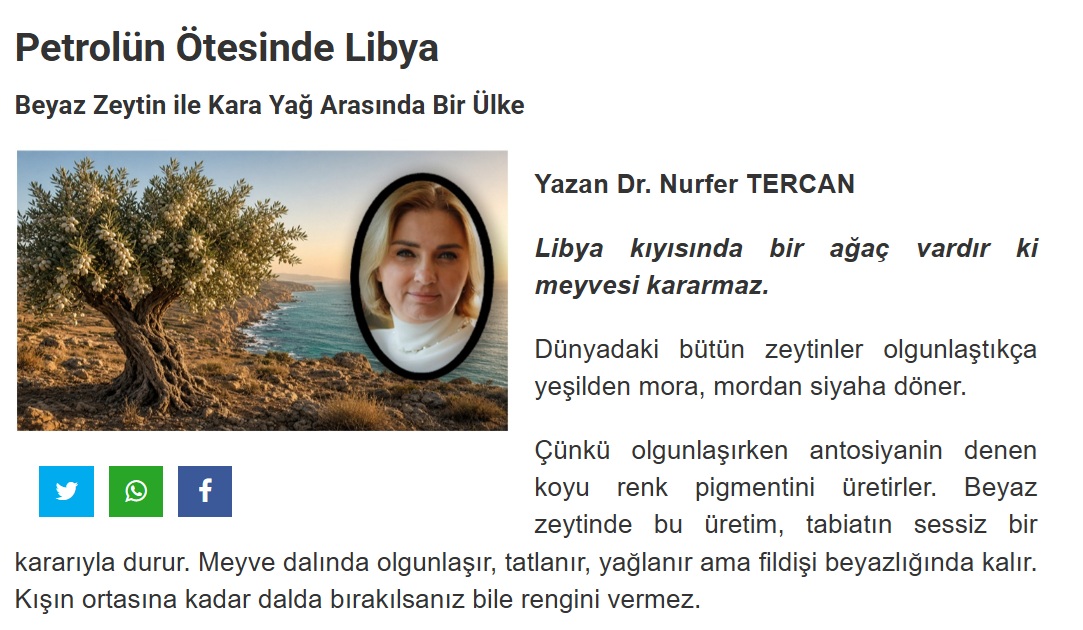
On the coast of Libya there is a tree whose fruit does not darken.
All the olives in the world turn from green to purple and from purple to black as they ripen.
For as they ripen they produce the dark pigment called anthocyanin. In the white olive this production stops, by a silent decision of nature. The fruit ripens on the branch, grows sweet, fills with oil, yet remains ivory white. Even if you leave it on the branch until the middle of winter, it does not give up its colour.
In other words, the white olive does not refuse to ripen. It refuses to darken.
Its botanical name is Olea europaea / leucocarpa var. It is one of the rarest olives in the world; it has managed to hold on in only a few corners of the Mediterranean, and the Libyan coast is one of those corners.
Along that coast more than a hundred recorded olive varieties grow; the white olive is the most silent, the least known of them. As if it were the silent waiting of a way out from the Sahara to the Mediterranean…
Throughout history the oil of this tree was sought not at tables but in temples. Because it left no soot when burned in a lamp and did not stain marble, it was counted a sacred oil. That is why in Italy it was called
“the olive of Mary”. It never became commercially popular. Because it yields little, yields late, and is not easily transported.
Now let us look beneath the same soil.
Libya, with proven reserves exceeding 48 billion barrels, is Africa’s largest oil country. More than 40 percent of the continent’s proven reserves lie beneath this desert. And here the whole fortune and the whole tragedy of a country meet in a single sentence:
Beneath the same soil there is an oil that darkens; above it, a fruit that does not.
The oil beneath the ground stains every place it is extracted from: hands, contracts, borders, institutions.
It makes one rich, but it leaves a mark!
The oil above the ground gives only light when it is burned. It earns little, but it does not pollute.
One is rent, the other is labour.
One is measured in months, the other in generations. An oil well comes into production in a few months; an olive tree keeps you waiting years for its first fruit and gives its true abundance to the grandchildren.
Which oil a country leans on is in fact the answer to how it understands time.
THE SETTLEMENT PLAN OF COMPANIES, THE SETTLEMENT PLAN OF STATES
2026 has not been an ordinary year for Libya.
In January, in Tripoli, a 25-year agreement worth more than 20 billion dollars was signed with Total Energies and Conoco Phillips; the Waha concessions were extended to 2050. In February the results of the first licensing round since 2007 were announced; Chevron returned to Libya after sixteen years, and the Eni–Qatar Energy partnership and Repsol won blocks. In June production rose to 1.44 million barrels a day, the highest level since 2013.
The figures are bright. But of the 22 blocks opened for bids in that same round, only five could be awarded.
The number of companies showing interest had exceeded fifty. Only a handful went on to binding commitments. Because a signature is easy and its cost is low; an investment decision, however, is rather expensive.
And if you look at where the companies settle, you actually see where the states settle.
The western coast, with the pipeline running from Mellitah to Sicily, is Italy’s gas architecture. The Sirte basin, the country’s oil heart, is the domain of American and French capital.
Murzuq in the southwest is the face of Libya that looks towards the Sahel. The Cyrenaica platform and the offshore blocks in the east, meanwhile, are not merely a matter of geology but a matter of maritime jurisdiction.
Capital comes from the West and is signed for in Tripoli. The fields and terminals are in practice under the umbrella of the powers in the east. And the revenue is shared out through the Central Bank in Tripoli.
Three separate chains of legitimacy intersect over a single barrel of oil.
Indeed, this past August in Zawiya, the complex housing the country’s largest operating refinery was struck by unmanned aerial vehicles for days; a fuel tank holding millions of litres burned and collapsed, the city’s electricity infrastructure was damaged, and the state oil company issued a force majeure warning.
The lesson is clear: owning an oil field is not enough to be an energy power. One must be a state able to protect its energy infrastructure.
THREE THRESHOLDS: 2030 – 2045 – 2053
2030 is not a year of capacity but a year of protection. Without a single central bank, a single budget, a single revenue pool and an infrastructure that can be protected, no barrel target has any meaning. The risk of this threshold is plain: the companies settle in, the state is not built. Then a country becomes a guest on its own soil.
2045 is a mathematical threshold. The Waha concessions end in 2050; 2045 is the year of renegotiation, that is, of real bargaining power. But the real threshold is not oil. It is water.
The Great Man-Made River, which keeps Libya’s agriculture and cities alive, relies on non-renewable fossil water. This is the one calendar that no barrel price can postpone.
2053, for its part, is a threshold that can no longer be measured in barrels. The questions to be asked on that date are not economic but civilisational: Which cities were founded in this country? Which universities, which libraries? Where did the young population settle, what did it produce, what did it believe in?
And here Libya’s most overlooked capital comes to light: its memory.
BELONGING NEITHER TO THE EAST NOR TO THE WEST
That famous parable in the Surah an-Nur seems to have been spoken precisely for this geography: the oil of the lamp comes from a blessed olive tree that belongs neither to the east nor to the west; it is an oil so clear that it would almost give light of itself even if no fire touched it.
Belonging neither to the east nor to the west.
For a country divided between its east and its west, squeezed between Europe and Africa, standing between the Mediterranean and the Sahara, a more meaningful sentence is hard to find.
The real question before Libya is not whether it will choose the east or the west.
It is whether it can choose to be its own tree.
For this reason the white olive is, in this essay, not a botanical detail but a measure.
You can measure a country’s development by its number of barrels. But you measure a country’s claim to civilisation by what it does with its rarest tree.
A Libya that can protect that tree, multiply it, register its name with a geographical indication and tell the world about its oil through its own story will in fact have rehearsed what it wants to do with petroleum: turning a resource into an identity.
For in history no natural resource has ever built a civilisation on its own.
A resource turns into wealth only when it is joined with reason; wealth into a state when joined with institutions; a state into power when joined with production; power into civilisation when joined with culture and memory.
Oil does not have to be Libya’s destiny. Oil can be the capital in Libya’s hands with which to rewrite its destiny.
And perhaps the question that this country — perhaps all of us — must ask ourselves is this:
When the black oil beneath the ground runs out, will there still be something above the ground that does not darken?
https://www.5gvirusnews.com/yazarlar/petrolun-otesinde-libya-h1943.html
Translated from the Turkish original.