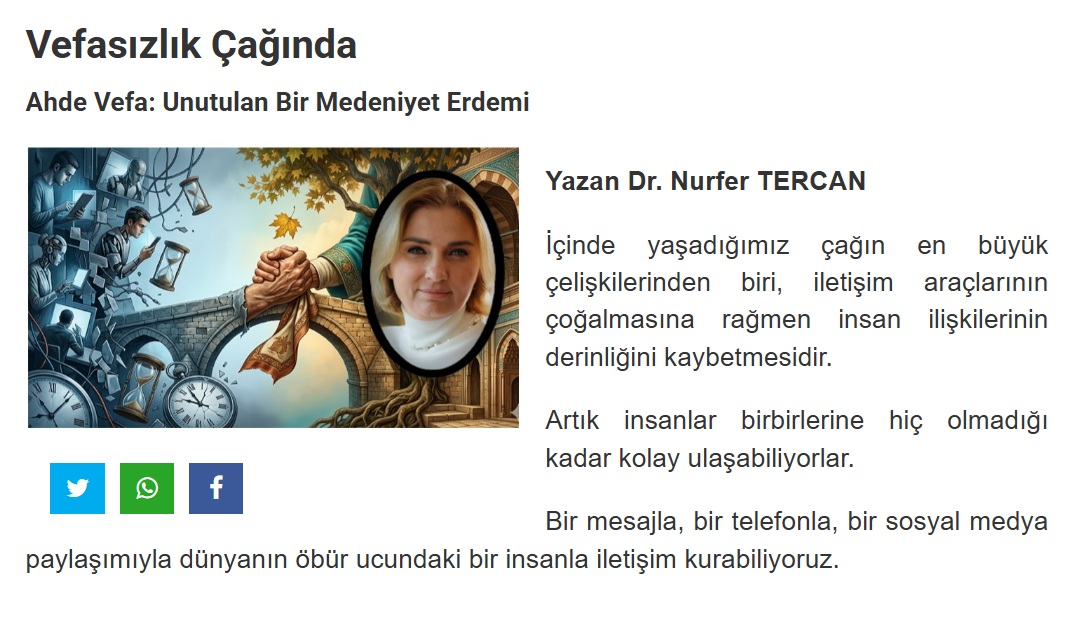
By Dr. Nurfer TERCAN
One of the greatest contradictions of the age we live in is that, despite the multiplication of the means of communication, human relationships are losing their depth.
People can now reach one another more easily than ever before.
With a message, a phone call, a social media post, we can communicate with a person at the other end of the world.
Yet at the same time we are becoming lonelier than ever before.
Because as the number of relationships increases, the quality of the bonds diminishes.
Friendships are turning into visibility rather than depth, loyalty into interests rather than principles, and fidelity into something talked about rather than remembered.
This, too, is one of the greatest delusions of modern man:
To take every crowd for friendship…
Yet crowds gather around power.
Friends, around the person.
While there is power, everyone seems close.
If you hold office, your telephone never falls silent.
If you have means, your circle widens.
If you have authority, the people around you who say you are right multiply.
But the unchanging law of life is this:
One day the office goes.
One day the means dwindle.
One day the applause stops.
What remains on that day is the true reckoning of your life.
Because some people love not you, but the means you possess.
Some care not about you, but about the benefit you can provide.
And some know your office but never know your character.
For this reason, to see that friendships end when the benefit ends is in fact not a loss but a discovery.
It is then that a person begins to know not those around him, but the truths.
A significant part of our hurts is born here too.
Because a person grieves not for having been betrayed, but for having been mistaken.
In reality the other person has not changed.
Only the masks have fallen, and the real faces have become visible.
That is why the disappointments experienced at certain periods of life are not a punishment but an education.
They teach us to read not people’s words but their characters.
Because character emerges in hard times.
Loyalty is the virtue not of easy days but of difficult days.
Fidelity is tested not in abundance but in want.
Ingratitude, for its part, is recognised not by how a person receives what he has, but by how he meets what he has lost.
This truth also lies at the root of the crisis of trust experienced today by many institutions, many relationships and even many societies.
People now find it hard to trust one another.
Because the value of words has fallen.
The value of interests has risen.
Yet civilisations are not built only with stone, concrete and technology.
Civilisations are built with trust.
When fidelity declines in a society, it is not only friendships that are lost.
At the same time the sense of belonging also weakens.
People begin to invest not in one another, but only in their own interests.
It is at this point that social disintegration begins.
For this reason, fidelity is not a romantic feeling; it is a question of civilisation.
And ingratitude is not merely an individual flaw; it is the harbinger of a social decay.
For this reason, fidelity is not a romantic feeling; it is a question of civilisation.
And ingratitude is not only an individual flaw, but the harbinger of social disintegration and moral erosion.
According to tradition, when Ibn Muljam, who was to martyr him, was brought into his presence, Ali addressed him with these reproachful words:
“Talemâ ehsentu ileyke…”
“How much good I had done you…”
These words, spoken centuries ago, continue to echo in the conscience of humanity today.
Because this sentence tells not only of a disappointment, but of the unchanging truth of human relationships.
Sometimes a person is wounded not by his enemy, but by those who forget his kindness.
Sometimes the deepest hurts are born not of the wrongs done, but of the forgetting of the good done.
Yet in spite of all this, to give up doing good would be to give up our own character because of the faults of others.
Because goodness is not valuable because it is reciprocated.
Goodness is a person’s loyalty to his own conscience.
Fidelity matures a person.
Goodness exalts a person.
Ingratitude, however, diminishes its owner.
And time…
Like a silent but unerring judge, it leaves everyone alone with his own character.
Offices change.
Fortunes change hands.
Crowds disperse.
Applause dies away.
But two things always remain:
A person’s character and the trace he leaves in people’s memory.
That is why true wealth is not what is possessed, but what is worth remembering.
The true legacy is not the figures sitting in banks; it is the memories living in hearts.
Because when a person dies, his property becomes an inheritance.
His character becomes a memory.
And those worth remembering will always be those who know how to show fidelity.
Notes from the Blue of the Windy City
https://www.5gvirusnews.com/yazarlar/vefasizlik-caginda-h1891.html
Translated from the Turkish original.