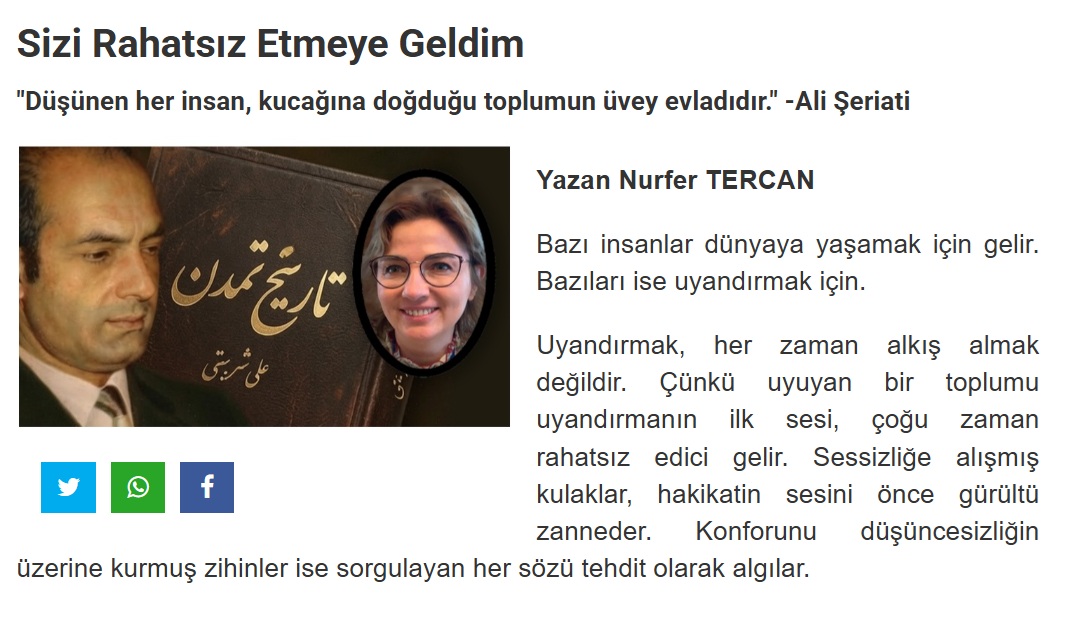
“Every thinking person is the stepchild of the society into whose lap he was born.” -Ali Shariati
By Nurfer TERCAN
Some people come into the world to live. Others, to awaken.
To awaken is not always to be applauded. For the first sound that rouses a sleeping society is, more often than not, a disturbing one. Ears accustomed to silence at first mistake the voice of truth for noise. And minds that have built their comfort upon thoughtlessness perceive every questioning word as a threat.
That is why, when Ali Shariati said, “I have come to disturb you,” he was not merely forming a sentence; he was proclaiming anew humanity’s oldest struggle.
Because truth first brings not peace, but unrest.
To think is to be able to put a distance between oneself and the age one lives in. For this reason the person who truly thinks is, most of the time, the loneliest person in his own society. He lives among the crowds but does not belong to the crowd. He pursues not the truths that are applauded, but the truths that are silenced.
Perhaps that is why Shariati said, “Every thinking person is the stepchild of the society he was born into.”
Because societies mostly love those who repeat them, not those who force them to think themselves anew.
Comfort demands order.
Truth demands change.
That is why, throughout history, prophets, philosophers, sages, scholars and great thinkers have been the most criticised people of their own ages. For they did not settle into the existing order; they weighed that order anew on the scales of conscience.
But thought alone is not enough.
One of Shariati’s most important emphases begins here.
When thought does not meet faith, it produces only cleverness.
And when faith does not meet thought, it produces only habit.
Yet what transforms a human being is the moral alliance that reason makes with faith.
When thought and faith come together, not merely knowledge but a wakeful consciousness is born.
Not merely attention; a vigilant conscience takes shape.
Not merely curiosity; an inquiring spirit emerges that strives to grasp the whole of truth.
This is the real force that builds civilisations.
Because knowledge can give a person power.
But consciousness teaches how that power is to be used.
Today humanity is perhaps living through the period of history that produces the most information. Yet at the same time it is living through its greatest crisis of meaning. Information has increased; wisdom has diminished. Communication has multiplied; understanding has dwindled.
Images have multiplied; the eyes that see the truth have grown fewer.
The problem is not ignorance.
The problem is knowledge severed from conscience.
The problem is reason separated from faith.
The problem is that belief which does not think and thought which does not believe walk side by side in the same age.
For this reason the first duty of one who seeks the truth is not to find crowds that applaud him.
His first duty is to be able to remain faithful to his own conscience.
Because having faith is, most of the time, more valuable than having many friends.
The person who stands beside the truth has no need of crowds.
Because truth is not measured in numbers.
History is the greatest witness to this.
The Prophet Noah was alone before the flood.
The Prophet Abraham was alone among the idols.
The Prophet Moses was alone before Pharaoh.
The Prophet Muhammad (peace be upon him) was alone in the first days in Mecca.
But loneliness was not the weakness of truth.
It was the price of truth.
Today the same question stands before us:
Shall we be someone whom society applauds?
Or someone whom conscience affirms?
Because civilisations have risen not through those who enlarged their comfort zones, but through those who dared to be disturbed.
Truth was never born from within noisy crowds.
It always sprouted in the hearts of a few people who thought in silence.
Perhaps the true intellectual is not the one who hands out peace of mind to people.
The true intellectual is the one who dares first to disturb them in order to bring them into the presence of truth.
It is exactly here that Ali Shariati’s legacy takes on its meaning.
Not in order to disturb…
But in order to awaken numbed consciences.
Because it is not answers that change a person.
What changes a person are the questions that have grown too large to be silenced any longer.
And perhaps the greatest question is this:
Are we truly living, or are we merely repeating the life we were taught?
If this question has begun to echo in our minds, the disturbance has achieved its purpose.
Because every great awakening begins first with a small unrest.
Notes from the Blue of the Windy City
https://www.5gvirusnews.com/yazarlar/sizi-rahatsiz-etmeye-geldim-h1916.html
Translated from the Turkish original.