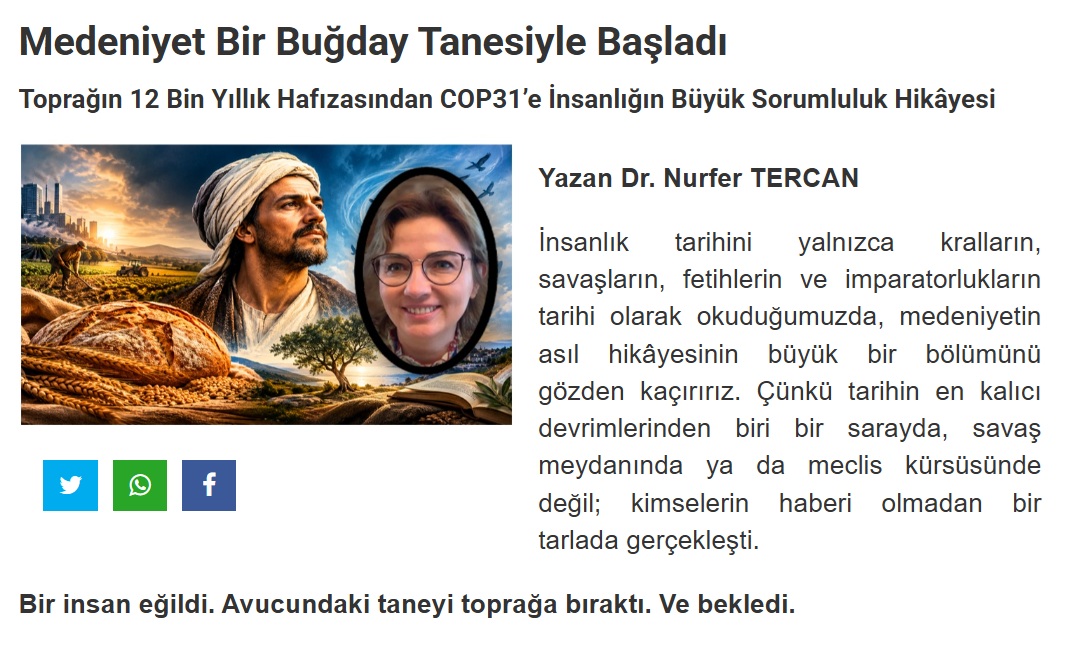
From the Soil’s 12,000-Year Memory to COP31: The Story of Humanity’s Great Responsibility
By Dr. Nurfer TERCAN
When we read human history solely as the history of kings, wars, conquests and empires, we miss a large part of the real story of civilization. For one of the most enduring revolutions in history took place not in a palace, on a battlefield or at a parliamentary rostrum, but in a field, without anyone taking notice.
A human being bent down. Laid the grain in their palm into the soil. And waited.
Perhaps civilization began in that very act of waiting. For the first time, a human being was thinking not only of today’s hunger but of tomorrow’s possibility. To entrust the grain in one’s hand to the dark soil instead of eating it at once was to forgo the certain benefit of today for the sake of the uncertain abundance of tomorrow. It was not only wheat that was laid in the soil. It was trust in the future.
That is why wheat’s journey of roughly 12,000 years is in fact humanity’s own journey: the silent witness of the great transformation from nomadism to settlement, from gathering to producing, from the struggle to survive alone to the shared table… It is no accident that the word “culture” in Western languages derives from the Latin verb colere, that is, to till the soil and to tend it with care. Human culture, in the literal sense of the word, came out of the field.
In tilling the soil, humans did not domesticate wheat alone; they domesticated time as well. They learned to count the seasons, to read the sky, to sow, to wait, to harvest and to store. Then they established the granary, the calendar, property, the division of labour, ritual and the table. The shared rhythm that Durkheim regarded as the source of social solidarity was perhaps first heard in the rhythm of the field. That is why a grain of wheat holds more than nourishment. It holds memory.
The first great truth that wheat teaches is this: if a grain wishes to multiply, it must first enter the darkness of the soil. If it stays on the surface, it is only a single grain; a being sufficient unto itself, yet consisting of nothing but itself. If it falls into the soil, its husk cracks, it loses its form, and at the very point where we think it has perished, it turns into another life.
It is possible that humanity learned the idea of death and rebirth not only from the sky but also from the soil. Humans buried the seed, waited, and saw that what they had buried came back. For people who entrusted their dead to the same soil, this sight was more than a consolation: every apparent end could be the husk of an unseen beginning. Nature falling silent and turning green again in the story of Demeter and Persephone; the showing of a reaped ear of grain at the highest moment of the Eleusinian Mysteries—these are traces of that ancient intuition. The deepest secret of the ancient world was the most ordinary fact of a field: not every disappearance is an annihilation; some disappearances are the beginning of transformation.
One of the most powerful accounts of wheat in the sacred texts appears in the story of Joseph: seven full ears and seven withered ears; plenty and famine… Yet this account is not merely an example of ancient agricultural planning. A great principle of civilization lies hidden within it: to be able to think of famine in the time of plenty.
Joseph advises that the harvested wheat be left in the ear; he wants the grain to be kept within its natural protection. This is not just a storage technique, but a wisdom which says that abundance cannot be preserved without prudence. For plenty, when it is not managed properly, can pave the way for the next famine. What Joseph does is to turn a dream into an institutional order, and foresight into social responsibility.
This is also the ethic we need to relearn in the face of the climate crisis: to be able to think of thirst while the water is flowing, of the soil’s exhaustion while it is still bearing crops, of fire while the forest still stands, of another’s hunger while our own table is full, and of the rights of future generations while the catastrophe has not yet arrived. Civilization is not merely the capacity to produce; it is the will to preserve what one holds for the future.
Centuries later, the same image appears on the threshold of one of the greatest works of world literature. Dostoevsky places the grain of wheat from the Gospel of John at the gate of The Brothers Karamazov: the grain that does not fall into the soil and transform remains alone; the one that can give itself up multiplies. The novel’s concern is not the perfection of human beings but their capacity to be transformed. The thought Zosima leaves to Alyosha, that “every person is responsible to everyone and for everything”, carries the ethic of wheat into human relations. A person is responsible not only for themselves, but also for how they pass by the suffering of another.
Today the scope of this responsibility is wider still. “The suffering of another” also includes the suffering of people whose faces we will never see, of children not yet born, and of all living beings that cannot make their voices heard. Just as the grain that falls into the soil gives life to the ears that come after it, human morality turns into civilization to the extent that it can go beyond the limits of one’s own lifetime.
Anatolia did not see wheat merely as an agricultural product. It made it the first link in a long chain of meaning: it turned wheat into bread, bread into blessing, blessing into gratitude, gratitude into the table, and the table into sharing. This chain is the story of how a substance can turn into value, value into ethics, and ethics into a social bond.
That is why bread that has fallen to the ground is picked up, kissed and placed somewhere high. For bread is no longer just flour, water and fire. Behind it are the soil, the rain, the farmer’s calloused hand, the millstone, the fire of the oven, the mother’s table, the neighbour’s due and a memory thousands of years old. It is no coincidence that the Turkish expression “the right of salt and bread” denotes a moral obligation, or that “the bread gate” is the name for one’s livelihood. The root of the word companion, meaning a fellow traveller in Western languages, also goes back to the person “who shares bread”.
The legend told around Yunus Emre sets two needs before a human being: the wheat that fills the stomach, and the breath that develops and broadens the soul. Perhaps today we should read these not as opposites but as complements. For a human being needs both bread and meaning. One cannot live without bread; and when left without meaning, one forgets why one lives. The crisis of our age is the crisis of an order of production that has severed bread from meaning: the result of a mentality that regards abundance not as a blessing but merely as a commodity, and the soil not as memory but merely as a resource.
In the wisdom of Anatolia, the ear of wheat is also an ethic of knowledge. The empty ear stands upright; as it fills, it bows. A human being, too, should be able to bow the head a little more as they truly come to know and mature. True knowledge produces not superiority but responsibility. The bowing ear is the person who carries the weight of knowledge.
In the literature of the Republican era, the meaning of wheat widens once again. It is no longer only a metaphysical symbol; it is the sweat of the brow, the farmer and Anatolia. In the world of Yaşar Kemal, the soil is not a backdrop but a living being that speaks with people and bears witness to injustice. In Nâzım Hikmet, bread is the language of shared labour that must be divided fairly. The wind wandering through Cahit Külebi’s wheat fields is the very voice of the homeland. In Sezai Karakoç, the ear of wheat rises to metaphysics once more; the logic of the grain that falls into the soil turns into the possibility of a civilization’s rebirth.
Thus the ear of wheat brings together labour and prayer, body and soul, earth and sky along the same line. For a century it is written as the answer to the questions “Whose labour, whose right, whose hope?”
Thousands of years have passed. Humans built villages, cities and empires; made the steam engine, extracted oil, split the atom, went into space, developed the digital world and artificial intelligence. Yet 12,000 years later, one of the greatest questions before us is still the same: how much more can the soil give us?
Progress did not free humanity from its dependence on the soil; it only made this bond invisible. The modern city dweller may not know which field their bread comes from. But when the field dries up, not knowing will not protect them. As in Ibn Khaldun’s cycle of umran, when prosperity makes people forget the conditions that gave birth to it, the door to dissolution opens.
From the soil to COP31: a reckoning of civilization
For this reason, the fact that the world will gather in Antalya for COP31 should not be seen merely as a diplomatic climate meeting. This gathering is an opportunity to reread the ancient covenant humanity made with the soil. Moreover, that this reading will take place on the northern arc of the Fertile Crescent, where wheat was domesticated, close to Göbeklitepe and Karacadağ, is one of history’s striking symmetries: the land where the seed first fell will be the place where the future of the seed is discussed.
For the climate crisis is the story not only of the amount of carbon in the atmosphere, but of a model of civilization. How much do we produce? How much do we consume? How much of it do we throw away? How much do we take from the soil, and how much of what we take are we able to give back?
Perhaps we are asking the question wrongly from the outset: “How much more resource can the Earth provide for us?” This question treats the Earth as a storehouse and the human being as a claimant with unlimited demands. Yet the real question is this: how much more do we think we have the right to ask of the Earth? Before it is a question of technology, this is a question of ethics and measure. The sophrosyne of ancient Greece, the moderation (itidal) of Islamic ethics and the contentment (kanaat) of Anatolia all tell the same truth: nothing is enough for one who does not know what enough is.
Joseph’s seven ears of grain still hold their place today, once again at the very centre of life. Today’s water is tomorrow’s water. Today’s seed is tomorrow’s food security. Today’s soil is the soil of children not yet born. Sustainability is therefore not merely a technical concept; it is the ethic of being able to hand over, from today, what rightfully belongs to people who have not yet come into the world.
The principle of responsibility that Hans Jonas proposed for the technological age expresses exactly this: we must act so that the consequences of our actions are compatible with the continuation of genuine human life on Earth. The power of modern humanity reaches as far as people whose faces it will never see. We can consume their water today, poison their soil today, change their climate today. They, for their part, can neither prevent what is done to them nor defend themselves against us. This relationship, in which one side holds all the power and the other has no voice at all, is the greatest invisible moral test of our age.
It is precisely here that The Journey of Wheat Through Civilization ceases to be a romantic longing for the past and turns into a forward-looking proposal for civilization: One Ear of Wheat, One Table, One Civilization. For the ear of wheat speaks of the soil, the table of sharing, and civilization of the ethics between the two.
The memory that stretches from Göbeklitepe to the Fertile Crescent, from the ancient grains of Anatolia to the wheat-ear motifs of the Seljuks, from village mills to stone ovens, from grandmothers’ leavens to modern gastronomy, must meet with climate responsibility. As Maurice Halbwachs reminded us, the memory of societies lives in objects, places and practices. A sourdough starter, a millstone, a tandır oven or a threshing floor is not merely an old object; it is the bearer of a way of knowing.
The ancient grains, from siyez (einkorn) to karakılçık, are likewise not merely a flavour of the past. These varieties, which over thousands of years adapted to Anatolia’s soil, climate and drought, are a living archive of biodiversity, local knowledge and the memory of producers. In the face of the fragility of uniform agriculture, the knowledge of resilience carried by ancient seeds is highly topical. To set the table of the future, we need to look again at the field of the past.
Here the yellow of the wheat ear meets the blue of Anatolia. Wheat is the colour of the soil; blue is the colour of the sky and of water. Neither can live without the other. Blue is also the common colour of the planet. It knows no borders; the sky of one country is not separated from another’s by walls. Air polluted in one place does not go through passport control. A climate that changes in one place will surely knock on the door of other lands.
Garrett Hardin described the tragedy of the commons as the depletion of a resource that everyone uses but for which no one takes responsibility. Elinor Ostrom, however, showed another possibility: there are communities that have been able to protect their shared water, pasture and forest for centuries through trust, reciprocity and common rules. Anatolia’s rotational irrigation systems, its imece (collective work) and its pasture law are home-grown examples of this collective wisdom. The sky is humanity’s greatest common good. The climate crisis is telling us once again the oldest truth we have forgotten: We are under the same sky.
In the halls of COP31, energy policies, carbon markets, finance, emissions, technologies and models of transition will be discussed. Of course they must be discussed. For when intention does not turn into institution, it remains nothing more than a wish in the face of history. Yet in the midst of all these great concepts, I want to place one tiny grain of wheat. That grain has a very old word to say to humanity: Take from me only as much as you need. Lay me in the soil again. Learn to wait. Multiply. Share. And do not forget the one who will come after you.
In the days of hunger during the siege of Leningrad, the scientists of the Vavilov Institute were guarding one of the world’s largest seed collections. They had tonnes of grain, rice and potato seed at hand. Some of them died of starvation, refusing to eat these seeds. For they knew that what they were protecting was not a meal but the future. This was one of the most shattering repetitions of the choice made by the first farmer 12,000 years ago: to forgo today’s hunger for the sake of tomorrow’s abundance.
Perhaps the essence of the truth that sustainability reports set out over thousands of pages comes down to this: if you eat all of the seed, you will go hungry tomorrow; if you leave part of it in the soil, the future begins. This is both humanity’s oldest lesson in economics and its oldest lesson in ethics. Oikos, at the root of the word economy, means “home”. An economy that consumes the home betrays its own meaning.
So by what shall we now measure how advanced a civilization is? By the steel it produces, the energy it consumes, the skyscrapers it raises and the technology it possesses? Or by the quality of the soil, the water, the air and the life it leaves to those who come after it? True civilization is not only producing more, but knowing when to say “enough”.
If knowledge does not bring the individual and society to maturity, then the city, however rich it may be, is not virtuous. This, too, is the fundamental question of today: what kind of human being does what we know turn us into? We know climate science, drought, the loss of ecosystems, and that resources are not unlimited. No age has seen its own future through data as clear as ours. So the issue is no longer knowing, but taking on the responsibility of what we know.
For civilization begins not with what a human being knows, but with what they turn their knowledge into.
Once upon a time a human being bent down to the soil and laid the grain in their palm into the earth. The rain fell, the sun rose, the seed cracked open; it became a sprout, an ear, and hundreds of grains. Then came bread, the table, the village, the city and civilization.
Now humanity stands once again at the edge of the same field. But this time what we hold in our palm is not just a seed, but a planet. And before us lies the same choice: to consume what we have, or to leave part of it to the future?
The grain of wheat that falls into the soil has been saying the same thing for thousands of years: life continues not by possessing, but by being able to hand on. We are not the owners of the soil, the water and the seed; we are their temporary trustees. At the end of the day we will be asked not how much we grew, but what we protected while growing; not how much we produced, but what we used up while producing; not how much richer we became, but what we took away from the future while growing rich.
And perhaps humanity’s entire claim to civilization will be tested by how it treats the tiny grain of wheat in its palm.
For sometimes the whole story of a civilization begins where an ear of wheat bows.
Nurfer Tercan
Notes in the Blue of the Windy City
https://www.5gvirusnews.com/yazarlar/medeniyet-bir-bugday-tanesiyle-basladi-h1963.html
Translated from the Turkish original.