The year is 2020, and we are now living in such an age that everything hidden has come to light; this is an age in which all the reckonings of history have been spilled out into the open.
Now let us take history back some three centuries, that is, from today’s Türkiye of the 21st century. In which firsts in the history of the Republic have been lived through, unimaginable transformations have been staged and, indeed, an era has ended in the administration of the state and in parliament, which the West still cannot accept and perhaps still finds hard to believe; and even those among ourselves who, with their experience, are masters of standing still, who have witnessed every kind of world politics and who, from seeing far ahead, have gone blind to what is near, could not believe it either. Of course they cannot believe it; for language, religion, race, flag, seat, a devotion bordering on worship, and their grudges, they would lay down their lives. If they were told to pick a date from among all dates, who would choose 3 November 2020? A date on which an election was held, on which being elected was regretted a thousand times, and not being elected was applauded. From the day when swords of green paper were drawn with the country of Uncle Sam, who thinks he is guilty of and answerable for nothing but his blond hair, let us look to the last quarter of the 18th century…
The Ottoman Empire, which suffered losses of territory through wars and treaties in the 18th century, set about seeking solutions in order to restore the upset balance of power to its former state. The search for solutions, which began from the end of the 17th century, emerged with charismatic rulers taking military measures first of all. These efforts, however, could not prevent the collapse. In the 18th century, as in the Tulip Era too, foreign contacts were initiated in order to restore the Empire to its former strength, and reorganisations were undertaken in the army. These reorganisations, too, were carried out to a great extent with the support of army men and technical experts coming from the European states. The sultans of the 19th century such as Selim III, Mahmud II and Abdülmecid undertook innovative initiatives in the military, administrative, social and political fields. These initiatives, launched with the Nizam-ı Cedid, had to some extent enabled the Ottoman Empire to free itself from religious bigotry and to make borrowings from the technical and social developments in Europe. That a sultan as authoritarian as Mahmud II had the Imperial Edict of Gülhane prepared in his last period showed the distance the Ottoman state had covered in the field of human rights as well.
These are the days, in the 19th century, the most arduous and longest period of the Ottoman Empire, when it was quite literally on a knife-edge, that is, the periods of the Tanzimat Edict and the Reform Edict. To understand these periods and make sense of them is, I think, more than understanding the Ottomans; it goes together with the Türkiye that has been trying to stay on its feet, in the 21st century and indeed down to today, through political coups called change…
Even to examine the Tanzimat Period, which holds an important place within this great history, is quite difficult. The Ottomans’ struggle with England, France, Russia and many other countries, the darkened reality presented by its own internal constitution, the changes made under the name of innovations in many fields and how these came about, those who were in the echelons of government: all are of a magnitude that could be the subject of a very wide-ranging study.
For the Ottomans, who became a world state in the process stretching from principality to empire, after long and successful years the need to carry out reforms in the state had come onto the agenda with the onset of a number of disorders towards the end of the 16th century. The aim was to regain the well-known power of the state by taking imported additional support for their own minds.
The Pasha who was able to put the fez on the head of the Ottomans, who had managed to become a world state within two hundred years and lived in might. “Şeyhü’l – Vüzerâ Koca Hüsrev Mehmed Pasha”, who succeeded in adding himself to the list of names of the Forty Grand Viziers by the miracle of a seal. A name who, under the headings of innovation and reform of the Sublime State, in fact devoted his efforts to no one but himself.
Koca Hüsrev Mehmed Pasha, who from the last quarter of the 18th century to the second half of the 19th century, for three quarters of a century, in the capital of the Ottoman State to which he had been brought as a slave, rapidly climbed the rungs of the hierarchy with his personal ambition, pragmatism and opportunism.
The movements of renewal that began in the Ottoman State in the last quarter of the 18th century, in the reign of Selim III, in the military field as the primary and central one, continued with Mahmud II, reached their peak with the abolition of the Janissary corps in 1826 and, in the reign of Abdülmecid, spread with the Tanzimat to the administrative and social fields as well. Hüsrev Pasha, by taking on important duties in the reigns of all three sultans, had a part in the realisation of these reforms. A personality who took part in the power struggles within the bureaucracy and who, as he had aimed, was able to assume important roles in the front ranks and in the forward planning as well.
In Cairo he was appointed to train drilled Nizam-ı Cedid soldiers through a barracks arrangement, to bring the Mamluk beys under control, to put the civil and administrative structure right, and to deal with financial matters. During his post in Egypt he finds the opportunity to get to know the European armies at close hand, and he will find the opportunity to apply these experiences during his term as serasker, as the favourite of Mahmud II, with the support he gave to the process of renewal after the abolition of the Janissary corps.
In his master’s efforts to reform the navy, it is an advantage that Hüsrev Pasha has knowledge of the European military system and training, thanks to the experience he gained from the French and the English during his post in Egypt. He convinces the Sultan that military drill is necessary and, just as he has the soldiers put on the fez he had seen among the populace during his Tunis–Algiers–Egypt voyage, he has the Sultan watch at Kuleli the drill he has them perform to the commands “has dur, rast dur”. The Sultan orders all units to abandon the threefold drill system belonging to the Nizam-ı Cedid era and to train in the manner of the ‘Ta‘lîm-i Hüsrevî’. With his innovative and zealous attitude, Hüsrev Pasha wished to show, as it were, that he himself was the name most worthy of the office of serasker.
In these days when we have left three centuries behind us, this is how they built our after-yesterdays and before-tomorrows. They said reform, in the name of a collapsing empire; they said renew yourselves quickly and break, at last, at the point where you have worn thin. They measured and cut, with a few pieces of cloth, the ambition of the document that was drawn up on a heap of hatred and signed in blood, and dressed the Sultan in it. Well, after all, we were being renewed!
Reform, Revolution, Renewal or Transformation? With a piece of cloth, a fez, a cap, a hat and a few gilded documents enlightening a certain section, for the last three centuries they have said, “You are being renewed.” Their aim: to tear out the mighty universal knowledge that exists in our essence and to exile us to second-hand lives.
There are some who, within their own limits, in other people’s stories, are resolute in the battle of life in the role of an extra. They live like others with second-hand, copied knowledge, and use up a lifetime, and even a world empire, in repeating the copies of others.
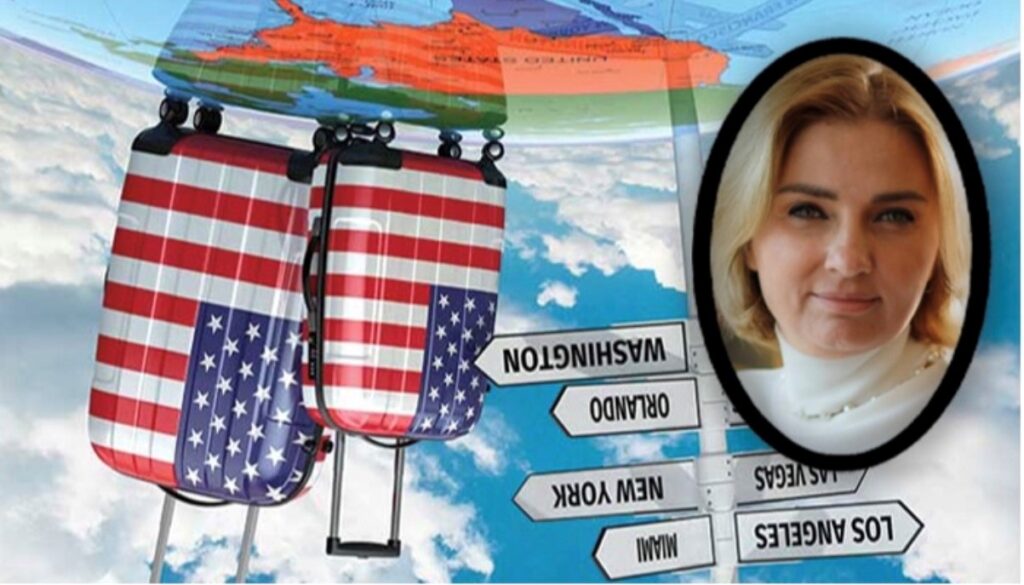
Should we now rejoice that the hopes of American Tourism professionals have turned green again with Biden? And why were we ever saddened by the vanishing of the American dream?
İzmir has collapsed on our heads; are we to fix our attention on the Trump collapse in American Tourism, or what are we to do?
Should we tie the turning of the World to tourism, and take a new global fez, one we had flung away, and put it on our heads?
Those who know, know the heart-rending story of the tassel of the Fez…
Translated from the Turkish original.