The Future of Life Institute is a non-profit research institute and outreach organisation in the Boston area that works to reduce the existential risks facing humanity, particularly the existential risk arising from advanced artificial intelligence.
One day, while having coffee with friends in the living room of their home, the founding team begins to discuss how technology has the potential, as never before, either to make life easier and better or to destroy life. They think that this power of technology should be used for good ends and that work on this should be accelerated. They decide that something must be done about the concerns over the misuse of technology’s ever-increasing power, and they set to work before finding time to drink their second cup of coffee. Max Tegmark, who brewed the coffee as host of this meeting, which took place in the spring of 2014, and his wife Meia persuade their physicist friend Anthony Aguirre, Harvard doctoral student Viktoriya Krakovna and Skype founder Jaan Tallinn to join them on this journey.
Our couple, who consider themselves very fortunate to be in such a magnificent intellectual environment as Boston, are later joined by many well-known names who volunteer for their board of advisers. And they hold the organisation’s first meeting, again in the living room of their home, with a group of 30 idealistic students and academics. At this meeting they gather under agenda headings the questions of what they want the future of humanity with technology to be like and what kind of steps need to be taken for this. The topics on the agenda are such things as nuclear weapons, biotechnology and climate change… But the main goal is to draw attention to Artificial Intelligence and safety research. At the end of the meeting Frank Wilczek, of MIT physics, who received the Nobel Prize for explaining how quarks work, suggests writing an op-ed in order to draw attention to the subject. Later, together with Max Tegmark, he reaches out to Stuart Russell and Stephen Hawking and makes them co-authors of this piece. The piece is rejected many times by “The Washington Post” and similar outlets. Subsequently published on a Huffington Post blog account, this piece suddenly has a tremendous impact in the media. This subject, which gathers the support of technology leaders such as Elon Musk and Bill Gates, also determines the subsequent goals of the Future of Life Institute. On this occasion they also make the first official announcement of the founding of the FUTURE OF LIFE INSTITUTE.
As for their goals, they express them with this statement: “we want to guarantee that life will continue in the future as well.”
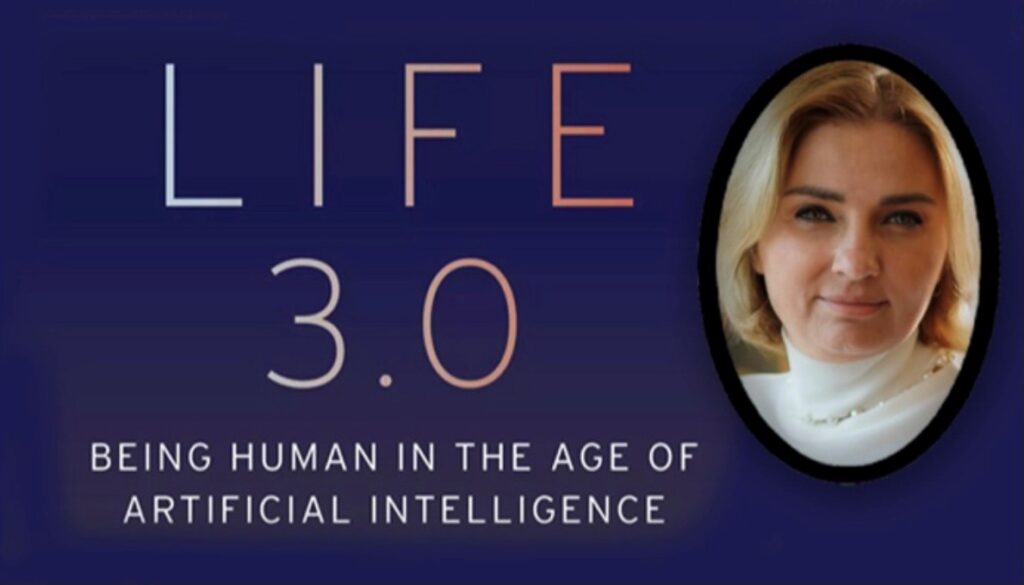
Max Tegmark, a Swedish-American cosmologist, published all his concerns about the future of the world as a book in 2017 under the title “Life 3.0: Being Human in the Age of Artificial Intelligence”. The book presents research into the impact of artificial intelligence on the future of human life on Earth, its possible effects on society (both positive and negative), the measures we can take to maximise the likelihood that the outcomes will be positive, and analyses, in the fullest detail, of potential future scenarios for their combinations. The author’s purpose in setting out on the book is to investigate where the place of the human being might be in the age of artificial intelligence. What is it like to be human in the Age of Artificial Intelligence? In the book he discusses in detail the possible scenarios and the consequences they will bring.
Among the possible artificial intelligence scenarios there is a variety that will be our servant, there are hybrid approaches, and he also conveys an approach that will rule us. You may read again and again the pages containing the warnings that the development of artificial intelligence is so very fascinating but that we must be careful. He also draws attention to the fact that we have never encountered an entity more intelligent than ourselves, but that it is highly probable we shall make one with our own hands. You may also come across comments by the foremost experts on these subjects saying that the book Life 3.0 is the most profound study written to date.
Tegmark’s book treats human life, from its beginning, as divided into three different states.
The Three Stages of Humanity
The title of Tegmark’s book Life 3.0 expresses what he classifies as the third and current stage of humanity, in which new technologies such as artificial intelligence have begun to shape a future that may one day include computers able to redesign their own internal structures. It points to learning in the ways we have discovered before, as well as to hardware.
For this reason, at the very beginning of the book there is a scenario in which technology has already surpassed human intelligence and has begun to change society through its pervasiveness.
He has expressed life, defined as a process that can retain its complexity and replicate itself, in three stages: “If bacteria are Life 1.0 and humans are Life 2.0, we can classify the mouse as 1.1. The biological stage (1.0), in which its software and hardware are evolved; the cultural stage (2.0), which can design its software (through learning); and the technological stage (3.0), which can design its hardware as well and is the master of its own destiny.”
How can we prevent people from being left without work and without purpose while we raise our level of prosperity through automation? What career advice should we give our children? How can we make future Artificial Intelligence systems more robust so that they do what we want without crashing, malfunctioning or being hacked? Should we fear an arms race in lethal autonomous weapon systems? Will machines in time outdo us in every field and take away our jobs, even our place on the planet? Will Artificial Intelligence help life flourish in a way never seen before, or will it give us more power than we can handle?
What kind of future do you want? He has also written that this book enables us to join what may be the most important debate of our age. While giving room to all points of view, he has not shied away from touching on the most radical subjects, such as superintelligence, meaning, consciousness and the physical limits of life in the universe.
While, with mechanisation, humanity’s struggles with nature and with one another were rapidly changing dimension from the past to the present, while institutes of life were being founded at meetings lasting the length of a coffee, where were we? Why did we never think, while technology, at every stage of history, was working unexpected changes in human life deep into our every cell? At the point we have reached today, have we taken action for solutions, methods and systems concerning the knotted complexity of the situation? Or does it come easier to us to throw stones from afar on social media? While the digital life that we did not reflect on until the New Normal of Twenty Twenty bears down on us, could it be that we have uploaded to our smartphones and our smart home appliances the Mind that was bestowed upon us as well, and are now in no state to make it work?
When Erwin Schrödinger said, “I think we are in serious danger of losing the path to perfection”, was he trying forcefully to draw attention not only to machines being able to think but to the fact that human thought would degenerate with excessive mechanisation? How could we be sure that the development of the thinking machine aimed at with the Turing Test would not exhaust our intellectual development as humanity? Where are our studies that could prevent our own capacity for thought from atrophying? At this point we have reached, rather than throwing stones and passing judgement in season and out, to choose a path in order to produce ideas and solutions …
It is high time to take action for a thinking society!
Keywords: Artificial Intelligence Technology Institute
Translated from the Turkish original.