GAS IS THE PRETEXT, THE SILK ROAD IS SPLENDID
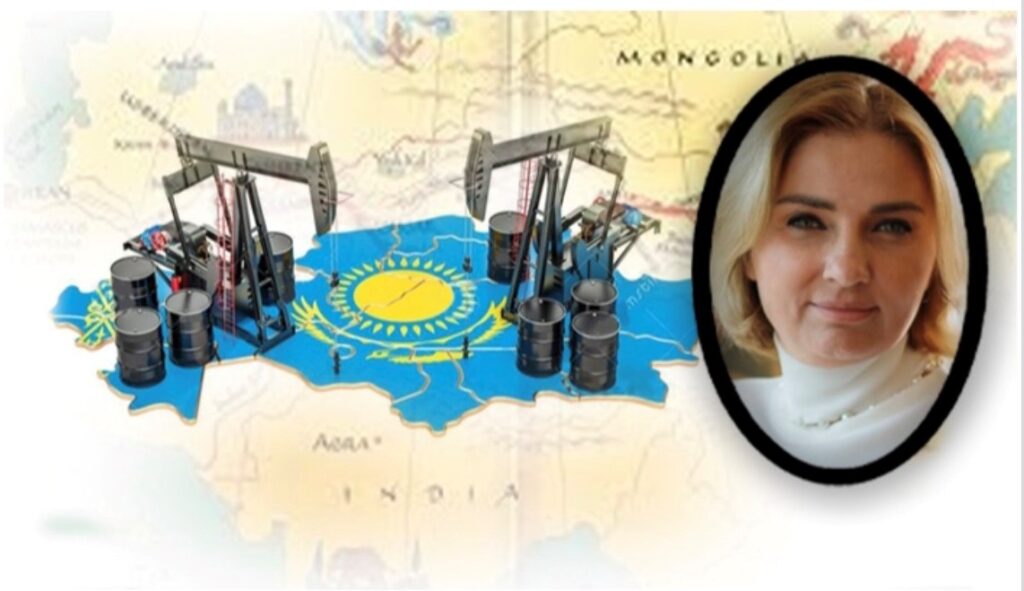
After the collapse of the Soviet Union in 1991, the question has been how best to use the new opportunities that opened up in Central Asia. Over the last 30 years the USA’s rivalry with Russia, China, the European powers and Japan has gone on for years, for the sake of political influence in this key strategic region and, as of 2001, for the right to benefit from the world’s largest untapped oil and natural gas reserves in the Central Asian Republics (Turkmenistan, Kazakhstan, Uzbekistan, Tajikistan, Kyrgyzstan). Yet those who noticed did notice that, under the heading “New Abnormal”, disinfectant and hydroxychloroquine, that is, the so-called malaria drugs, and the supply-chain wars had become the new lead actor that made this rivalry forgotten; those who could not chose to be gassed up by embellished tidings piled on top of the comments springing from every tweet.
Following the protests against the fuel price rise that began in the Mangystau region of Kazakhstan, a state of emergency was declared throughout the country and the first news that 2022 gave the country was the resignation of the Kazakh government.
This resignation was not a surprise development. For in the Elbasy’s Address to the Nation in January 2014, Kazakhstan’s 2050 strategies had been announced under the heading “The new political course of the established state” and had begun to be implemented step by step. In the first item of these goals, above all the 2050 strategy had been set as a brand-new political course, and an important step had also been taken particularly with regard to digital state governance. The greatest sign of these steps was that the Astana Financial Services Authority (AFSA), the Astana Financial Services Authority (Digital) Centre, had been opened together with the Expo 2017 Future Energy international energy fair.
Of course, at the centre of the 2050 transformation strategies is the Cooperation Council of Turkic Speaking States (Turkic Council) and, as the goal of this council, the creation of the united states of the Turkic world.
As for the aim of the Council’s creation of the united states of the Turkic world, at the summit held on 31 March 2021, the leaders, coming together for the first time after Azerbaijan’s victory in Karabakh, had made clearer statements.
The most crucial news of the summit was that the city of Turkistan in Kazakhstan was declared the spiritual centre of the Turkic world. It was indicated that other cities in the Turkic world, such as Istanbul, Samarkand, Bukhara, Shusha, Baku and Almaty, could also be given special status in the shortest possible time.
The golden shot of the summit was that the “Turkic Council Strategy 2020-2025 and Turkic World Vision – 2040” was laid on the table, and what the Council had prepared was defined as the “Turkic Council Strategy 2020-2025 and Turkic World Vision – 2040”.
They had announced the Turkic World Vision, underlined in the thickest possible way and in capital letters, to those who keep their silence and say “what can we do to break up this table?”. To the boundless ones who know no bounds and are masters at breaking things up, the Council had made known its underlined, loud-voiced 2040 road map as follows. That the Council’s road map to 2040 would be completed in the shortest possible time; strong foreign policy and SECURITY coordination, the signing of a Free Trade Agreement, the opening of borders in transport, and strong cooperation among the Council countries, especially on business and the alphabet, were secured.
In the light of this information, let us understand what happened on 4 January 2022, whose corns found their voice, and the cause of the unrest, rich in fires, which was started in the summer months of 2021 and still continues, by those who lack the skill to voice their troubles as in “Ask which part of my aching, hurting head is out of order, and I will tell you the reason”.
By getting to know Kazakhstan and the region a little, we can look at what happened without commenting.
Mangystau is a province in Kazakhstan. Its centre is Aktau, with a population of 154,500 (according to the 2004 census). The population of the whole of Mangystau province is 373,400. Geographically, it is located in the south-west of the country and includes the Mangyshlak Peninsula. It has long shores on the Caspian coast. It has borders with Turkmenistan and Uzbekistan. Mangystau also neighbours two Kazakh provinces: Atyrau province and Aktobe province. The province has an area of 165,600 km². In the days of the Soviet Union, oil was found and worked there by engineers. As a result, industry developed here. In addition, the city of Aktau has the BN-350 Nuclear Power Plant, left over from the Soviets. The plant was decommissioned in 1999. It is worth remembering the protest movements in 2011 of the workers employed in the State Oil and Gas Companies in the Mangystau region of Kazakhstan.
On 16 November 2021, that is, only yesterday, an understanding was reached with Russia to operate Kazakhstan’s “Kalamkas-Sea” and “Khazar” oil fields in the Caspian Sea!
According to the statement made by Kazakhstan’s oil and gas company KazMunayGas, the company agreed with Lukoil, Russia’s 2nd largest oil producer, to operate the oil reserves in question jointly. The cooperation agreement on the “Kalamkas-Sea” and “Khazar” oil fields in the Caspian Sea was signed between KazMunayGas Chairman Alik Aidarbayev and Lukoil President Vagit Alekperov. The “Kalamkas-Sea” field is estimated to hold 159 million tonnes of oil reserves. Companies such as NCOC N.V. and Shell, which hold an important place in Kazakhstan’s oil and gas sector, had announced that they had abandoned the project in question because of its high cost. The Russian oil company Lukoil had announced in July that it had reached an agreement to acquire 50 per cent of the operating rights of the field called “Area 4” in Mexico for 435 million dollars.
The statement, which included the information that the company was continuing its energy investments in Mexico, said: “We have reached an agreement with the project operator PetroBal to acquire 50 per cent of the operating rights of the field called Area 4 in Mexico for 435 million dollars. The project consists of two blocks with an area of 58 square kilometres in the Gulf of Mexico.” In the Lukoil statement, which pointed out that the total reserves in the area acquired amount to approximately 564 million barrels of oil, the approval of the relevant state institutions in Mexico for the agreement to enter into force is, for its part, at the door!
“We know nothing – that is the first point.
Therefore we should be very modest – that is the second.
We should not claim to know when we do not know – AND THAT IS THE THIRD!”
All Life Is Problem Solving
Karl Raimund Popper
Translated from the Turkish original.