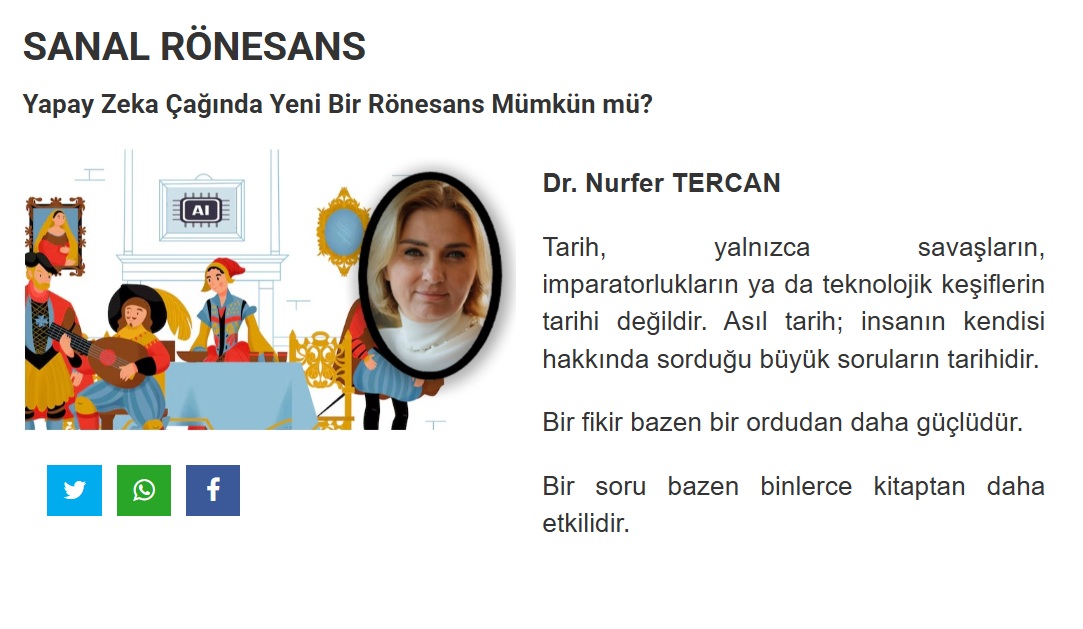
Is a New Renaissance Possible in the Age of Artificial Intelligence?
Dr. Nurfer TERCAN
History is not merely the history of wars, empires or technological discoveries. The real history is the history of the great questions the human being has asked about himself.
An idea is sometimes stronger than an army.
A question is sometimes more powerful than thousands of books.
The questions Socrates asked in the streets of Athens have outlived the Roman legions. Ibn Sina’s pen went beyond the limits of the age he lived in. Al-Farabi’s conception of reason built, for centuries, a bridge of thought between East and West.
Today humanity stands once again on such a threshold.
But this time it is not the printing press that stands before us…
Nor the steam engine…
Nor electricity…
This time what stands before us is an intelligence that can imitate the human way of thinking.
Perhaps for the first time in history, the human being is obliged to redefine his own reason.
That is why the coming years will be years not only of a technological transformation, but also of a reckoning at the level of philosophy and civilisation.
When we say Renaissance, Leonardo da Vinci comes to mind.
Michelangelo comes to mind.
Galileo comes to mind.
But it was not only their works that made them great.
What set them apart was that they were never confined within the boundaries of a single discipline.
Art…
Science…
Philosophy…
Mathematics…
Astronomy…
Architecture…
The observation of nature…
All of them could meet in the same mind.
The true secret of the Renaissance lay exactly here.
Not to fragment knowledge, but to unite it…
Not to separate the disciplines, but to make them speak to one another…
Today artificial intelligence is making the same call to us once again. The future can no longer be built by computer engineers alone.
Nor by philosophers alone.
By jurists alone…
By sociologists alone…
By psychologists alone…
None of them is sufficient on their own.
Because the name of the new age is not the age of specialisation; it is the age of collective reason.
Aristotle defined the human being as a being that, thanks to its reason, can think, can question, and has the potential to choose a virtuous life.
Descartes changed the direction of modern philosophy by saying, “I think, therefore I am.”
Al-Farabi did not separate reason from virtue.
Ibn Sina completed knowledge with wisdom.
And today perhaps the time has come to form a new sentence:
“I question, therefore I am human.”
Because calculating is no longer peculiar to the human being alone.
Writing…
Translating…
Composing music…
Producing images…
Writing code…
Artificial intelligence systems too can carry out a significant part of these.
But the question that still cannot be answered is this: what is it that makes a human being human?
Is it compassion?
Is it conscience?
Is it judgement?
Is it the sense of justice?
Is it the awareness of responsibility?
Perhaps it is none of these on its own.
Perhaps the human being is the only being that can carry all of these at the same time.
And no algorithm can fully assume the moral responsibility of the human being.
Artificial intelligence has held up an unexpected mirror to us.
For years we thought we were developing machines.
Yet in fact we were trying to understand the human being.
While teaching a machine to learn, we began to think again about what learning is. While trying to model decision-making, we realised that a decision is not merely computation. As we developed algorithms that try to process language, we saw that meaning is far more than the sum of words.
So artificial intelligence does not merely produce technology!
It reopens the debate on what the human being is!
Perhaps the greatest mistake of the 21st century is to take technology for progress itself.
No.
Technology is not progress.
Technology is only a possibility.
Real progress is the human being’s rise in morality, in justice, in freedom and in wisdom.
If conscience recedes while technology develops…
If justice shrinks while algorithms grow…
If wisdom diminishes while knowledge increases…
Then what we have is not civilisation, but only speed.
And speed that has lost its direction carries humanity not to its goal, but into uncertainty.
That is why the centre of the new Renaissance will not be Silicon Valley alone. The real centre will be the human mind that thinks anew. The new laboratories will not consist of data centres alone. They will at the same time be laboratories of ethics, laboratories of law and laboratories of ideas.
The new universities will not merely turn out graduates who develop software; they will raise generations who question how algorithms transform human life.
UNESCO’s ethical and educational frameworks on artificial intelligence likewise emphasise, in this direction, that technical competences alone are not sufficient; that critical thinking, human rights, ethical reasoning and human oversight are indispensable elements of the age of artificial intelligence. (see)
Because the greatest competition of the future will take place not in processor speed, but in the capacity to produce meaning.
A country’s real power will not be measured merely by how many artificial intelligence models it has developed.
The real question will be this:
“Can this society produce the values that will give direction to artificial intelligence?”
This is exactly where civilisation begins.
Civilisation is not producing technology.
It is being able to decide which understanding of the human being technology will serve.
Perhaps the history books of the future will record the 21st century not as “the Age of Artificial Intelligence”, but as “the Age in Which the Human Being Rediscovered Himself”.
Because artificial intelligence is not merely humanity’s greatest technological achievement.
It is at the same time the greatest philosophical question the human being has put to himself.
The answer to this question may begin in the laboratories.
But it will not be completed there.
The answer will mature in chairs of philosophy, in faculties of law, in departments of sociology, in art studios, in academies of science and, above all, in free consciences.
Perhaps the new Renaissance will begin not with building more powerful machines, but with raising wiser human beings.
Because the future will belong not to those who possess the most advanced algorithms, but to the societies that manage to remain human beyond the algorithms.
Now is exactly the time to think!
Notes from the Blue of the Windy City
https://www.5gvirusnews.com/yazarlar/sanal-ronesans-h1909.html
Translated from the Turkish original.