And now, “Nothing is as it was”!
Yesterday, too, has stayed in yesterday; today we woke up to a new yesterday that we do not know at all. Frankly, it is no longer possible to speak of any such thing as the freedom of the individuals of the flat-world society.
The board of fictional science, of the globally branded mask they have worked into our faces and eyes, has today snapped shut the block lock chained over the flat world, never to be broken again. Let us recall the brand of the lock right away: “Blockchain”!
The telephone they have glued to our hands, the television they have hung on our wall, reflecting the shadows that fall on the wall of the cave of our mind… Those who watched the shadow plays of YouTube on the tablet, at which we were helpless with laughter, could not see; those who listened could not understand; those who heard could not speak.
As of today, with masks of courtesy on their faces and sticks of fear in their hands, they have once again told the people of the flat world of lies: chain yourselves to your homes, that is, go back to your cave. Meanwhile they did not neglect to open a hole in the ceiling of our cave either, by the hand of the managers of the most crisis-ridden economy. They also promised to throw our bread down on our heads every day. How? With the Online service of the digital Lords who know no limits in service… In the cave our bellies are full and our backs are warm. They also gave the guarantee: “If your temperature rises, the cuff on your wrist will let us know; do not worry at all, the first-aid teams will at once come flying through the hole in the ceiling to help.” Nor did they neglect to spell out what is expected of us in return for all this: “Under the heading of The Great Reset series of the third season of The Great Game, until your new-season series comes on air, OBEDIENCE!”
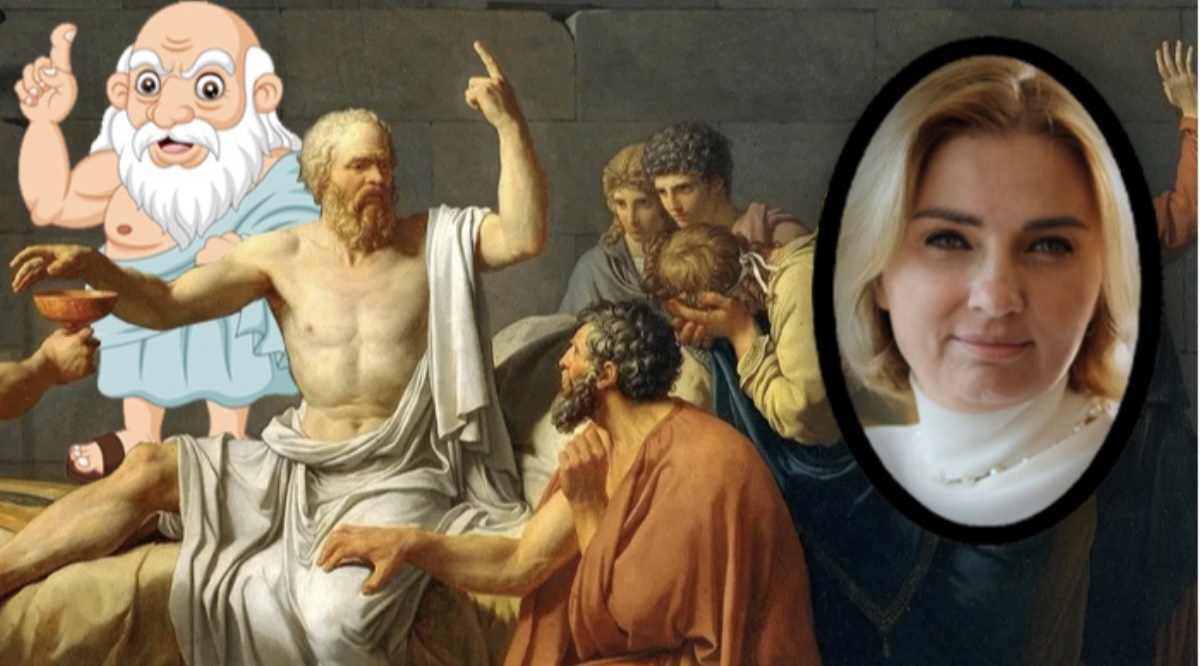
To understand and know this situation better, we have had no choice but to turn to Plato’s metaphor of the cave.
I think this famous cave metaphor of Plato’s is what the global Lords, too, take as the basis of their systems.
So what is Plato’s Allegory of the Cave?
The Allegory of the Cave appears in the seventh book of Plato’s work the Republic. In the Allegory of the Cave he depicts for us, through images and similes, the ideal ruler of the state, that is, the philosophers. In a cave, a group of people who have been captives from the moment they were born are chained in such a way that they cannot see behind them and cannot even move their necks to right or left. Since their backs are turned to the entrance of the cave, they have no knowledge of the outside world. Because their world consists only of the wall they can see in the cave, the shadows reflected on the wall and the echoes they can hear, in the world they believe in there is no being other than these. Thinking that the shadows and the echoes are real, they have never imagined any other reality apart from them. One day one of the captives manages to loosen his chain and leaves the cave. The cave is deep in the earth; to reach its exit one has to climb a long way up. And he manages to get out of the cave. Because he is meeting the sun for the first time, his eyes are badly affected, he feels pain and experiences temporary blindness. After getting used to the sun, his blindness passes and he begins to see what is around him. For the first time he looks not in one direction but in all directions. He understands that the only reality he had believed in until now was in fact the shadow of people passing in front of a fire behind them and of the objects they carried. After seeing the real world and understanding that the things around him are real and that the shadows are only a reflection, he goes to explain this to the captives who are still chained in the cave. When he enters the cave, he notices that he is no longer accustomed to its dim surroundings and cannot see the shadows reflected on the wall as clearly as before. When he tells the captives what has happened, nobody tries to understand him; they think that he has now become stupid and blind. For them the only reality is the shadows reflected on the wall. That is why they do not believe the one who has broken his chains and seen the outside world; they even think that the outside world has corrupted him, and they violently oppose breaking the chains and leaving the cave.
These are the reflections on the wall and the objects, carried by the Lords of the flat world, that cause these reflections to form. The fire there, for its part, is depicted as the basic source of the working of this world.
The objects that the people carry are not objects of perception in the sense we know; those objects point to the working and the fictional nature of the flat world. The things carried are the traditions and ideologies that shape society, that is, the fiction of each age. Consequently, when people think, when they begin to question, they realise that they are in the cave. They arrive at the awareness that their supposition, which they had previously called the only reality, in fact consists of nothing but a reflection.
This temporary blindness symbolises the state of bewilderment of having lost one’s way. As they slowly get used to the brightness of the sun, they look at the ground and see the shadows of the things around them. First the reflection; then, once the eye has adjusted, they become able to see what is around them. In the end they learn that the principle of everything that exists, and the one that makes it possible for us to see, is the sun. And when they think of the cave they came from, it immediately comes to their minds that inside there are still people bound to their chains.
So shall we try to understand the order of the Changing Flat World with this metaphor as well, what do you say? Whose is the choice, and is freedom to come with digital handcuffs?
They kept their word: “nothing will ever be the same again”…
Translated from the Turkish original.