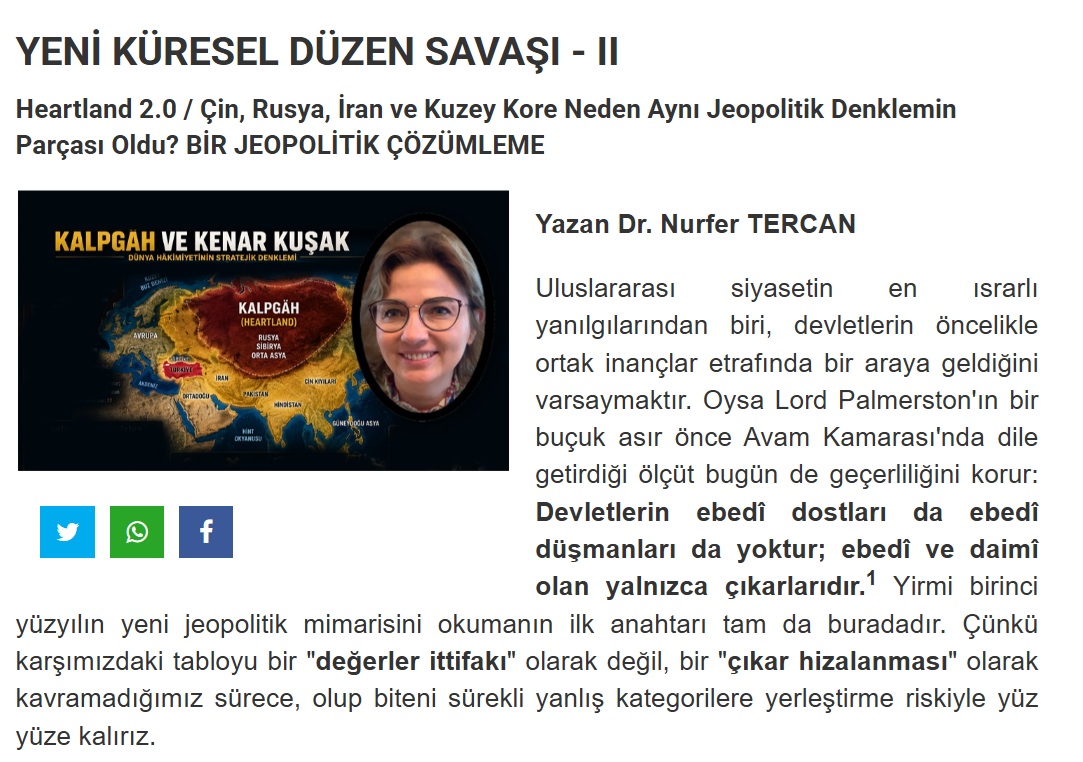
Heartland 2.0 / Why Have China, Russia, Iran and North Korea Become Part of the Same Geopolitical Equation? A GEOPOLITICAL ANALYSIS
By Dr. Nurfer TERCAN
One of the most persistent fallacies of international politics is to assume that states come together primarily around shared beliefs. Yet the criterion that Lord Palmerston voiced in the House of Commons a century and a half ago still holds today: States have neither eternal friends nor eternal enemies; only their interests are eternal and perpetual.1 The first key to reading the new geopolitical architecture of the twenty-first century lies exactly here. For as long as we fail to grasp the picture before us not as an “alliance of values” but as an “alignment of interests“, we remain face to face with the risk of constantly placing what is happening into the wrong categories.
The basic finding that stands out in Michael Beckley and Hal Brands’s work Danger Zone, and in the literature that followed it, points in the same direction: China, Russia, Iran and North Korea have not formed an ideological bloc in the classical sense.2 There is no common worldview, no common development model and no common political grammar that holds these four states together. What brings them side by side is more concrete and colder: the desire to change the existing distribution of power, and a shared discomfort with the limits imposed by the American-led order. Indeed, the concept of an “axis of upheaval” coined for this quartet in Western strategic writing describes exactly this shared revisionist impulse; not a common utopia, but a common discontent.3
This distinction is no trivial nuance. For what we have before us is neither a new Warsaw Pact nor a new Comintern. There is no central command hierarchy, no binding security umbrella, no doctrine directed from a single capital. Instead, there is a flexible yet functional strategic network formed by states with different historical memories, different political regimes and regional priorities that often contradict one another. The looseness of this network is the source of its resilience as much as of its weakness: because there is no common ideology, it does not fall apart along ideological cracks either; as long as each actor sees its own interest, cooperation reproduces itself.
At the centre of gravity of this network stands China. Yet the centrality here is not only geographical, but functional. The classical Heartland concept formulated by Halford Mackinder a century ago held that the power dominating the interior of Eurasia would command the World-Island, and from there the world.4 In the twenty-first century this thesis has not become wholly invalid; but it has shed its skin. Today’s Heartland is not merely a landmass, but a multi-layered field of power woven from production capacity, capital accumulation, supply chains and technology standards. Land connections, sea power and digital infrastructure are now brought into play together as three separate vectors of the same strategic objective. This is what is meant by “Heartland 2.0”: a concentration of power in which geography is intertwined with economy, and economy with technology.
What really places Beijing at the centre of this equation is not its sheer size alone, but the fact that it acts as a multiplier raising the capacity of the other revisionist actors. Russia brings to the table its war experience, its military doctrine tested along a broad front line, and its energy resources. Iran generates a regional harassing power in the Middle East through its proxy networks and its capability for asymmetric warfare. North Korea, with its nuclear deterrent and its unpredictability, has the capacity to produce crises and to divide the adversary’s attention. China, for its part, forms the economic backbone of this axis with its industry, finance, advanced technology and production infrastructure. Evidence from the field makes this mutual dependence concrete: the link established between China’s dual-use technology and production capacity and the needs of Russia’s war economy, or the decisive role played by Iranian-origin unmanned aerial vehicles on the modern battlefield, shows that this cooperation is acquiring not merely a diplomatic but an increasingly operational character.
However, to read this picture as a purely military alignment would be to miss the most critical dimension of the image. The distinguishing feature of the new Heartland is that economic and technological integration can be steered in the same strategic direction as military capacity. For this reason it is insufficient to assess the Belt and Road Initiative, which China announced in 2013, merely as a chain of infrastructure investments.5 The initiative aims to strengthen land connections by building alternative transport and energy corridors in the interior of Eurasia, and thereby to reduce dependence on sea routes. In short, this is Mackinder’s land-power thesis rewritten with logistical and financial instruments.
The same logic operates at sea as well. China’s enormous investment in its navy is not, as was long assumed, directed solely at coastal defence. The aim is to go beyond the First Island Chain, a term inherited from the jargon of the Cold War, to shift the balance of power in the Western Pacific in its own favour, and to increase the pressure on the maritime belt that Nicholas Spykman defined as the “Rimland”.6 Here we see the two classical schools of geopolitics, the land-centred Mackinder tradition and the sea-centred Spykman tradition, meeting in a single strategy. China is trying to take these two approaches, historically presented as alternatives to each other, out of the realm of choice and turn them into a programme that can be implemented simultaneously.
The third and perhaps newest front is digital space. The “Digital Silk Road“, whose framework was drawn in 2015, aims to weave a long-term strategic sphere of influence through telecommunications infrastructures, submarine cables, data centres, surveillance systems and digital payment platforms.7 Precisely at this point the boundary line between geopolitics and technology is erased. A fibre-optic cable is no longer merely a means of communication, but a strategic corridor; a data centre is critical infrastructure; and a payment system is directly a matter of national security. In an age in which the power that sets the standards also sets the rules of the game, technical norm-setting itself turns into a form of sovereignty.
Within this framework the geostrategic position of East Turkestan (Xinjiang) stands out as a separate heading. For China the region is not merely an internal administrative unit, but a critical node opening onto Central Asia in the land connections of the Belt and Road route. At the same time, however, the region has also been documented as an area in which a high-technology architecture of surveillance has been tested in the field; reports by human rights organisations draw attention to the nature of the mass data collection and monitoring capacity developed there.8 The sociological dimension of this capacity must not be overlooked: what is at issue is not merely a security technology, but the transformation of authoritarian models of governance into an exportable template. That is to say, the matter concerns, beyond a single region, how power is established and how it is maintained in the digital age.
All of this leads us to a single conclusion: geopolitics can no longer be read on maps alone. The energy lines, data flows, financial clearing systems and technology standards that do not appear on the map are objects of strategic competition at least as much as borders and straits. The physical geography of classical geopolitics is giving way to a hybrid geography in which physical and digital layers are intertwined.
Yet the impressive appearance of Heartland 2.0 is no guarantee of an uninterrupted rise. On the contrary, this axis has its limits too. The American-led Rimland alliance still holds considerable advantages in terms of economic size, advanced technology production, deep capital markets, the reserve currency and security of energy supply. Moreover, the trust deficit within the revisionist axis itself, the occasional clash of interests and the asymmetric dependencies also point to the fragility of the “axis of upheaval”.9 The matter is therefore too layered to be reduced to the question “who is stronger?”.
The real question is this: Who will be able to turn the power it possesses into a more coherent and more coordinated strategy? For in international politics superiority is determined not only by the quantity of resources, but by the capacity to align and coordinate those resources. A scattered superiority is frequently defeated by a well-coordinated disadvantage. The response that the Rimland gives to this rise will determine the direction of the twenty-first century as much as the rise of the Heartland itself.
That is why our focus must now turn, or be assessed as turning, from the centre of Eurasia towards the maritime belt, that is, towards the Rimland. For the great geopolitical struggle cannot be explained solely by understanding the rising actors; one must analyse with the same care the balance that is built, or cannot be built, against them.
NOTES
1. The saying is attributed to Lord Palmerston (Henry John Temple), British Foreign Secretary and later Prime Minister. His words in the speech he delivered in the House of Commons on 1 March 1848 are usually rendered as follows: “We have no eternal allies and no perpetual enemies. What is eternal and perpetual is our interests.” The expression has become, in the realist tradition, the classic maxim for explaining state behaviour on the basis of interest.
2. Michael Beckley and Hal Brands emphasise that the quartet constitutes not an ideological unity but a “coalition of interests” aiming to change the status quo. The basic argument here is that what holds these actors together is not a common vision of the future, but a common objection to the existing order.
3. The concept of the “axis of upheaval” was popularised by Andrea Kendall-Taylor and Richard Fontaine in Foreign Affairs (2024). The concept defines the China-Russia-Iran-North Korea quartet (referred to in some analyses by the acronym “CRINK“) not as a formal alliance, but as a flexible coalition of the discontented aligned in the direction of shaking the order.
4. Halford J. Mackinder developed the Heartland thesis in his article “The Geographical Pivot of History” (1904) and in his book Democratic Ideals and Reality (1919). His famous formulation is this: “Who rules East Europe commands the Heartland; who rules the Heartland commands the World-Island; who rules the World-Island commands the world.” In the text, a version of this thesis that has “shed its skin” in the digital age is discussed.
5. The Belt and Road Initiative was announced in 2013 by Chinese President Xi Jinping. The “Belt” refers to the overland economic corridors, and the “Road” to the maritime silk road.
6. The concept of the “Rimland” belongs to Nicholas J. Spykman; it was formulated in his work The Geography of the Peace (1944). Reversing Mackinder, Spykman argued that the real source of power was not the inner landmass but the coastal belt surrounding Eurasia: “Who controls the Rimland rules Eurasia; who rules Eurasia controls the destinies of the world.” The concept of the “First Island Chain”, for its part, is associated with the United States’ Pacific containment strategy in the early period of the Cold War.
7. The “Digital Silk Road” was framed around 2015 as the technology component of the Belt and Road Initiative; it covers telecommunications, data infrastructure, surveillance systems and digital payment networks.
8. For documentation concerning the mass surveillance practices in Xinjiang/East Turkestan, the field reports of human rights organisations in particular have been consulted (e.g. Human Rights Watch’s work on algorithmic monitoring and data collection practices in the region). The text treats the region both as a logistical node and as a “rehearsal ground” for technologies of authoritarian governance.
9. For the counter-thesis concerning the fragility of the axis, see in particular Christopher S. Chivvis’s analysis “The Fragile Axis of Upheaval” (Foreign Affairs, 2025). This literature questions the resilience of the axis by emphasising the trust deficit, the asymmetric dependencies and the conflicts of interest among the quartet.
REFERENCES
Beckley, Michael ve Hal Brands. Danger Zone: The Coming Conflict with China. New York: W. W. Norton & Company, 2022. Chivvis, Christopher S. “The Fragile Axis of Upheaval.” Foreign Affairs, 2025.
Kendall-Taylor, Andrea ve Richard Fontaine. “The Axis of Upheaval: How America’s Adversaries Are Uniting to Overturn the Global Order.” Foreign Affairs, Mayıs/Haziran 2024.
Mackinder, Halford J. “The Geographical Pivot of History.” The Geographical Journal 23, no. 4 (1904): 421–437.
Mackinder, Halford J. Democratic Ideals and Reality: A Study in the Politics of Reconstruction. Londra: Constable and Company, 1919.
Spykman, Nicholas J. The Geography of the Peace. New York: Harcourt, Brace and Company, 1944.
Human Rights Watch. Reports on mass surveillance and algorithmic monitoring practices in Xinjiang/East Turkestan (e.g. “China’s Algorithms of Repression”, 2019).
Note: Lord Palmerston’s speech in the House of Commons dated 1 March 1848 is the primary source of the maxim in question (Hansard, Parliamentary Debates).
https://www.5gvirusnews.com/yazarlar/yeni-kuresel-duzen-savasi-ii-h1924.html
Translated from the Turkish original.