Dynamic Code Support Parameter
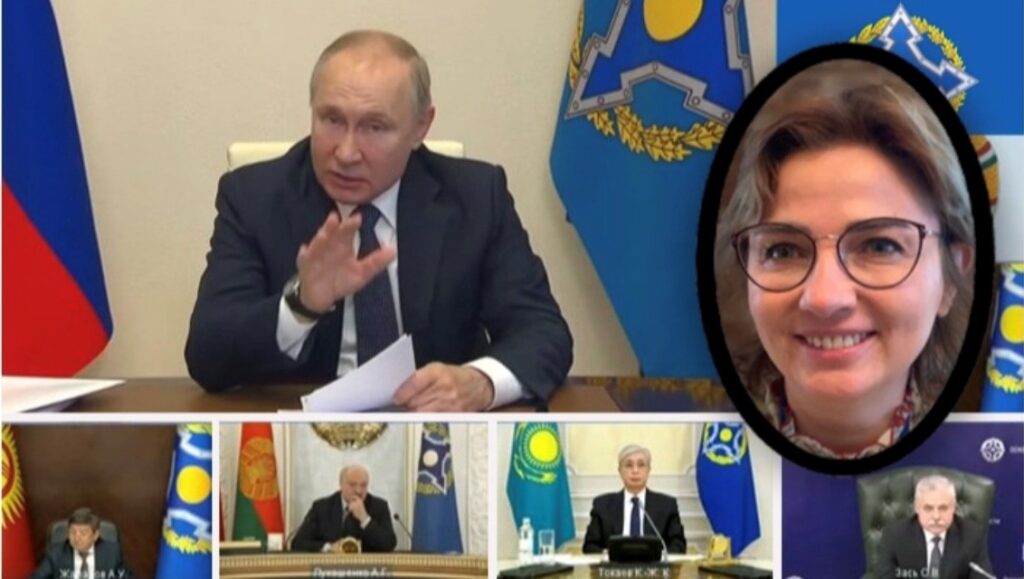
The Kazakh leader Tokayev, at the extraordinary meeting of the CSTO countries on 10 January 2022, described what had happened in his country as a ‘coup attempt’ and said: “Kazakhstan has overcome a coup attempt.”
Tokayev stated that the violent events in his country had been coordinated from a single centre and prepared in advance. The President of Kazakhstan noted that the city of Almaty, regarded as the financial centre of his country and where the fiercest clashes between aggressive groups and Kazakh security forces took place, together with nine regions, had during the violent events been seized in places by bandits.
Tokayev also stated that the Collective Security Treaty Organization had sent 2,030 soldiers and 250 pieces of military equipment to Kazakhstan as a peacekeeping force.
Russian President Vladimir Putin, in his remarks at the extraordinary meeting of the CSTO, said of what had happened in Kazakhstan: “This is an attack against Kazakhstan, an act of aggression.” The Russian leader stated that ‘it is clear that’ the attackers involved in the violent events in Kazakhstan ‘underwent training in the camps of international terrorists abroad’.
Putin used the words: “The threat to the state of Kazakhstan was created by external and internal forces; the issue is not gas prices.”
Putin noted ‘that it is necessary to distinguish between those who were angered by the rise in fuel prices in Kazakhstan and those who took up arms, and that the two groups have different aims’. Of what had happened in Kazakhstan, Putin said ‘that Kazakhstan was facing an unprecedented test concerning its security’. The Russian leader also emphasised that the CSTO peacekeeping forces, which went to the country at the call of the Kazakh leader Tokayev, had been sent there for a limited period.
The Russian President stated that the CSTO peacekeeping forces were acting in line with the interests of the leadership of Kazakhstan and added that the task of maintaining public order in the country was being carried out solely by the Kazakh security forces. The Russian leader stated ‘that the CSTO peacekeeping forces will stay in Kazakhstan for as long as they need to stay’ and said that after the completion of the mission all the peacekeeping soldiers would leave Kazakhstan.
It is necessary to spell out in a little more detail what Putin meant when, saying that the situation in Kazakhstan was gradually returning to normal and that in the very near future the situation would stabilise throughout the country, he emphasised: “We will not let them shake the situation in our home and we will not allow colour revolutions.” While the three-letter ones, who do not put their own hand in the fire, have their fire-rakes such as the “bearded” or the beardless, what happens when the four-letter “CSTO”, this union, comes face to face with them, so that the plan of the three-letter ones becomes bait for those who dive headlong into the water?
The dissolution of the Soviet Union also brought with it the disappearance of an army that was one of the most powerful armed forces in the world. As a result, the newly independent countries were faced with the problem of ensuring their own security.
On 8 December 1991, Belarus, Ukraine and the Russian Federation formally put an end to the Soviet Union by signing the agreement on the establishment of the Commonwealth of Independent States. Later, on 21 December 1991, the former Soviet Republics, with the exception of Latvia, Lithuania and Estonia, signed the agreement establishing the CIS in Almaty, the capital of Kazakhstan.
In the 1990s, because most of the CIS member countries had not yet formed their national armies, there were three ways for them to secure their safety:
First – multilateral military cooperation within the CIS; second – military-political cooperation within the framework of the Collective Security Treaty, separate from the CIS; third – cooperation in the military field based on bilateral agreement. The important document forming the basis of the former Soviet countries’ cooperation on security was the Collective Security Treaty. The Collective Security Treaty, later transformed into an organisation, is one of the youngest establishments among international security organisations and in the field of military-political cooperation. In addition, because it is the only security organisation existing in the Central Asian region, the CSTO is very important in terms of ensuring the security of these countries.
The Collective Security Treaty was signed on 15 May 1992 in the city of Tashkent, the capital of Uzbekistan, by Russia, Armenia, Kazakhstan, Kyrgyzstan, Tajikistan and Uzbekistan. The treaty, concluded for 5 years with the possibility of extension, entered into force on 20 April 1994 after being ratified by the parliaments of the member countries. Today Armenia, Belarus, Kazakhstan, Kyrgyzstan, Russia and Tajikistan are members of the treaty. The Collective Security Treaty played an important role in maintaining stability in the former Soviet countries after the dissolution of the USSR. First, together with the agreement establishing the CIS, it ensured that the Soviet Republics separated peacefully and refrained from the use of force among themselves and in international relations. Second, the CST became a guarantor of security against external threats for the newly forming states at the stage of developing their military and defence fields. From Russia’s point of view, the Collective Security Treaty was a step towards re-legitimising, in the regions it called the “near abroad”, the influence that Russia had lost in the Soviet period.
One of the reasons for the Central Asian countries’ accession to the treaty was also the deterioration of the situation in Afghanistan. With the dissolution of the USSR, the cutting off of aid to the Democratic Republic of Afghanistan caused the Najibullah government to lose its control over the country. The coming to power of the mujahideen, who were enemies of the Soviet Union, and the rise of extremist movements in the country were perceived as a serious threat to the security and sovereignty of the post-Soviet states.
The Collective Security Treaty was registered by the UN Secretariat on 1 November 1995 in accordance with Article 102 of the Charter of the United Nations, and the CST is made up of 11 articles.
Article 4 forms the backbone of the Collective Security Treaty. According to this article, an attack on one of the countries party to the treaty will be regarded as an attack on all the members. The article continues as follows:
“In the event of aggression against any of the states parties, all the other members will, at the request of that state, provide the necessary assistance, including military assistance, and will lend support with the means at their disposal for the exercise of the right of collective defence in accordance with Article 51 of the UN Charter!”
Collective security is addressed by researchers and experts in two aspects, legal and political. The legal aspect of collective security includes the following elements: the norms and principles of international law prohibiting the use of force, the peaceful settlement of international disputes, the recognition of sovereignty, the equality of states, with the condition of non-interference in internal affairs. The political aspect, for its part, covers diplomatic relations and diplomatic measures between states, economic sanctions, and the joint actions of the collective security forces, including armament.
The most important question here, or a series of questions that may arise, is still seeking its answer. While, since the establishment of the Organization of Turkic States, the role of the Organization has been developing in ensuring cooperation and coordination in the Turkic World and in the greater promotion of the values and interests of the Turkic World in the regional and international community; with the Organization of Turkic States aiming to strengthen the security and stability of the Member States in accordance with the generally accepted norms and principles of international law, above all respect and support for sovereignty, territorial integrity, the inviolability of internationally recognised borders and non-interference in internal affairs; there are many vital issues waiting in line that need to reach a solution, such as the encouragement of initiatives relating to trade, transport, investment and regional connectivity. In our view, the first answer sought is: what will be the position of the other countries which, like Türkiye, are members of the ORGANIZATION OF TURKIC STATES but do not yet take part in the CSTO?
One wonders whether this question will have been clarified at the “support” meeting concerning the events in Kazakhstan that the Honourable Minister of Foreign Affairs Mevlüt Çavuşoğlu is to convene on 13-14 January 2022?
Keywords: Kazakhstan Putin Russia
Translated from the Turkish original.