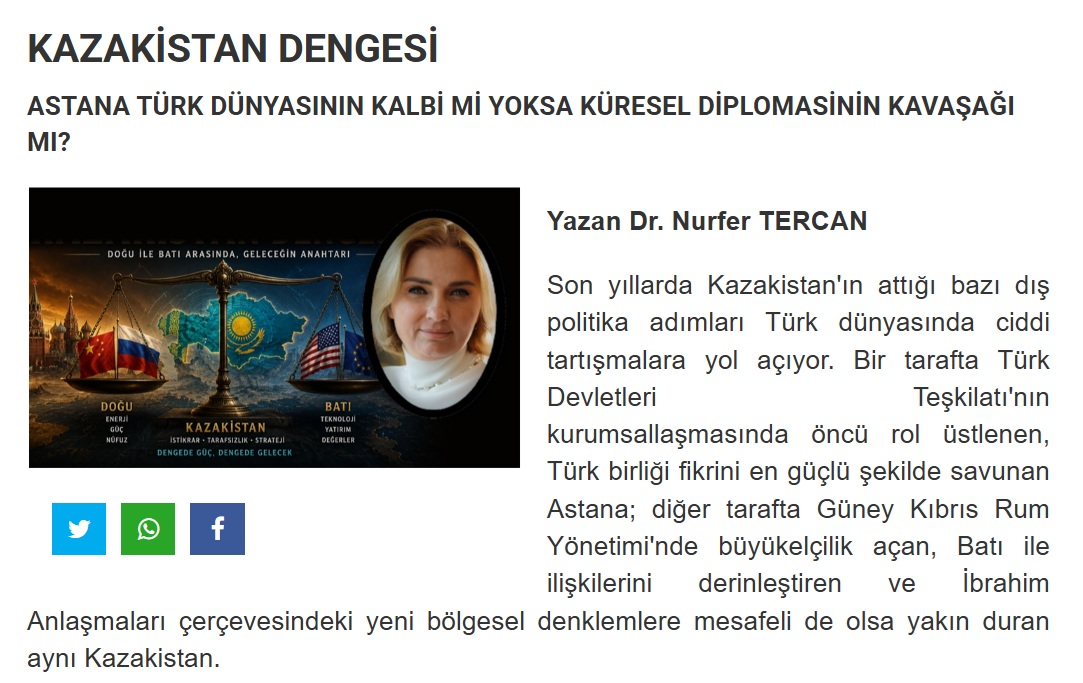
IS ASTANA THE HEART OF THE TURKIC WORLD OR THE CROSSROADS OF GLOBAL DIPLOMACY?
By Dr. Nurfer TERCAN
In recent years, some of the foreign policy steps taken by Kazakhstan have been giving rise to serious debate in the Turkic world. On the one hand, there is the Astana that has assumed a pioneering role in the institutionalisation of the Organization of Turkic States and defends the idea of Turkic unity most strongly; on the other, the same Kazakhstan that opens an embassy in the Greek Cypriot Administration of Southern Cyprus, deepens its relations with the West and stands close, albeit at a distance, to the new regional equations within the framework of the Abraham Accords.
So is there a contradiction here, or an understanding of diplomacy made necessary by the new world?
In fact, when the matter is viewed from Astana, the answer is clear: Kazakhstan has never defined itself as the country of a single axis alone. The understanding of a “multi-vector foreign policy” shaped in the era of Nursultan Nazarbayev and continued today by President Kassym-Jomart Tokayev is the foundation of the country’s strategy of existence.
It is in any case impossible for a country that is a neighbour of Russia, shares a border with China, is an important part of the Turkic world, needs Western capital and has strong ties with the Islamic world to be confined to a single geopolitical line.
However, the issue that causes debate in the Turkic world begins exactly here.
Because the Organization of Turkic States is not seen merely as an economic or diplomatic platform. For many people this structure is the institutional expression of the idea of a common history, a common culture and a common destiny. Therefore, considering the sensitivities of Türkiye, which is trying to increase the international visibility of the Turkish Republic of Northern Cyprus, raising relations with the Greek Cypriot Administration of Southern Cyprus to embassy level naturally creates question marks.
Astana’s approach, however, is rather different.
From the standpoint of Kazakh decision-makers, the matter is one of relations with the European Union far more than of Cyprus. Europe is one of Kazakhstan’s largest trading partners. Maintaining strong relations with the EU in terms of energy exports, technology transfer, investment flows and logistics corridors is among Astana’s economic priorities. For this reason, the embassy opened in Southern Cyprus can be read as a message addressed not only to Nicosia but also to Brussels.
A similar situation is seen along the axis of the Abraham Accords as well.
While new economic and diplomatic networks are being formed in the Middle East, Kazakhstan does not want to remain outside these processes. While preserving its relations with Israel, it also maintains its close relations with the Arab world. Considering the eighth “Congress of Leaders of World and Traditional Religions”, hosted by Astana and bringing together representatives of the world’s different religions and faiths, the dialogue summits in the capital Astana and the international peace initiatives, Kazakhstan is trying to position itself not as a party but as an actor that builds bridges between the parties.
But there is an important fact here that must not be overlooked.
Diplomacy is sometimes the language of interests; yet identities and belonging are also powerful elements of international relations. The future of the Turkic world will be shaped not only by economic corridors but also by a sense of mutual trust and solidarity. If the Turkic states cannot develop a common language on one another’s most sensitive issues, the political depth of the organisation may begin to be questioned.
Kazakhstan today is one of the most important countries of the Turkic world. Astana has devoted great effort to building the institutional architecture of Turkic integration. Yet at the same time it is a state that feels the necessity of acting in a multifaceted way within the global system.
For this reason, what we have before us is a search for balance rather than a contradiction.
The real question is this: in this century, what kind of balance will the leading countries of the Turkic world strike between their global interests and the expectations of the common Turkic identity?
Perhaps the most important geopolitical debate of the coming years will take shape precisely around this question.
Notes from the Blue of the Windy City
https://www.5gvirusnews.com/yazarlar/kazakistan-dengesi-h1892.html
Translated from the Turkish original.