Once Upon a Time
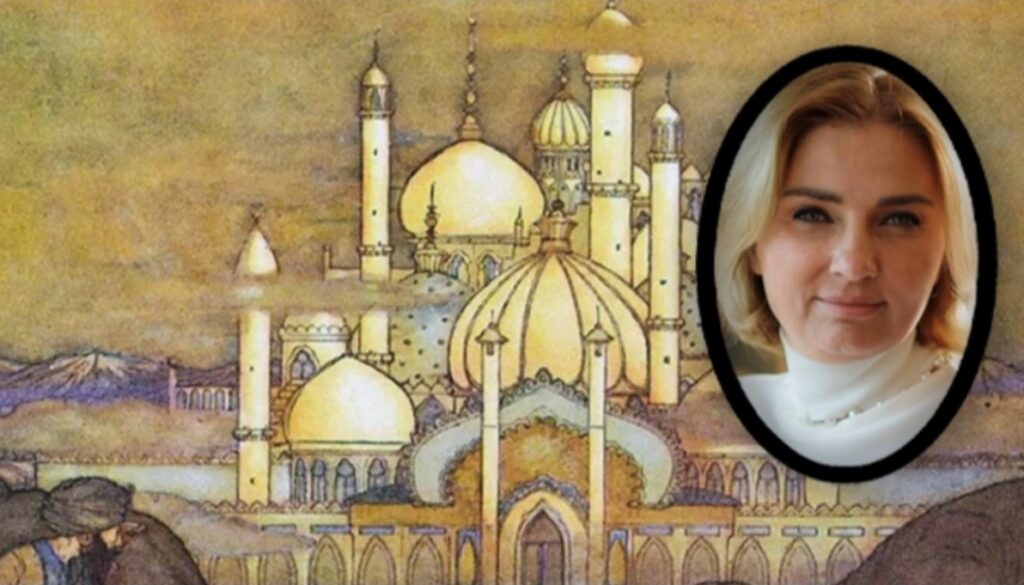
“I shall tell you one such tale that you will say: ‘in what wells, in what caves, even how many levels beneath the earth and how many levels above it have these tales been hidden until now? We had never heard the like of it before; is there no more?’” With these words, they say, Scheherazade would begin, as she told the story of the 1001 matters of the days with the mystery of the 1001 nights. A secret far from reality, layer upon layer underground, layer upon layer in the dreams of some… The words of the world’s matters wrapped in mystery, the reality their symbols reflect, their encrypted mechanisms… Is it in the mastery of the pen or in the teller himself that the generations who will remember the tales for centuries lie hidden? And the old priest who is the voice of Johann Wolfgang von Goethe’s tales would begin to tell of the world of matters like this: “This evening I promise you a tale. Thanks to this tale you should be reminded of nothing, or else you should be reminded of everything”. The listener of the stories gathered with the words of this alchemical world is either a hero of the matter or the one who ponders the words shaped by the mastery of the writing pen.
These were the days of a year ago, whose memory we are trying to fit into our homes… When those saying “The time has come at last!”, on the mainstream’s programmes of every kind with their “I said it first, I knew it first”, declared: “At long last the time has come for the thing that is coming; we shall witness that it is the rising of a temple from beneath the earth; know the worth of the days when little remains before a secret is remembered. And we are given the glad tidings that a new thousand-year age has begun”, was what we were listening to a tale from Goethe’s old priest, or was this tale coming true? In this time, when none of our calculations held, we chose to believe the heralds of this matter, and from channel to channel we never let them out of our sight.
Together with the matter of The History of Jack and the Bean-Stalk, published in 1807, whose author and the time it first began to be told are not exactly known, we are now following on our screens the excitement of the story of the seed bearing golden fruit of a Chinese emperor of once upon a time. The second season, whose shooting, as we understand from the trailers, has been completed, is coming very soon!
Ludwig Tieck’s tale called The Elves is the future that is on its way. It is the story of the dark region on the far side of the brook, where Zerina and Marie live through their extraordinary experiences. The matter begins when the door of the real world in which the heroes live opens onto a supernatural world. While showing her friend Marie around, Zerina goes off to the palace for a moment. She comes back with a box made of gold in her hand. Inside this box are seeds that look like glittering dust. She dips her little hand into the box, then draws it out and sprinkles the seeds in her hand over the green earth. At that moment the grass stirs as if in waves, and a few minutes later rose trees shining brilliantly begin to spring from the soil. The trees grow fast and their buds appear at once. A very sweet scent of perfume spreads all around. Marie too takes a little of the dust and sprinkles it. She sees white lilacs and the most variegated carnations blossoming around her. Then, at a sign from Zerina, all the flowers vanish and new ones bloom in their place. After that Zerina throws two pine seeds on the ground, and she and Marie feel themselves moving upwards. The trees rise beneath them at great speed, and as the tall pines sway back and forth, the two children, clinging tightly to each other, swing among the red clouds of the twilight.
Albert Einstein, one of the founders of modern science and one of the names that have lit up its history, replies, in an interview of 1929, to a question about the way his mind works: “Imagination is more important than knowledge, for knowledge has limits, whereas imagination encircles the whole world.”
Imagine a cloud of sensors, each the size of a grain of sand, blown into the air by hurricane winds and relaying data about the storm to the weather stations below. Or the miracle of tiny robotic chips travelling through a human artery to find and destroy a hidden clot…
The secret of the miracle, the future of the measurable world, lies in smart dust; Zerina’s magic seeds from the land of Ludwig Tieck’s Elves are no longer a tale but the matter of today!
Kristofer S. J. Pister, who did not leave Einstein’s word “imagine” lying on the ground, dreamed in the 1990s the craziest dream of all, defying the world with a “Pinch of Smart Dust”. Aiming for a pinch of dust floating in the air to be able to collect the information of every particle it could reach, he laid the foundations of the “world of big data” in order to be able to store in a single centre the data of the world, below the moon and above it. For a future in which the calculations will not go astray, one that can be constructed by sprinkling a pinch of tiny sensors of one cubic millimetre over the earth and beyond! Pister had given his pinch-sized dream the name “smart”. The concept of smart was first heard in 1997, the dizzying prize year of files competing with one another, when the project chests were opened. Kris Pister, however, thought that, along with the concept of the internet of things, adding the name smart to every stone and clod of earth was far too exaggerated. For that reason Pister, taking a playful attitude towards this state of affairs that he found exaggerated, gave his pinch of dust the name “Smart DUST”. In the first half of 2001 he developed further his pinch of smart dust, which he had devised by taking inspiration from the working principles of bees, the miracle of nature. Dr. Pister, who says “When we came out of the university environment, we learned that size was not especially important, that power and reliability were important”, with industry’s ever-growing interest in smart dust founded a company called Dust Networks (later acquired by Linear Technology) in order to speed up its application in every possible industrial field.
In the past year, in which Covid the 19th has been trying to cram our lives into the house, we are trying to understand the internet of things, still in the beak of the blue bird, the herald of social media, and cars that communicate with one another. While it has not yet occurred to us to address the MOBILE phone by the name smart, it is only a month since we migrated from the land of whatsapp for fear of our personal data being seized through its touch screen. Yet Pister’s pinch of dust, it turns out, has been developing, sprinkled and sprinkled over us, since 2003. And we, at that time, at Sunday breakfasts, were spreading and spreading outwards with the breakfast spread on our table.
Smart networks that use smart dust by means of computer software carry out, besides military operations, a variety of tasks such as detecting fires, bringing to light the extraordinary conditions inside mountains, monitoring the mating processes of birds and identifying endangered species.
And the year is 2025…
An army of nano sensors is scattered like dust over Britain’s fields and farms. They are the eyes, ears and noses of the farming world; programmed to work together, designed to respond to every variation in water, temperature or nutrients. Most important of all, they are networked so as to respond instantly to disease and attack. No, this is not science fiction; this is the reality of farming, far sooner than you think! Investments in nanotechnology and ‘smart dust’ to create a safer and more efficient food and agriculture system are now everywhere in the world… Our new production, partly shaped for the food-obsessed world of 2060: Roots Replanted!
So what is it? Nanotechnology is the manipulation of matter at the atomic scale, and smart dust is the use of tiny wireless sensors and transponders to transmit the information they sense. They can be sprinkled over a field and connected to the existing farm equipment used in precision agriculture and to your computer.
These are in fact the further stages of Pister’s pinch of smart dust, which has been used in other sectors for many years. Smart dust was sprinkled on Great Duck Island off the coast of Maine (USA). With the aim of developing a non-intrusive habitat monitoring kit, a network of 150 wireless sensors monitors the microclimates in and around the nesting burrows of seabirds.
And the same technology, bringing the expiry date under control, has developed Smart Packaging systems. Kraft Foods is developing an ‘electronic tongue, a set of nano sensors that are extremely sensitive to the gases released by food when it spoils and that, as a result, cause the colour of the sensor strip to change. And smart foods! Overeating will be prevented by a signal to be sent to the brain before one is full. A small molecule called peptide-1 (GLP-1), detected in the cells of the stomach, which regulates the feeling of appetite in the brain, will determine the amount of food to be taken daily according to the person. Very soon…
For anyone trying to make sense of the world of matters, Protagoras said: “Man is the measure of all things”. Natural reality and social reality? The dialectic between the human being and social reality… The approach of setting out from the individual or from the structure… Intertwined traditions, the supposition of life that becomes institutionalised through assumptions about the individual’s relation to society under the effects of micro or macro theory…
At the brightest timing of our dreams, while our eyes were blindfolded, those who were “off the ground” lasted only until the recess bell of innocence. Was it those off the ground, never letting themselves be caught, who shattered both the pot and the pan? Virtualisation has surrounded both the human being and the mass media, and virtuality cunningly keeps everything for itself. The swollen gains in the hypocrite’s ledger, the running out of the times of innocence that had been deceitfully hidden away, were plain from the shattering of the pots and pans.
Translated from the Turkish original.