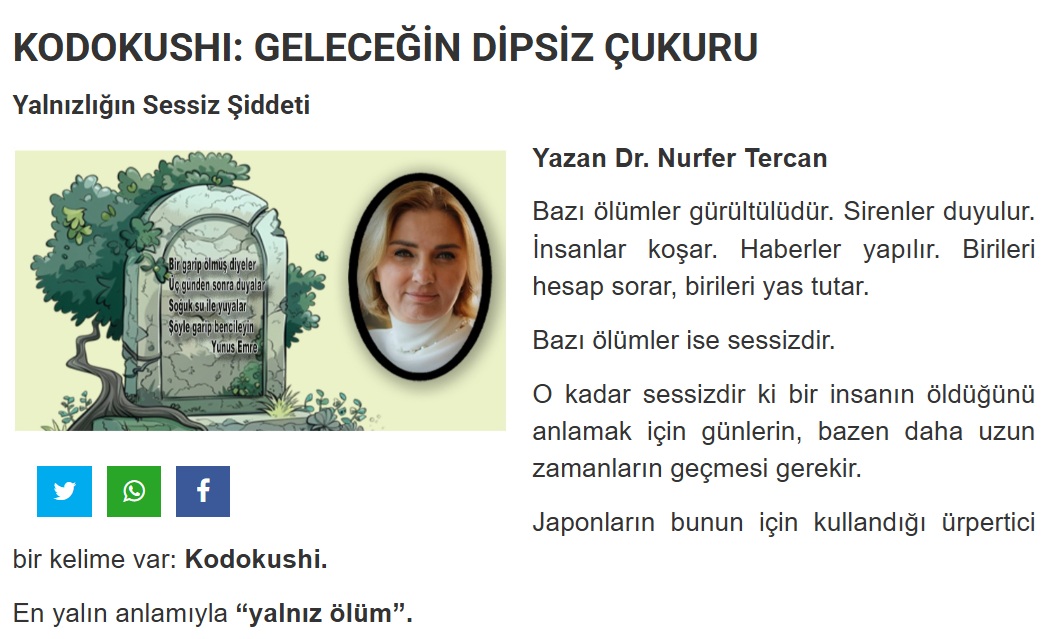
The Silent Violence of Loneliness
By Dr. Nurfer Tercan
Some deaths are loud. Sirens are heard. People run. News reports are made. Some demand an account, some mourn.
Some deaths, however, are silent.
So silent that days, sometimes far longer, must pass before anyone realizes that a person has died.
The Japanese have a chilling word for this: Kodokushi.
In its plainest sense, “lonely death”.
A person dying at home with no one beside them, and the death being noticed only some time later… Yet Kodokushi actually speaks about life more than about death.
For the real question is this:
How can a person become so lonely that their absence goes unnoticed for days—in a city where millions live; on a street where hundreds of people pass; in one of modern life’s multi-storey, high-security apartment buildings, its façade insulated with the finest materials, where at least two households live door to door on every floor; right in the middle of thousands of digital connections?
We have insulated our buildings layer upon layer to protect them from the cold, the heat and the noise of the outside world. Our walls have grown thicker, our doors stronger, our security systems more advanced. But without noticing it, we have also insulated human beings from one another.
Perhaps the greatest irony of the modern city lies hidden right here:
While perfecting the insulation of our apartment buildings, we lost the warmth of our neighbourly ties. Perhaps one of the gravest yet most invisible forms of violence of our age begins right here:
Silent violence.
A violence in which no one strikes anyone, shouts at anyone or threatens anyone; yet in which people slowly withdraw from one another’s lives.
One that begins with the closing of doors…
Continues with phones ringing less often…
Grows as the “let’s get together sometime” never comes to pass…
And is finally completed when the difference between a person’s presence and absence can no longer be felt by society.
Not Loneliness, but Having No One
Loneliness and being on one’s own are not the same thing. Sometimes a person finds themselves when left on their own. They think, read, create, turn to their inner world. A significant part of philosophy, art, poetry and contemplation was born of such solitude.
The problem is not being able to be alone, but coming to have no one. For having no one is not merely the absence of people around you.
It is that no one wonders about you. It is that your voice no longer finds an echo in another person’s world. It is that there is no one to notice when you do not open your curtains one morning. It is that there is no hand to knock on your door when you have not answered your phone for three days.
And perhaps what is heavier still:
It is that after a while you, too, get used to not knocking on anyone’s door.
At that very point loneliness ceases to be a personal feeling and turns into a social issue.
The Bottomless Pit of the Future
When we talk about the future, we discuss artificial intelligence, the climate crisis, wars, energy resources, the economy and technology.
But there is another pit quietly growing before humanity:
Loneliness!
What is more, this pit makes no noise.
It grows in silence.
Modern human beings want to be ever more independent:
Not to need anyone…
Not to answer to anyone…
Not to carry anyone’s burden…
Not to let anyone interfere in their own life…
It is clear that, to a certain extent, these are gains of freedom.
But the tragedy of modernity emerges elsewhere: we have begun to confuse independence with having no bonds.
In wanting to be free, we are trying to be rid of one another.
Yet while some bonds enslave a person, some bonds keep a person alive.
A mother’s phone call…
A friend asking, “Where are you?”…
A neighbour knocking on the door…
A chair set aside for you at a table…
Someone waiting for you…
None of these is a technological development.
But perhaps what we call civilization is precisely the sum of them.
The “I Need No One” Fallacy
Our age has not only taught us to live alone; it has also turned not needing others into a mark of success.
“Stand on your own two feet.”
“Don’t depend on anyone.”
“Solve your own problem yourself.”
“Don’t be a burden to anyone.”
“Be strong.”
Behind these sentences, which seem reasonable at first glance, another conception of the human being is growing unnoticed: the ideal person is the one who needs no one.
Yet such a person has never existed.
From the moment we are born, we need another’s arms.
We learn to speak from others.
We receive our knowledge from earlier generations.
When we fall ill, we need another’s care.
When we grow old, we draw close once again to the mercy of others.
And when we die, even our body is carried by others!
Both the beginning and the end of human life are in the hands of other people.
Even so, in the middle of life we tell ourselves a strange tale:
“I need no one.”
Yet to need is not a flaw.
To need is one of the conditions of being human.
From Al-Farabi’s City to the City of Kodokushi
It is right here that Al-Farabi needs to be read again.
In Al-Farabi’s idea of the virtuous city, the human being is not a creature capable of attaining perfection and happiness entirely alone. Human beings need other human beings; mutual help is a necessity not only economic, but one that concerns human existence itself.
Now let us carry this thought into today’s metropolises.
Millions of people live side by side.
But living side by side does not mean living together.
We ride in the same lift, but we do not know one another’s names.
We walk down the same corridor, but we do not know behind which door there is a sick elderly person.
We write hundreds of messages in the same building’s chat group, but we do not wonder about the neighbour who has not been seen for three days.
Perhaps we should measure the cities of the future not by the height of their skyscrapers, but by this question:
When a person disappears, how long does it take the city to notice?
Perhaps there is no more shattering measure of civilization than this.
Ibn Khaldun: Not Even a Loaf of Bread Can Be Produced Alone
In explaining human communities, Ibn Khaldun starts from the fact that a human being cannot sustain life alone.
Not even the bread a person eats can be produced single-handedly.
Someone grows the seed.
Someone tills the soil.
Someone carries the crop.
Someone grinds it.
Someone kneads the dough.
Someone lights the oven.
Behind even a tiny piece of bread on the table there is an invisible chain of people.
So the sentence “I need no one” is a great illusion not only psychologically, but sociologically as well.
We all live on one another’s invisible labour.
Civilization is the art of being able to meet our needs through one another’s existence.
But the modern city has made this reciprocity invisible.
We see the bread; we do not see the farmer.
We see the order; we do not see the person who carries it.
We see the elderly person in the building; we do not know their story.
Increasingly, we know people not by their being, but by their functions.
Thus society is slowly turning from a community of people into a network of services.
Surveillance Has Increased, Watching Over Has Decreased
In the past, the neighbour was the silent witness of everyday life.
They would see your curtain open in the morning.
They would notice that your light was not on in the evening.
If you were ill, they would knock on your door.
Today we live in gated communities.
We have cameras.
We have digital locks.
We have smart doors.
We have video intercoms.
But sometimes there is no one who truly sees us.
The irony of our age perhaps fits into a single sentence:
Surveillance has increased; watching over one another has decreased.
There are cameras everywhere, yet we look at one another less.
Our phone knows where we are.
The algorithm knows which music we like.
The bank knows what we buy.
Social media knows which people we are interested in.
But the person living in the flat next door does not know that we have not left our home for three days.
While more and more data is produced about us, the number of people who truly know us may be shrinking.
Thousands of Followers, a Door No One Knocks On
A person may have thousands of followers.
They may see the lives of hundreds of people every morning.
They may be in dozens of message groups.
Their photo may be liked hundreds of times.
But when they fall ill, they may not have a single person to knock on their door.
Being “online” and being present in someone’s life are not the same thing.
A heart emoji is not a hand laid on a shoulder.
A “get well soon” message is not a knock on the door.
A follower is not a friend.
A notification is not being remembered.
And even if the algorithm remembers you every day, that does not mean a human being is wondering about you.
Facing the Loneliness We Choose
But to lay all the blame on technology, the city or modern life would be taking the easy way out.
We must face a more uncomfortable question:
Are we ourselves building part of this loneliness?
We want friendship, but we do not want to give the time friendship takes.
We want family, but we do not want to put up with one another.
We want to be loved, but we do not want to carry another’s burden.
We want to be understood, but our patience for listening is wearing thin.
We want to be remembered, but we do not call.
We want solidarity, but we do not want anyone to touch the boundaries of our life.
Then we ask: why are we so lonely?
Perhaps the truth we avoid facing is this: we were not merely pushed into the bottomless pit of the future; we laid some of its stones with our own hands.
Loneliness Does Not Begin in a Day
The most chilling aspect of Kodokushi is not death.
For death is the final scene.
The story began much earlier.
Perhaps years ago a phone call was not made.
A friendship was neglected.
A family bond was defeated by pride.
One person drew back, saying, “I’d better not bother them.”
The other waited, thinking, “They’ll call anyway.”
The small neglects of life turned, over time, into great silences.
Loneliness mostly does not arrive in a dramatic fashion.
It comes millimetre by millimetre.
First a chair goes missing from the table.
Then a name from the phone’s contact list.
Then someone who used to call on holidays.
Then someone who used to ask, “How are you?”
And in the end a person gets used to their own silence.
Perhaps this is the most dangerous stage:
When loneliness no longer feels like loneliness.
Who Is the Perpetrator of Silent Violence?
So who is the perpetrator of this violence?
The state?
The city?
The economic order?
Technology?
The family?
The individual?
Perhaps all of them, a little.
Perhaps none of them alone.
For the most frightening aspect of silent violence is that it mostly has no identifiable perpetrator.
No one wanted that person to be left alone.
No one consciously abandoned them.
Everyone is just a little busy.
One has work.
One has a meeting.
One has a child.
One has a career.
One has a problem of their own.
Everyone has perfectly legitimate reasons.
But from the sum of all these legitimate reasons, a terrible result sometimes emerges:
Having no one.
Perhaps the moral dilemma of modern society begins here: in a world where no one is guilty individually, can we all be responsible socially?
Spinoza: Some People Multiply Us into Life
Baruch Spinoza does not think of the human being as a closed island cut off from the world. Human beings live within encounters; some encounters increase our power to exist and to act, while others diminish it.
When we carry this over to today’s loneliness, a profound conclusion emerges: some people multiply us into life.
A half-hour conversation with a friend…
A single sentence a teacher says to a student…
A child holding an elderly person’s hand…
A neighbour knocking on the door…
Someone saying, for no reason at all, “I thought of you”…
Their economic value cannot be calculated.
They have no equivalent in gross national product.
They have no price on the stock exchange.
They do not appear in productivity tables.
But perhaps the real capital of human life is exactly these:
Encounters.
For some people pass us by.
Others increase our being.
The New Ethics of Loneliness
Perhaps from now on we should not speak of ethics only in terms of “doing no evil”.
I have killed no one.
I have defrauded no one.
I have taken what was due to no one.
I have harmed no one.
Of course all of these are important.
But are they enough?
Perhaps we should add other questions to the ethics of our age:
Whose loneliness did I notice?
Whose voice did I truly listen to?
Whose absence did I notice?
Whose door did I knock on?
In whose life was I present, not only when I needed them, but without expecting anything in return?
For goodness is not merely doing no evil.
Sometimes goodness is being there.
The Greatest Luxury of the Future
In the near future, technology may meet many of our needs.
We may have artificial intelligence assistants.
We may have driverless vehicles.
Our robots may prepare meals.
Our homes may monitor our health.
Our watch may measure our heart rhythm.
Our refrigerator may order the food that has run out.
But all this technology cannot produce one thing:
The time one human being voluntarily sets aside for another.
For time is the only wealth a human being cannot get back.
When someone gives you two hours, they are in fact giving two hours of their life.
Perhaps the true wealth of the future will be measured not by the number of objects we own, but by two simple questions:
When your phone goes dead, how many people are there who will knock on your door?
And more importantly: how many people’s doors would you knock on?
A Test of Civilization
Perhaps we should no longer measure cities only by per capita income, the length of the metro, the number of skyscrapers, internet speed and technology investments.
We should think of other indicators as well:
How many days pass between an elderly person’s face-to-face conversations with another human being?
How many times a week does a child sit at the same table with their family?
Do the people living in an apartment building know one another’s names?
When a person falls ill, how many people are there to notice?
And perhaps most important of all:
When a person dies, how long does it take for their absence to be noticed?
This is the terrible ruler that Kodokushi holds up to civilization.
A society’s technological development is one thing.
Its human development is another.
The Last Door
Think of the human being of the future.
Extremely well educated.
Economically independent.
Surrounded by technology.
Able to reach all the world’s knowledge within seconds.
With thousands of digital connections.
But when evening comes, there is a single plate on the table.
There are hundreds of names on the phone screen, but no one to call.
The health app tracks the heartbeat, but there is no one to ask why the heart has grown heavy.
And one day the heart stops.
The smart home goes on working.
The internet is connected.
The bills are paid automatically.
The algorithms go on producing data.
Outside, the city flows on at full speed.
But inside, a human being is no longer there.
And no one notices.
Perhaps this is the heaviest thing Kodokushi tells us:
The greatest danger humanity may face in the future may not be death.
It may be that a person’s death leaves no void in anyone’s life.
That is when loneliness ceases to be a personal pain.
It turns into a crisis of civilization.
Perhaps the great catastrophe of the future will not be machines becoming human.
It will be human beings becoming machines towards one another.
We have succeeded in connecting the whole world.
Now we must ask ourselves a much harder question:
Have we been able to connect human being to human being?
The answer perhaps lies not on the servers of technology companies, but behind a door we have not knocked on for a long time.
For sometimes there is no need for grand manifestos to rebuild a civilization.
A phone call is enough.
Pulling up a chair is enough.
Setting one more plate on the table is enough.
Calling someone we have not called for a long time is enough.
Knocking on a door is enough.
And perhaps humanity, in the midst of all its technological splendour, must once again remember the meaning of a few words:
“I am here.”
But before that, we must ask one more question:
“Are you still there?”
For the real collapse of a society does not begin with people dying.
It begins when they no longer notice one another’s absence.
Notes from the Blue of the Windy City
https://www.5gvirusnews.com/yazarlar/kodokushi-gelecegin-dipsiz-cukuru-h1953.html
Translated from the Turkish original.