AT THE BALLOT BOX KAZAKHSTAN IS CHANGING NOT A PARTY BUT AN ERA
From Nur Otan to Amanat, from Amanat to Adilet: As the Names Change, the State’s Language of Legitimacy Changes Too
By Dr. Nurfer TERCAN
When the name of a party changes, does a country’s political memory change as well?
On 23 August 2026 the voters who went to the polls in Kazakhstan had before them not merely a new parliamentary election. In fact the language of an era was also in the ballot box.
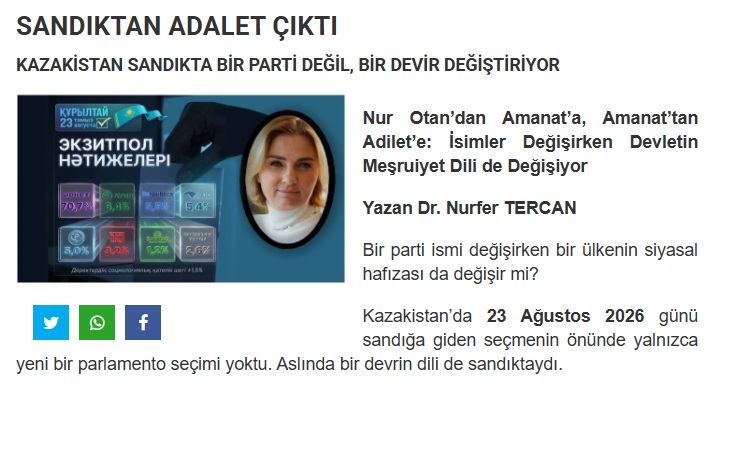
According to the preliminary results announced by the Central Election Commission on 24 August, 9,351,539 of the 12,623,289 registered voters cast their ballots. Turnout reached 74.08 percent. The Adilet Party, not yet four months old, received 71.17 percent of the votes.
According to the preliminary results of 23 August 2026, the picture was as follows:
Adilet 71.17 percent; Auyl 6.26 percent; Respublica 5.56 percent; Ak Zhol 5.21 percent; the Nationwide Social Democratic Party 5.11 percent; the People’s Party of Kazakhstan 3.11 percent; Baytaq 1.07 percent. The share of those who chose the “against all” option was 2.51 percent.
The electoral threshold is 5 percent.
Adilet is preparing to take about 110 of the 145 seats in the new Kurultai.
But the real story behind the figures is not the 71.17 percent.
The real story lies in this question:
Why did Kazakhstan, within a few years, move from Nur Otan to Amanat, and now from Amanat to Adilet?
Because sometimes, when the name of a party is changed, what is actually being changed is the language of the contract made with society.
The transformation Kazakhstan has gone through in the last few years is exactly such a change of meaning.
FIRST THERE WAS NUR OTAN
Nur Otan was the name of independent Kazakhstan’s first great political era.
Over the years it became not merely a political organisation but one of the principal structures carrying the institutional memory of the Nursultan Nazarbayev era. It was a backbone that cut across parliament, the bureaucracy, local government and the rungs of the political career ladder all at once.
For this reason the name “Nur Otan” could not, over time, be read in its dictionary meaning alone.
It evoked an era.
A leadership.
A style of government.
A process of state-building.
The political memory of a generation.
Moreover, the name itself carried a double meaning that everyone knew. “Nur” meant both light and Nursultan.
That the name of a party should at the same time evoke the name of a person was, symbolically, one of the most powerful examples of political personalisation.
But every political brand ages together with the era that gave birth to it.
That is exactly why the events of January 2022 were, for Kazakhstan, not merely a social upheaval lasting a few days. They were a historic rupture that forced a rethinking of the relationship between state and society.
In those days Nazarbayev’s chairmanship of the party passed to Tokayev; then the symbols began to change one after another.
WHY DID NUR OTAN BECOME AMANAT?
On 1 March 2022 the name of Nur Otan was changed to Amanat.
“Amanat” is an extremely powerful word in Kazakh and in the shared world of meaning of the Turkic world.
Something entrusted.
A responsibility taken over from the previous generation.
A value that must be protected.
A legacy that must be handed on to the next generation.
In the official statements of the time, too, the word was explained in the sense of “the legacy of the ancestors and a message to future generations”.
For this reason it would be inadequate to read the move from Nur Otan to Amanat as merely a change of signboard.
For there is a most striking shift of meaning in the name:
A move from the association with a person and an era to the concept of responsibility.
The operation performed is not an addition but a subtraction.
It was as if this were being said:
An era may be coming to an end; but the state continues. The name may change; but continuity must be preserved. Memory must not be erased, but it must be given a new meaning.
In those same days Tokayev also strengthened the discourse of a “New Kazakhstan”. In the reform package he announced on 16 March 2022 he said that the political system needed to be restructured.
Amanat, therefore, was not merely a new name.
It was the transition word of post-2022 Kazakhstan.
But today we see that Amanat was not the final stop either.
A thing held in trust is, by definition, temporary. It is carried and handed over.
Perhaps the word carried its own end within it from the very beginning.
WHY ADILET NOW?
By 2026 a new word had emerged:
Әділет — Adilet.
In Turkish: Adalet — justice.
The new party was founded in May 2026. On 7 May Aibek Dadebay, former Head of the Presidential Administration, was elected chairman; on 1 June it received its state registration. In June it was decided that Amanat would join Adilet.
In other words, what had for years been the country’s largest political organisation moved under a new roof about two months before the election.
This detail matters.
Because technically it is not quite accurate to say merely that “Amanat’s name became Adilet”. A new political legal entity was created and the old large organisation was moved into this structure.
Symbolically this is a far more powerful operation.
It is not merely that the signboard of the old building was changed.
It was said that a new building had been constructed, and the old structure was moved into it.
The difference is psychological as much as it is legal.
In a change of name the past comes along with you; in a new foundation the past becomes something you have taken over.
In the first you are the owner of the history.
In the second, its heir.
So why justice?
Because in the societies of the 21st century the most important issue facing states is no longer economic growth alone.
People are asking other questions:
Growth for whom?
Opportunities for whom?
Good education for whom?
Good jobs for whom?
Who benefits from the resources?
Is the law the same for everyone?
Is success really possible through labour?
In a country per capita income may rise. New roads may be built. New cities may be founded. A technological transformation may be accomplished.
But if the feeling that “life is not fair” takes shape among broad sections of society, economic indicators alone cannot deliver social satisfaction.
That January 2022 began with a rise in liquefied gas prices and ended up somewhere entirely different was exactly the counterpart of this observation on the ground.
The price was the spark.
The fuel of the fire lay elsewhere.
That the name Adilet was chosen precisely here is too meaningful to be counted a coincidence.
In the party programme, too, the concepts of justice, law and order, responsibility, labour and patriotism are placed at the centre.
That is, the legitimacy word of the new era is no longer stability alone.
It is justice.
THREE NAMES, THREE ERAS
Perhaps it is possible to read Kazakhstan’s last quarter century through just three words:
Nur Otan — Foundation and continuity.
Amanat — Handover and responsibility.
Adilet — Justice and the search for renewed legitimacy.
In this respect the party names are small but extremely meaningful indicators of the transformation in Kazakhstan’s thinking about the state.
The first era asked this question:
How will the state be founded and protected?
The second era:
How will the structure that has been taken over be sustained?
The present era, however, is increasingly faced with a much harder question:
Will the citizen believe that this structure treats him fairly?
The three are not the same question.
And the third, unlike the first two, is a question whose answer is given not only by the state but by society.
WHY DOES THE KURULTAI MATTER?
The 2026 elections have yet another historic feature.
Kazakhstan now goes forward not with the old Senate–Mazhilis structure but with the unicameral Kurultai system of 145 members.
The new constitution was adopted in the referendum of 15 March 2026 and entered into force on 1 July. The election of 23 August was the first great test of the new constitutional order.
Here terminology matters too.
“Kurultai” is not an ordinary technical name.
In the political memory of the Turkic and steppe tradition of statehood it carries the meaning of consultation, representation and the deliberation of common affairs.
Moreover, the word was already in use in Kazakhstan’s recent politics. The National Kurultai, established in 2022, functioned as a consultative platform.
Now the same word has been carried from a consultative body to the name of the legislative body.
Thus on one side there is Adilet, on the other Kurultai.
Justice and consultation.
Two extremely powerful choices at the conceptual level.
But from now on the issue is being able to move from concepts to results.
Because:
History judges a country not by the words it chooses but by how far it fills those words with substance.
THE NEW CONSTITUTION DID NOT CHANGE ONLY THE PARLIAMENT
Public attention focused mostly on unicameralism. Yet the 2026 Constitution brought a far broader architectural change than that.
The Senate was abolished.
The president’s quota for appointing members to the legislature came to an end.
The death penalty was explicitly prohibited in the text of the constitution.
Broader autonomy was granted to the regions and local governments.
A People’s Council was envisaged for national dialogue.
And none of the sitting deputies passed automatically into the new parliament; everyone went before the voters again.
Some of these are steps that can be read as pointing towards the dispersal of power away from the centre.
But the same constitution brought one more thing:
The vice presidency.
This office is appointed by the president and confirmed by a simple majority of parliament.
On election day, at the polling station, Tokayev said that the name would be announced shortly and that this person was someone well known to the public, and he stressed that the office was necessary in the difficult period we are in.
When a new office of vice president is created in a country, one of the questions political science will ask is unavoidable:
Is this office merely a deputyship, or could it in the future turn into part of a succession mechanism?
The answer to this will be given not only by the text of the constitution but by time and political practice.
AND THE DECISION OF 7 JULY
One of the important developments that requires this whole picture to be read anew took place on 7 July 2026.
The Constitutional Court set out an interpretation concerning the application of the limits in the new constitution with respect to elections and appointments made under the new constitutional order.
The political meaning of this is extremely important.
Because the question of how terms of office under the new constitutional order and the previous constitutional period are to be assessed directly concerns Kazakhstan’s future presidential calendar.
The Court may open up a space of legal possibility; but in the end the political decision will be determined by society and the electoral process.
Tokayev, too, when asked on election day whether he would stand again, replied that it was still too early to say.
Consequently the political calendar, which until a few months ago looked more predictable, has today become more open-ended.
And this situation brings with it a larger question:
When a constitutional order changes, on what ground will institutional continuity rest?
This is not a question peculiar to Kazakhstan.
One of the most important issues of modern political science is exactly this:
Are institutions shaped according to persons, or do persons act within the limits set by institutions?
THE 71.17 PERCENT BRINGS ANOTHER QUESTION AS WELL
Adilet’s winning 71.17 percent of the vote is a strong election result.
But from the standpoint of political science a high share of the vote is not only an indicator of strength.
It is at the same time a great burden of responsibility.
Because after 71 percent support the room for excuses shrinks.
If the economy goes badly…
If the cost of living rises…
If young people begin to look for their future in other countries…
If the development gaps between regions widen…
If the sense of injustice in the distribution of income grows stronger…
If equality of opportunity in education cannot be secured…
If society is not convinced on the matter of merit…
The word “Adilet” itself will one day confront the party as a question.
Because the moment you take the word justice into your name, society asks of you not an ordinary administration but the visible results of justice.
The name thus turns into a yardstick as much as an advantage.
In politics, choosing a name is at the same time writing your own examination question.
THE OPPOSITION’S FIVE-PERCENT CORRIDOR
Perhaps the most interesting part of the election results, as much as Adilet’s 71 percent, is the distribution of the other parties.
Auyl 6.26 percent.
Respublica 5.56 percent.
Ak Zhol 5.21 percent.
The Nationwide Social Democratic Party 5.11 percent.
That four parties sit in almost the same narrow band is striking.
The assessments of international election observers also dwell on political pluralism, the opportunities for representation of a genuine opposition and the position of independent candidates.
This picture gives rise to an important question about Kazakhstan’s future:
Will the Kurultai be a real arena of debate and oversight, or a structure made up of smaller political colours arranged around one large centre party?
The answer to this question cannot be given on election night.
The working of the Kurultai will show it.
The existence of an opposition party and its being effective are not the same thing.
What matters is not only the number of deputies.
Can it amend bills?
Can it bring social problems onto the agenda?
Can it question government policies?
Can it offer the public an alternative?
Is the Kurultai a stage for real debates?
Political pluralism is measured exactly here.
THERE IS ALSO A CONTRADICTION HERE
There is an important point about the new system that must not be overlooked.
In the 2023 election part of the parliament could be elected from single-member constituencies, and independent candidates had the opportunity to compete.
The new Kurultai, by contrast, is formed through a proportional electoral system based on a nationwide constituency and closed party lists.
The word “closed” is not a technical detail here.
The voter votes not for a name but for a list.
And the order on the list is determined by the party leadership.
The political consequences of this need to be thought through.
Because the political future of a deputy becomes ever more dependent on how the relationship between the voter and the party headquarters is built.
Therefore, while the new system on the one hand lays claim to representation and institutional simplification, it must on the other hand also be debated whether it narrows the access of independent political actors to parliament.
Because a real Kurultai is not merely a large number of deputies being present in the same hall.
It is its being a place where different voices of society can be heard.
In the steppe tradition, too, the meaning of the kurultai was not only that the ruler spoke, but that different voices could speak in the ruler’s presence.
WHEN IS THE REAL GREAT TEST?
Until recently the answer to this question could comfortably have been given as 2029.
Today one needs to be more cautious.
Because three variables are now moving at the same time:
The legal debate over how terms of office will be assessed under the new constitutional order…
The newly created vice presidency…
And a brand-new party that was founded within a few months and grew strong enough to take about three quarters of the parliament.
The combination of these three tells us this:
The constitutional arrangements of 2026 must be read not only as a way of governing today but also in terms of how the state will pass into the next period.
Several possibilities emerge here.
The first: Adilet turns into the new long-term centre party and the political transition, whatever its date, is carried institutionally.
The second: Adilet becomes a strong transition platform but in the years ahead begins to produce different political wings within itself.
Because in large parties that win over 70 percent of the vote, not all political differences remain outside; in time they may form inside the party too.
The third: If society does not find what it expects, especially on the issues of the economy, youth, income distribution and equality of opportunity, the great centre that today stands at 71 percent will in time be confronted with different social demands coming from below.
It is not possible to say with certainty today which of these will come about.
But one thing can be foreseen:
The next stage of Kazakhstan’s politics will be determined no longer merely by the Nazarbayev–Tokayev comparison but by whether institutions function independently of persons.
This is a very important threshold.
A COUNTRY’S REAL SUCCESS IS UNDERSTOOD WHEN THE LEADER CHANGES
Strong leaders can create strong eras.
But strong states are those that can sustain their system even when the leader changes.
The real question is this:
Can a country move from the person to the institution?
Do the rules change according to persons, or do persons abide by the rules?
Can merit take precedence over personal closeness?
Can the new generation see itself in the country’s future?
Can the citizen obtain his rights without needing an acquaintance in order to reach the state?
Does he feel equal before the court?
Is economic advancement possible for everyone and not only for certain circles?
It is here that the real test of the word Adilet will begin.
THE NEW SOCIAL CONTRACT BEFORE KAZAKHSTAN
Kazakhstan is a large country.
It has enormous natural resources.
It has uranium.
It has oil.
It has gas.
It has critical minerals.
It lies at the centre of the Middle Corridor between China and Europe.
It has one of the world’s longest land borders, with Russia.
It opens onto the Caspian.
It forms one of the central geographies of the Turkic world.
But geopolitical power is at the same time a great responsibility and at times a source of fragility.
The classic dilemma of resource-rich countries is well known: when a significant part of state revenue comes from underground resources, the economic and political nature of the state–citizen relationship may become different.
Yet in the 21st century the real wealth of countries does not lie only beneath the ground.
It is the trust that the person above the ground has in the system.
This is where the great transformation before Kazakhstan lies.
The Nazarbayev era was the defining period of the founding and consolidation of the independent state.
The Tokayev era is trying to reorganise this state.
But the next era will ask a much harder question:
What kind of future does this state offer its citizen?
Especially the young Kazakhstani.
Because in the memory of the new generation the Soviet Union is receding ever further.
They do not remember the first years of independence.
Millions are coming who did not live through the hardships of the 1990s.
Their point of reference is no longer only the past.
It is the world.
When they open their phones they see Seoul.
Dubai.
Istanbul.
Berlin.
Singapore.
Shanghai.
And they compare their own country with these.
So it will not be enough merely to say to the new generation, “It used to be worse.”
Their question will be a different one:
“Why will tomorrow not be better?”
The politics of the future will be built on the answer to precisely this question.
THE REAL JOURNEY FROM NUR OTAN TO ADILET
For this reason I do not read the change through party names alone.
I see a longer road:
Nur Otan → Amanat → Adilet
And beneath it a far deeper transformation:
Founding leadership → institutional continuity → social legitimacy.
The first two stages have largely been accomplished.
The third is beginning now.
And the third stage is harder than the others.
Because a state can be reorganised by decree.
A party can change its name at a congress.
A constitution can be adopted by referendum.
A parliament can be re-established.
But society’s sense of justice cannot be produced by decree.
That sense takes shape within everyday life.
In the equality a student feels when entering university…
In the rules an entrepreneur encounters when setting up a business…
In an employee’s being able to receive the reward of his labour…
In the trust a citizen has in the court…
In a journalist’s being able to ask a question…
In a young person’s believing that his success depends not on his surname but on his talent…
That is justice.
And perhaps the greatest historical paradox behind the Adilet Party’s 71.17 percent victory lies here too:
Support this great creates an expectation of the same magnitude.
In 2026 the voters gave Adilet a large majority.
Now Adilet faces a choice far harder than the one at the ballot box:
Will it carry justice merely as a party name, or will it turn it into the experience of everyday life?
Perhaps the answer to Kazakhstan’s next ten years is hidden exactly here.
Because in history countries sometimes enter a new era by changing their names.
But whether they have really changed is told not by the signboards but by the life of the citizen.
NOTES AND SOURCES
The election data are based on the preliminary results statement of the Central Election Commission of Kazakhstan dated 24 August 2026; the distribution of seats is according to preliminary data and may change with the final results.
— The constitutional referendum was held on 15 March 2026; the new constitution was adopted with 87.15 percent of votes in favour and entered into force on 1 July 2026.
— The Constitutional Court’s decision concerning the term-of-office count is dated 7 July 2026. — The assessments of the OSCE/ODIHR observation mission and of human rights organisations are findings reported in the press after the election.
— The statements concerning the vice presidency are from the remarks Tokayev made to the press at the polling station on 23 August 2026.
https://www.5gvirusnews.com/yazarlar/sandiktan-adalet-cikti-h1945.html
Translated from the Turkish original.