“We Oppose Colour Revolutions.”
Sensation is a physiological event. Human beings have the sensations of sight, hearing, taste, smell, touch and the organic senses. The stimuli received by the sense organs and transmitted to the brain are grouped and interpreted. Perception, on the other hand, is an entirely psychological event. At the moment of perceiving, past experiences, other sensations coming from the other sense organs, the expectations of that moment, and social and cultural factors and values come into play. In other words, the way we perceive primary information about the world is greatly influenced by the way the sensory system and the brain were initially structured. Perception management, in its shortest definition, means controlling and improving the flow of data from the outside world in order to obtain information that is broader in scope, more beneficial and less ambiguous. This definition also shows that, in perception management, obtaining data is an inseparable part of an artificial information-gathering process. Owing to certain factors that affect the process of perception, inferences arise that lead to perceptual difficulty. The factors that cause difficulty in perception are these: Stereotyping (stereotyped judgement), the Halo Effect, Perceptual Defence and Projection.
We are faced with an entirely different kind of loss caused by the COVID-19 pandemic. Whether the experts would call this a loss of familiarity with the perceptual world, I do not know. The loss of familiarity with the perceptual world can be seen clearly, as in the fake glittering world of social media, in the response – formed by an ongoing, effortless and unsuccessful copying technique – to our perceptual environment, which characterises most of our daily life. In fact, this condition may sound familiar through different concepts known in psychology, such as mental breakdown, psychological breakdown and burnout syndrome. Mental breakdown in perception, however, is when perception, in matters described as conservative – where the great majority of acquired experience, culture and traditions is formed – gets caught in the net of disinformation and falls victim to a process of persuasion such as false and baseless claims. While mental breakdown in perception breaks new ground in individuals and societies on narrow, shallow, selected, noticed, targeted micro issues, what does not happen at the macro level too, reflected in the whole set of values – in short, in thought, behaviour, attitude or ideology…
Perhaps because mental breakdown is known to be, psychologically, only an individual problem, we sink deeper and deeper with the top-10 aphorisms produced by social media’s virtual centres of psychological science. The truth of mental breakdown is that, arising on both an individual and a societal basis, it retains its place in the field of expertise of many multidisciplinary sciences such as sociology, psychology and political science. In short, we are in the grip of today’s most severe contagious disease – that is, a loss of consciousness in which we have collapsed as a society and no one hears.
If we try to understand the factors that affect the process of perception and cause difficulty in perception, then at least as a society we may perhaps have a chance of escaping the grip of this disease. Stereotyping – that is, the stereotyped judgement that we cannot give up all day long, any more than our breath; the other being the inseparable companion of the stereotype, namely the Halo Effect; and their fellow players, Perceptual Defence and Projection.
And so the fact that, in recent days, the most improbable meanings have been attributed to the convulsions of the Black Sea, and that comments are made on images that do not exist, unfortunately shows that this disease is becoming contagious on an ever more dangerous scale.
The Kremlin had last issued a statement on 4 February 2022. O World! Read this statement now, it said; if you do not read it now, then a week from now, since the Kremlin will be off the shores of the Black Sea, it will be closed for a while and you will not be able to read it again. Those who heard, heard; nothing can be done for those who do not want to hear, it said, and fell silent.
We believe that today is exactly the time to recall this statement once again!
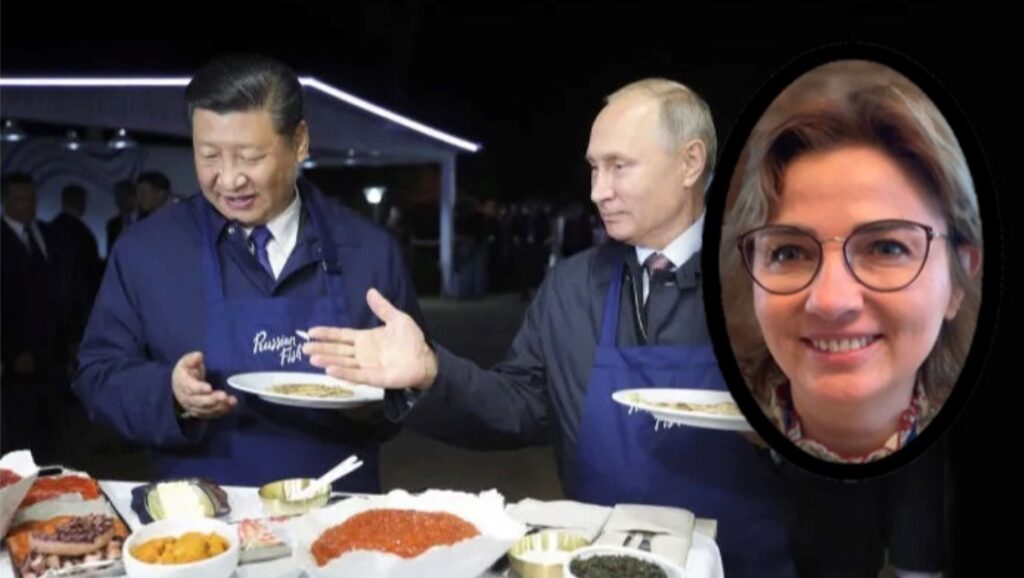
Russian President Vladimir Putin attended the opening ceremony of the Beijing Winter Olympics, despite the diplomatic boycott of the Games by US and Western officials over concerns about China’s human rights violations. Putin’s meeting with Chinese President Xi Jinping was the first encounter between the two leaders since their face-to-face talks in 2019. The purpose of the meeting was to strengthen Russia’s ties with China and to ensure that the two countries pursue a coordinated policy in the face of pressure from the West. After their bilateral meeting, Putin and Xi also attended the opening of the Beijing Winter Olympics together. In an article written for the Chinese news agency Xinhua, Putin had noted that Moscow and Beijing play “an important stabilising role” in global affairs and are working to make international relations “more equitable and inclusive”. Referring implicitly to the diplomatic boycott of the Beijing Winter Olympics by the US and some of its allies, Putin had criticised “attempts by some countries to politicise sport in a way that serves their own ambitions”.
Numerous Western officials had decided not to send diplomatic delegations to the Beijing Olympics in protest at China’s policies of repression against the more than one million Muslim Uyghurs living in the Xinjiang region in the north-east. However, the leaders of the former Soviet countries of Central Asia, which have close relations with both Russia and China, followed Putin and were at the opening ceremony of the Winter Olympics.
Here is what was in that very statement, announced by the Kremlin on 4 February 2022 and signed by Russian President Putin, who travelled to Beijing for the opening ceremony of the 2022 Beijing Winter Olympics, and his Chinese counterpart Xi.
While Xi stated that he supported Russia’s initiative concerning the security guarantees it has demanded from the West, the leaders emphasised that they would resist interference in the internal affairs of sovereign countries.
Russian leader Vladimir Putin, visiting China to attend the opening of the Beijing Winter Olympics, held a meeting with his counterpart Xi Jinping. At the end of the meeting the parties signed a document entitled ‘Joint Statement of the Russian Federation and the People’s Republic of China on International Relations Entering a New Era and Global Sustainable Development’. The joint statement, published on the Kremlin’s official website, included the following: “The Chinese side is sympathetic to and supports the proposals put forward by the Russian Federation on the creation of long-term legally binding security guarantees in Europe. The sides note that the denunciation by the United States of a number of important international arms control agreements has an extremely negative impact on international and regional security and stability. The sides express concern over the advancement of US plans to develop global missile defence and deploy its elements in various regions of the world, combined with the build-up of the potential of high-precision non-nuclear weapons for carrying out other strategic tasks.”
The salient points of the joint statement were as follows:
The sides underline that, as world powers and permanent members of the UN Security Council, Russia and China intend to adhere firmly to moral principles and responsibility, to resolutely uphold the international system in which the UN plays the central coordinating role in international affairs, to defend the world order based on international law, including the purposes and principles of the UN Charter, to promote multipolarity, to contribute to the democratisation of international relations, to build together a more prosperous, stable and just world, and to create together a new type of international relations.
‘The new type of relations between Russia and China is superior to the alliances of the Cold War era’: The sides are in favour of establishing a new type of relations between world powers based on mutual respect, peaceful coexistence and mutually beneficial cooperation, and reaffirm that the new type of inter-state relations between Russia and China is superior to the military-political alliances of the Cold War era. The friendship between the two states has no limits, there are no forbidden areas of cooperation, the strengthening of bilateral strategic cooperation is not directed against third countries, and it is not affected by the changing international environment or by situational changes in third countries.
‘We oppose the further enlargement of NATO‘ : The sides oppose the further enlargement of NATO and call on the North Atlantic Alliance to abandon the ideological approaches of the Cold War era, to respect the sovereignty, security and interests of other countries and the diversity of their civilisational, cultural and historical patterns, and to take an impartial and fair attitude towards the peaceful development of other states.
‘We are making consistent efforts for an equal and open security system in the Asia-Pacific Region’: The sides, which oppose the formation of closed bloc structures and opposing camps in the Asia-Pacific region, remain highly vigilant about the negative impact of the US Indo-Pacific strategy on peace and stability in this region. Russia and China are making consistent efforts to build in the Asia-Pacific Region an equal, open and inclusive security system that is not directed against third countries and that will ensure peace, stability and prosperity.
‘We oppose colour revolutions’: Russia and China oppose the actions of external forces aimed at undermining security and stability in their common neighbouring regions, intend to resist interference by external forces in the internal affairs of sovereign countries under any pretext, oppose ‘colour revolutions’, and will increase cooperation in the areas mentioned above.: In an interview with China Media Group, Putin also said: “We oppose attempts to politicise sport and the use of sport as an instrument of pressure, unfair competition and discrimination.”
Li Xin, Director of the Institute of European and Asian Studies at the Shanghai University of Political Science and Law, noted that Putin’s meeting with Xi and his attendance at the opening ceremony of the Olympics were “a declaration of the further advancement of the China–Russia relationship”. Li said that Russia and China were finding more and more common ground in the view that their security concerns were being disregarded by the US. Li also pointed out that both Russia and China had made a mockery of US domestic issues, such as the storming of the Capitol by supporters of former President Donald Trump on 6 January 2021 and its difficulty in bringing the Covid-19 pandemic under control.
“The US and Western countries are putting pressure on Russia over the Ukraine issue on the one hand, and on China over the Taiwan issue on the other,” Li said, adding: “Such steps of extreme pressure by the West will serve to strengthen cooperation between China and Russia.” Putin’s foreign policy adviser Yuri Ushakov said that the Russian President’s visit to China would mark a new stage in the Russia–China partnership. Ushakov described the cooperation between the two countries as “a key factor that will contribute to sustainable global development and to countering the destructive activities of certain countries”.
Saying that Moscow and Beijing were planning to issue a statement reflecting their shared views on global security and other matters in international relations, Yuri Ushakov added that Russian and Chinese officials were also preparing to sign a large number of agreements covering trade, energy and several other areas.
According to VOA’s report, Ushakov, who said that Moscow and Beijing share close or identical views on most international issues, particularly emphasised that China supports Russia in the Ukraine crisis.
Speaking to journalists by teleconference, Ushakov had also said: “Beijing supports Russia’s demands for security guarantees and shares the principle that a country cannot ensure its security at the expense of the security of others.” Russia’s deployment of more than 100,000 troops near the Ukrainian border had fuelled fears among Western countries that Moscow was planning to invade neighbouring Ukraine. Rejecting claims that it was planning to invade Ukraine, Russia had called on the US and its allies to give guarantees that NATO would not admit Ukraine and other former Soviet republics and would pull back its forces in Eastern Europe, but these demands had been turned down by the West. Some observers recalled that China, as it reflects on its Taiwan strategy, is closely watching what stance the US and its allies take in the face of the Ukraine crisis, and that indecision on Washington’s part could encourage China to be more assertive and coercive. Putin, who accused the US and its allies of ignoring Russia’s security demands but left the door ajar for further talks, had stated that NATO’s eastward enlargement and the offer of membership to Ukraine would harm Russia’s security and violate international agreements built on the principle of the “indivisibility of security”. The Russian leader had threatened that, should the West refuse to respond to Russia’s demands, he might resort to “military-technical measures”, the details of which he did not disclose. Short of an invasion of Ukraine such as the West fears, Putin may take steps to further strengthen military ties with China, which are already quite extensive. Russia and China had undertaken a series of military manoeuvres, including exercises and long-range bomber patrols in the Sea of Japan and the East China Sea. In August, Russian troops had been dispatched to Chinese territory for joint manoeuvres for the first time.
Although Moscow and Beijing have in the past rejected the possibility of forming a military alliance, Putin noted that it could not be said that such a partnership would never come about. Putin also stated that Russia shares sensitive military technologies with China to help it strengthen its defence capabilities.
Keywords: China Russia COVID19 NATO Beijing Moscow
Translated from the Turkish original.