WHAT HAPPENED WITH THE TECHNOLOGY REVOLUTION?
“Children who live without being able to possess a child’s heart, dreams, childishness and fears… The bourgeois advocates and practitioners of a philosophy of life that evaluates people by figures, rules and forms, and that maintains that everything, even every centimetre of lives, is a commodity bought and sold for money… The workers who try to live under their yoke and in the coal mines and weaving mills… Women who do not even have the right to love…” Charles Dickens
The people of the town of Coketown in north-west England… The suffering and poverty endured by the broad masses during the industrial revolution… Because he tells of them with a realistic eye, I wanted to begin, once again, with this novel called Hard Times by our English writer Mr Charles Dickens.
The first character we meet at the beginning of the novel, and one of Dickens’s central figures, is Thomas Gradgrind, a wealthy retired merchant in Coketown. “Thomas Grind begins, with his introduction of the utilitarian philosophy of education that he describes as “facts”, as follows: “Now, what I want from you is only “fact” knowledge. You will teach these children nothing but “facts”. What is needed for life are concrete “facts”. Plant nothing else in these heads, and root out whatever else is there. You can fill the minds of reasoning animals only with “facts”. Nothing else will be of any use to them. I bring up my own children on this principle too. Do not stray from the “facts”, Sir.” Thomas Gradgrind is someone who never uses anything that is not a “fact”; who, if he cannot count things or measure them, never thinks of them and does not want them to occupy a place in his head.” According to Gradgrind, an empty head is better than a head full of dreams; I underline this sentence of his!
To understand our present day, should we not read again, without judging and impartially, the files that we take down from the dusty shelves of history only on days of commemoration, that have never been closed, and that are our own plain past left behind in the past? We merely ignore them, while marking time on the spot. While the system renews itself at every moment, we are aware of nothing. In the year 2020, whenever it was that they lifted our feet off the ground, that was when we heard a little something. Of course, this being lifted off the ground and carried away was, for the whole world, neither a top-of-the-range automobile handed out without a raffle or a draw, nor a happiness that would sweep us off our feet for ever… We simply woke up one morning, and they said: until a second order arrives, you may enjoy freedom of movement within the home and, day and night in a uniform casual home outfit, attend bread-making courses in your own kitchen. And with our unlimited internet package they also gave us the right to unlimited live broadcasting. On TV and on social media applications such as instagram and You Tube, in the programmes of “A New World order is apparently being established, they have just told us, and we have only just learned of it”, we watched the contests of “I heard it first.”
Using our own minds, with a clean and broad perspective, we need to understand the files of our past in the best possible way. But without being carried away by differing judgements, that is, without raising dust. If we do not do this, it will be inevitable that, squandering our present day too on the gossip of “he said, she said” and on items of prophecy, we find ourselves setting sail for tomorrow towards a bankrupt, unbuilt, enslaved life. The sail of freedom that we open to life must have a meaning, and to know where we are going we need to know where we have come from. Researching and examining what happened in the past and being able to see its reflections in the present is important in forming and developing the story that tells our life. In other words, a logbook is a must !
Historical transformation, and the deep-rooted legacy of these transformations that has come down to our day, are the never-ending dusty footsteps of Western civilisation. Contemporary Western civilisation rises on the common knowledge movement of fundamental turning points such as the Renaissance, Humanism, the Reformation, the Scientific Revolution, the Bourgeois Revolutions, the Industrial Revolution and the Enlightenment. All these paradigm shifts differ in content, just as they do in the place and time in which they emerged. In the process of historical development, the French Revolutions, tied to the triggering system, give us a good deal of clarity, when compared with the English Revolutions of the 17th century, through the classes on which they rested and their political causes. One important detail is this: the meaning and aims of Enlightenment thought in England differ from the meaning and aims in France, with which this current of thought is identified. While the French and other Continental European thinkers of the 18th century perceived the Enlightenment as the sovereignty of reason, the Scottish thinkers, Adam Smith among them, pioneered the formation and development of the idea of enlightenment, “focusing on resolving the social and political paradoxes created by commercial society (capitalism). What lies at the root of this difference is the differing historical experiences in “A Tale of Two Cities”, that is, of these two countries that have always raised dust in this history.
From the historical experience of these two cities in the 19th century, it will do us good to recall once more a short passage that brings to mind the question “what is happening to us?” in the 21st century.
“The workers’ revolutions of 1848, the movements of freedom and revolution launched under the leadership of the workers in France between the years 1830 and 1848… Many European states had gone through great upheavals in this period. The revolution of 1848 had first broken out in France on 24 February and had spread across the whole European continent. Vienna had risen on 13 March and Berlin on 18 March, on 10 April the Chartists had held a great demonstration in England, and at the beginning of May a popular uprising had broken out in Italy.”
And the 21st century! 17 November 2018, the “Yellow Vests movement”! The footsteps of a movement in which an ordinary vest turned the dust of all Europe into a cloud, and they have still not died down… But we were unable to know what this Meant, we were unable to hear it, Alas… And then, while the Victoria Glorious Solar Crown still goes on living upon the throne, we were also unable to know those who said “Hayda Bre, Great Britain” and signed Brexit between the brow and the vest. While we had not been able to come out of the hypnosis of the fluorescent colour of the yellow vests, we were, would you believe, living through the helplessness of “how on earth did we fail to learn from the master chef contest team how to make bread at home” !
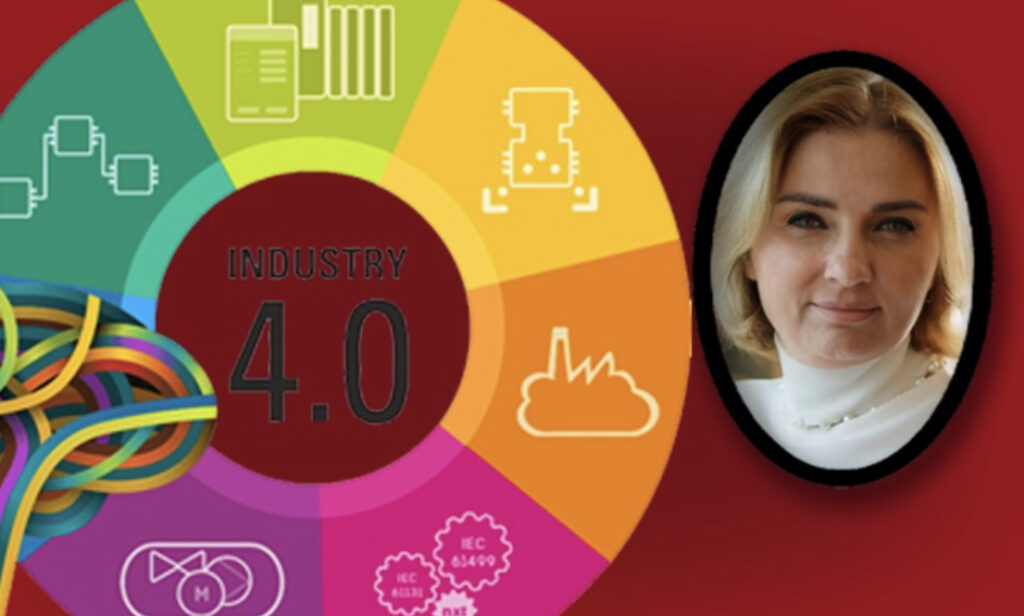
Fortunately, by now we have learned that there is some good in every evil, and bread as well, and at the very least we know what industry 4.0 means too. Now the time has come to set out on a short journey from Industry 1.0 to Industry 4.0.
I would like to share the short notes I took from “The Rise of the Network Society” by Manuel Castells, “The First Great Philosopher of the Virtual Realm”. I can claim that these observations of Manuel Castells hold important knowledge that will make us think, or rather make us put ourselves in order and gather our wits, in our seeing ahead and in our questionings of “what else will happen to us?”
(Manuel Castells has also carried out wide-ranging and detailed research in very different fields such as urban sociology, methodology in the social sciences, the sociology of development, the sociology of social movements and the sociology of information technology.)
So What Happened with the Technology Revolution?
“Radio lost its centrality; films, with the exception of government-supported arts and special-effects shows on wide screens, went through a process of change that would suit television audiences. Newspapers and magazines specialised in deepening their content and in selecting their target audiences. As for television, “The dominant ideology of all discourse on television is entertainment. No matter what is shown or from what point of view it is shown, the overarching presumption is that television exists for entertainment and pleasure.” (N.Postman) As for books; although the unconscious desire behind many books was to become a TV script, they remained books; the bestseller lists, however, were soon overflowing with titles referring to TV characters or to themes popular on TV. “For the first time in history it formed a hypertext and a meta-language integrating the written, oral and audio-visual forms of human communication within the same system.” Manuel Castells
The Industrial Revolution, by constantly altering the balances of political power within societies, between nations and between civilisations, revolutionised the social order and also changed the human being’s way of life and ways of thinking.
In fact, no one is entirely against the industrial revolutions that increase their prosperity. We complain only of the humanity that is lost amid the bad conditions that come along with the industrial revolutions, and of enslavement. Therefore it is now time not to be crushed under change, but to transform this situation together, with humane feelings. In this way our world can become a more liveable planet.
For a more liveable world, we need the guidance of love, hope and peace !
Keywords:Charles Dickens Nurfer Tercan Thomas Gradgrind
Translated from the Turkish original.