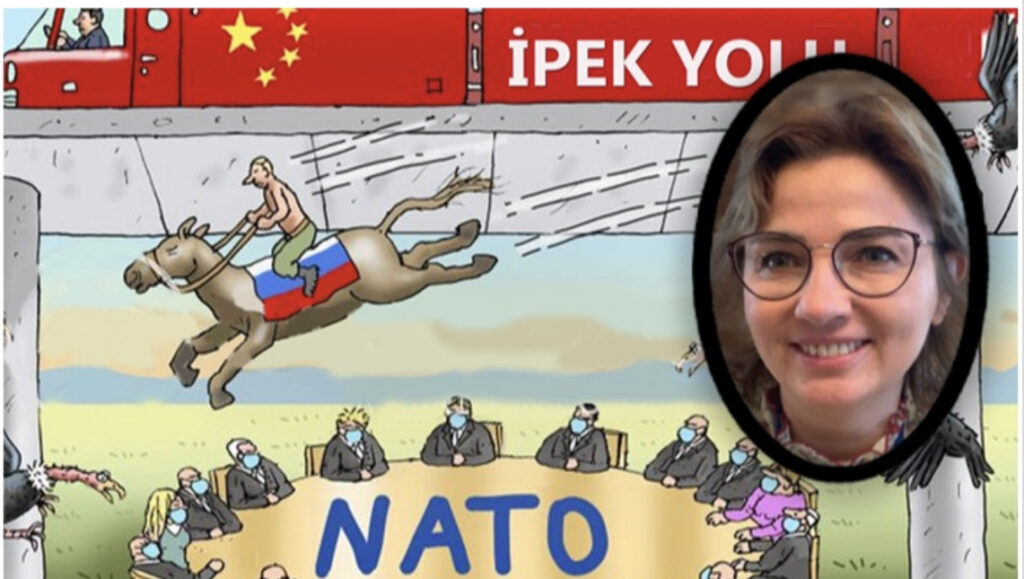
Central Asia is the region containing the five newly independent states (Kazakhstan, Kyrgyzstan, Uzbekistan, Tajikistan and Turkmenistan) that gained their independence as a result of the dissolution of the Soviet Union. This region, landlocked on all four sides and with no direct outlet to the sea, waited patiently, closed to the world, for more than a hundred years. In this process, the part played by the policies of isolation applied by the Tsarist administration in what was then called Turkestan, which came under Russia’s sphere of influence from the 1880s onwards, is foremost among the fundamental matters that have managed to be among the most quickly forgotten. Those boundless ones who know no bounds, who isolated Central Asia from world developments, have since the eighteenth century been masters at making the freest possible use, as opportunities for themselves, of the division and internal quarrels arising in the region, and they can hardly be said to have let go of this mastery even now. These master hands, which recognise no limit in tearing down: in the region where the Russian Tsardom from the north and the British Empire in the south fermented as they spread, after the arrival of Russian rule, transport channels intended to carry raw materials to the centre began to be built, and they succeeded in constructing a Moscow-centred transport infrastructure without clearing away the rubble of what they had demolished.
The British Empire, as the most successful web-knitting hands, has still not ceded the summit to anyone even in the 21st century. And so the aunties of the English Empire, the one and only leader in the art of knitting webs by bending and bending iron: while they were knitting India, knit one purl one, with a railway network, Afghanistan was left, under the agreement on the partition of colonies made with Russia in 1907, as a buffer zone between Central Asia and India. Emir Abdul Rahman, who ruled Afghanistan between 1880 and 1901 and closely followed developments in Turkestan and India, by his order banned the construction of railways in the country until the Afghans reached a level at which they could build them themselves.
In the period when the geographical discoveries had not yet been made and maritime trade was not widespread, the Silk Road, starting from China and stretching across Central Asia to Europe in the west and to India in the south, brought the region both commercial and cultural wealth. On the Silk Road, along which not only goods and wares but also cultures were carried, important cities such as Kashgar, Bukhara, Samarkand and Merv were founded. In Bukhara, where some 200 caravanserais are recorded to have existed in the 19th century, people of many different nations, Chinese, Hindu, Rumi, Persian, Jewish and so on, lived as settled residents together with the Uzbeks. Luminaries such as Mahmud al-Kashgari, Biruni, Ibn Sina, Farabi and Ali Qushji also emerged as the foundations of the thought and science of the civilisation that the Silk Road established in Central Asia.
The dissolution of the Soviet Union in 1991 was regarded as the beginning of a new golden age for the Central Asian Republics. In particular, the rich natural resources possessed by Kazakhstan, Turkmenistan and Uzbekistan were seen as the key to independence and development. However, the infrastructure deficiencies that were noticed before long revealed that the process of building a nation state and a national identity was not as easy as expected. While Türkiye made great progress in transport projects running westward from Central Asia, with projects such as the Baku-Tbilisi-Ceyhan oil pipeline, the Erzurum-Tbilisi-Baku natural gas pipeline and the Kars-Tbilisi-Baku railway line, the EU’s NABUCCO, TRACECA and TACIS projects were also constantly on the agenda. On the new routes connecting Central Asia to the east, meanwhile, the PRC played a pioneering role. The PRC, which resolved the border problems inherited from the Soviet Union with Kazakhstan, Kyrgyzstan and Tajikistan through the Shanghai Five initiative it launched in 1996, also tried to produce a solution to the Uyghur question by integrating East Turkestan economically into the region. The Atasu-Dushanzi oil pipeline carrying Kazakh oil to China began operating in 2006, while the Turkmenistan-Uzbekistan-Kazakhstan-China natural gas pipeline carrying Turkmen natural gas to China came on stream in December 2009. On 23 December 2009 the Kazakh-Chinese free trade zone became operational in the Uyghur Region. The PRC, which with its economic growth accelerating from the nineties onwards began to use the Asian Development Bank more effectively, launched the CAREC (Central Asia Regional Economic Cooperation) programme in 1997 and also carried out transport projects through the Asian Development Bank.
As for the tight turtleneck pattern, knit one purl one, tasselled at the bottom, knitted on size 11-to-9 needles, for the Taliban to come to power: that was the civil war in Afghanistan. This pattern had been chosen with care, because it had to cause the south to be perceived by the Central Asian Republics as a threat and a security problem. The settling of the USA in Afghanistan within the framework of the war on terror it launched after the terrorist incident of 11 September 2001 would profoundly affect the geopolitics of Central Asia. In 2005 the USA launched the Greater Central Asia initiative, with Afghanistan at its Centre; it would also set out in headlines the goal of reviving the deep-rooted ties between Central Asia and South Asia and creating new ties in the fields of trade, transport, democracy, energy and communications.
One of the Silk Road projects now current was the north-south line, with Afghanistan at its Centre and including Pakistan and India, uniting Central Asia with South Asia and carrying it to the Indian Ocean. With this approach, which first brings to mind the Trans-Afghan Natural Gas Pipeline project (TAPI), the modern Silk Road Project, which would bring important gains such as ending the civil war in Afghanistan and reconciling Afghanistan with Pakistan and Pakistan with India, had begun to settle in between the lines. Considered in broad terms, the most important obstacle before the project that would secure regional development and prosperity was the complexity and difficulty of the problems it aimed to solve, that is, the choice of a knit-one-purl-one, tasselled, tight-necked pattern.
Keywords: Kazakhstan Silk Road Central Asia China
Translated from the Turkish original.