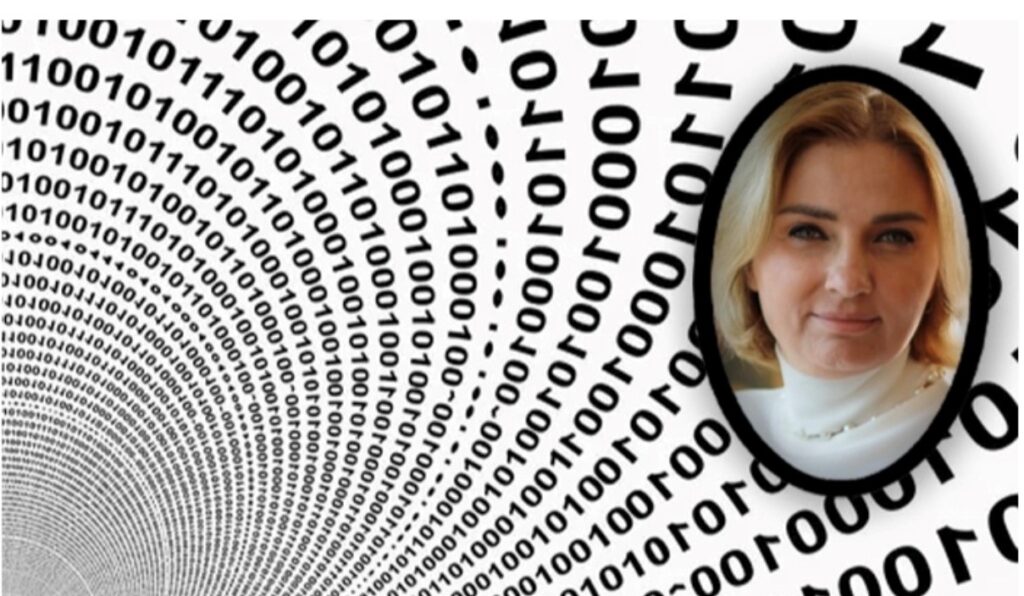
Advancing technology has opened the way ever wider to a more effective and more widespread use of the mass media; it has now reached a state that can no longer be guarded against and recognises no obstacle.
Over the past year we have come to understand very well the media’s success in consolidating its roots through the most powerful anchoring effect, and in hypnotising society. The media, owner of the chaos that sustains the collapse of national culture, the spread of global culture and, consequently, its own negative power over national cultures…
We used to hold that creating differences between groups is an inevitable condition for the existence of social order and for the balanced distribution of media messages. Yet we are almost tempted to be persuaded that societies with uniform ideas and ideologies do exist. Even though the utmost effort is made for the agenda created through the media to be a single one, the reactions to the content of that agenda and the thoughts that take shape will differ from one another and will not turn back from their path of forming the order of disorder.
As information is directed through the media from the centre where it is processed to the receiver, the probability that the content of the message will be emptied out and distorted is very high. For this high probability is a goal specific to the media’s own way of functioning. In other words, it is the most frequently encountered phenomenon. With such a goal, it is impossible to read the media’s messages as they are, without their losing their value.
Claude Shannon, known as the “father of information theory”, set out his findings quite plainly in his day: that the universe’s entropic tendency to disrupt orderliness also holds true in the process of communication. He set them out, and what came of it? This is no time at all to debate how much we, who always fall into the same trap again, have understood; that is an entirely different matter!
Shannon, who joined Bell Laboratories during the years of the Second World War, carried out work on fire-control systems and cryptography. In 1943 he met the British cryptanalyst and mathematician Alan Turing and the Turing Machine. He developed himself alongside important figures such as Alan Turing. His work on cryptography was used, during the years of the Second World War, in the communications between the US president of the time, Roosevelt, and the British prime minister, Churchill. When the power of encoding secret messages in the way Shannon proposed, with an alphabet of only two letters consisting of 0 and 1, was discovered, it was soon realised that this was a truly ground-breaking development. For even if the messages were transmitted over a communication line open to everyone, it could be ensured that the messages carried were understood only between sender and receiver. And this, by preventing third parties listening in on the communication line from reaching the content of the message, meant being able to convey top-secret messages by very simple methods.
While the foundations of the “Network society” were being laid at the dawn of the communication age, Shannon speeded up his work on the methods that needed to be developed in cryptography. He searched for ways in which communication could work correctly not only under conditions of secrecy but also under undesirable conditions affecting the communication channel. The idea of the message being delivered to the receiver correctly and securely, with the fewest errors, even over a noisy and error-prone communication channel, preoccupied Shannon a great deal. In his paper Shannon also gave a mathematical exposition of information and expressed its basic unit as the “bit”. Bits, just as in Boolean algebra, were represented only as 0 or 1, and it was argued that every kind of information (letters, numbers, images and so on) could be expressed in this representation.
This paper, which can be considered revolutionary for more than one reason, is the touchstone of today’s communication systems. This great leap at the foundation of the communication systems used in almost every field, from our everyday life, such as the calls you make on your mobile phone, your wireless internet connection and radio communication, to space research, belongs to none other than Shannon, who was able to foresee interpreting information and the basic dynamics of communication mathematically.
We had mentioned on this platform before that the unforgettable first slogan of the Network society, which evolved with the communication age and the mobile phone, was the foundation of the “Information Age”. You remember “Connecting People”, don’t you? The reason this slogan has not let itself be forgotten: together with the Nokia 3310 and similar models, we had grown very fond of the sound that came from inside them. Nokia endeared itself to us, and even connected us to one another, through the Morse code contained in the timeline of the ringing sounds we heard every time we were called or heard around us.
This tone is the one named “Ascending”, which sounds like a standard message tone and seems like a meaningless stretch of sound. In fact it is a sequence of words voiced in Morse code. That famous slogan, which we know as Nokia’s slogan, which connects us to one another, which means “Connecting people”, and which weaves the information society into webs of chaos!
In this process, furnished with unbalanced conditions, we must not forget that entropy will not diminish order, organisation and therefore life, but on the contrary will produce them. I think we have now understood how inadequate the traditional thermodynamic views are. While certain systems collapse, others are at the same time evolving and developing in a more harmonious way. Order emerges not in spite of entropy but, on the contrary, because of entropy.
Evolutionary systems are open and non-linear. There are always those who have the ability to analyse and evaluate new information and to work through the movement of information from a dialectical standpoint as well. We are faced with the uncertainty of 2021 at the many internal connection points of the social world (such as people, politics and commerce). We stand on a fine line between uncertainty, chaos and order; it is exactly the time to think!
Keywords: Shannon USA Information Age
Translated from the Turkish original.