and Order: The Human Being in Between
By Dr. Nurfer TERCAN
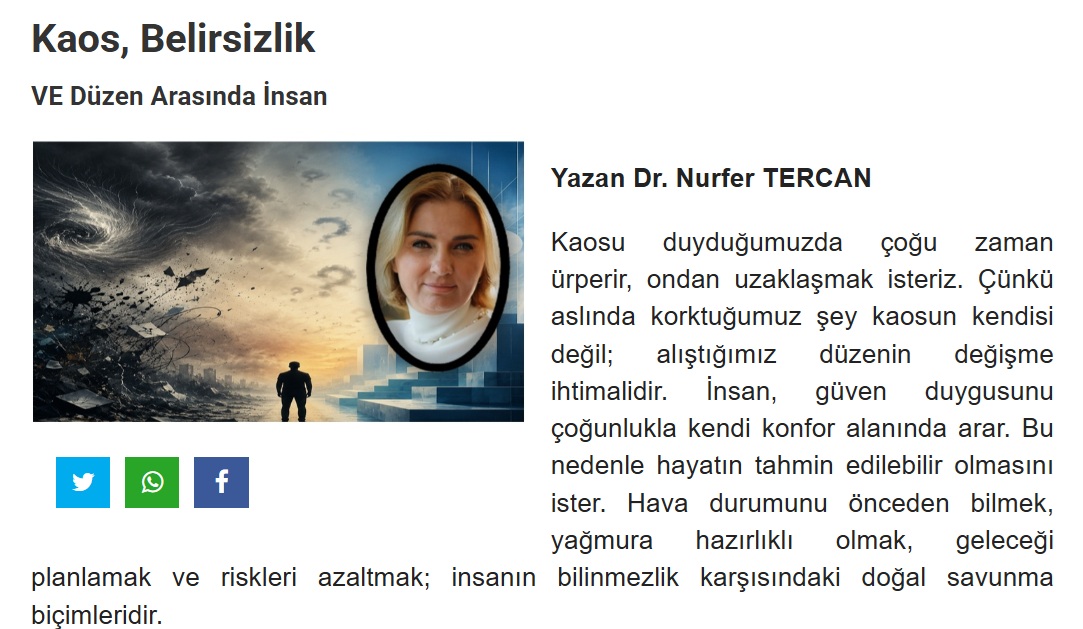
When we hear of chaos, we most often shudder and want to move away from it. Because what we actually fear is not chaos itself, but the possibility that the order we are used to will change. The human being mostly seeks the feeling of security within his own comfort zone. For this reason he wants life to be predictable. Knowing the weather in advance, being prepared for rain, planning the future and reducing risks are the human being’s natural forms of defence in the face of the unknown.
As Aristotle says at the opening of his Metaphysics: “All men by nature desire to know.”
Because the human being does not want merely to live; he also wants to know the reason, the meaning and the direction of the life he lives. The desire to know is an existential need of the human being.
Philosophy has most often been regarded as a body of questions whose answers are not certain. However, many problems belonging especially to the philosophy of knowledge have, thanks to modern science, become explicable in different ways. Kant’s distinction between analytic and synthetic judgements is also important at this point. According to Kant, analytic judgements bring to light knowledge that is already contained in the subject, whereas synthetic judgements add something new to knowledge. For this reason thought does not merely analyse what exists; it also tries to construct the unknown.
Scientific discoveries, too, have most often emerged through theoretical thought before direct observation. One of the most striking examples of this is the discovery of Neptune. Le Verrier and Galle, starting from the irregularities in the orbit of Uranus, mathematically calculated the existence of another, unseen planet, and then confirmed this prediction with telescope observations. This approach became one of the important developments that strengthened Pierre-Simon Laplace’s conception of determinism.
In the 19th century, determinism became one of the most powerful paradigms of Western thought. The universe was conceived as a mechanical, measurable and entirely predictable system. This understanding influenced not only the natural sciences, but also politics, society and models of governance. Humanity began to believe in the idea of an order in which everything could be calculated.
The Congress of Vienna, held after the Napoleonic Wars with the aim of re-establishing the political order of Europe, is also a product of this intellectual climate. Metternich, who presided over the congress, aimed to establish a balanced and controllable political structure in Europe. Indeed, according to some sources, Metternich carried Laplace’s works with him on his way to the congress. Because the fundamental belief of the period was this: if order is preserved, the future can be kept under control.
However, as the modern age advanced, humanity began to face another truth: life was not entirely predictable.
Chaos Theory, systematically expressed in 1975 by James Yorke and Tien-Yien Li, revealed that the universe does not operate within an entirely mechanical order. It was understood that small changes could give rise to great consequences. It was no longer possible to explain the world by exact calculations alone.
Edward Lorenz’s work on weather forecasting in 1961 is one of the most striking examples of this transformation. Lorenz noticed that even a small rounding error in a number changed the outcome of the whole system. Later this came to be described as the “butterfly effect”:
“The flap of a butterfly’s wings in China may cause a storm in America.”
This approach created a new field of thought for understanding not only physical systems but also social events. Because societies, just like nature, are complex, dynamic and unpredictable structures.
In explaining systems whose behaviour appears uncertain, two basic approaches generally emerge:
The first accepts that uncertainty is inherent in the nature of the system. The second argues that the system is in fact deterministic, but appears uncertain to us because of the inadequacy of human knowledge.
According to the deterministic understanding of systems, as knowledge increases, foresight should increase as well. But Chaos Theory shook this idea to its roots. Because some systems, even if they operate entirely through causal relationships, could display behaviour that cannot be predicted with certainty in the long term.
From the 1970s onwards, studies conducted especially on “deterministic chaos” brought the concept of “stable chaotic regimes” to the fore. This showed that systems move not entirely at random, but with a complex equilibrium within certain limits. In other words, chaos did not always mean destruction. Sometimes it could also be the source of development, transformation and adaptation.
Uncertainty, for its part, is mostly perceived in the human mind as a negative concept. Because the human being wants clarity in order to be able to act. Situations whose outcomes we cannot foresee create indecision, unease and a loss of trust. For this reason uncertainty threatens the human being’s comfort zone.
But life itself is founded not on an absolute order, but on the delicate balance between order and chaos. An entirely predictable world would lose its capacity for change and adaptation. Such a life would be the world not of vitality but of mechanical repetition.
Societies work in a similar way. Sometimes increasing social complexity gives birth to new regulatory mechanisms. Crises, wars, economic ruptures and global transformations force humanity to produce new solutions. Chaos, though at times destructive, at the same time prepares the ground for renewal.
The pandemic period we lived through in the recent past became one of the most concrete examples of this. The global epidemic, economic crises, energy wars, climate change, regional conflicts and political uncertainties showed once again how fragile a system humanity lives in. The world was suddenly swept into the centre of unpredictability.
Today we are still asking the same questions:
“What has happened to us?”
“What more will happen to us?”
Perhaps the real issue of humanity begins exactly here. Because the human being is not only a being that seeks order; he is at the same time a being that tries to produce meaning out of chaos.
Notes from the Blue of the Windy City
https://www.5gvirusnews.com/yazarlar/kaos-belirsizlik-h1888.html
Translated from the Turkish original.