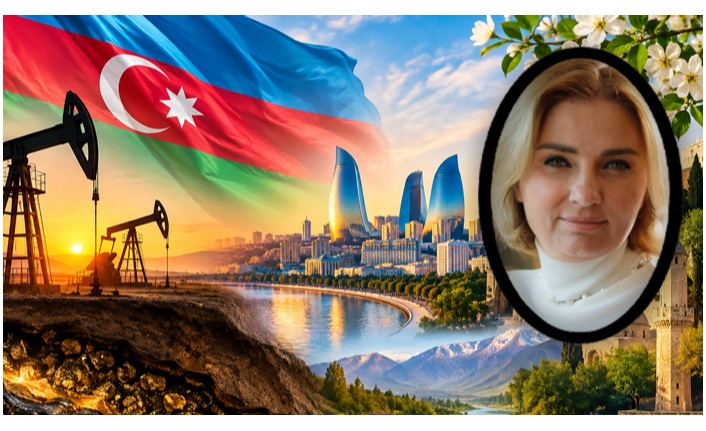
From Wealth to Civilisation
By Dr. Nurfer Tercan
How rich, really, is a country that holds wealth beneath its soil and anxiety about the future above it?
This is not Azerbaijan’s question alone. It is a question that tests every claim made by the development thinking of our age. Measuring wealth is easy: barrel prices, reserve tables and growth rates report it to us anew every quarter. What is hard is measuring what wealth becomes in the life of a society. Riches usually arrive as an opportunity. Their transformation into civilisation, however, can only be the work of labour, of awareness and of patience.
On the shores of the Caspian, on the Absheron peninsula where the earth bursts into flame of its own accord, people have for centuries gazed into fire and reflected. The undying flame of Yanar Dag and the stone walls of the Ateshgah remind us that this land’s relationship with energy is far older than the age of oil. The name “Land of Fire” is not a metaphor but a memory. Yet the history of fire teaches us one more thing: flame warms, illuminates and transforms. But held the wrong way, it also burns.
Today Azerbaijan stands between these two faces of fire. The towers rising along Baku’s waterfront, the energy corridors and the international investments form the visible face of modernisation. But every transformation also has an invisible face: plans postponed inside homes, young people staring for a long time at the announcement of a university abroad, parents in the village waiting for children who have moved to the city, changing expectations and lives being quietly rewritten.
A country’s true story is often hidden between the lines of its statistics. Development is not merely the rise of figures. It is the deepening of people’s trust in life.
The Wealth Below Ground, the Question Above It
Azerbaijan’s modern economic history has been written largely through oil and natural gas. These resources gave the country strategic weight, financial accumulation and the means to renew its infrastructure. On the road stretching from the first fragile years of independence to the present day, energy has been both the backbone of the state and its gateway to the world.
Natural resource wealth, however, carries a paradox of its own. Riches that come easily from beneath the ground tend to postpone the value that must be laboriously produced above it. What economists call the “resource curse” is in fact not a curse but a temptation: the quiet erosion, by easy income, of the will to do what is hard. The appreciation of the national currency in years of high oil prices, the loss of competitiveness in agriculture and manufacturing, and the drift of talent from productive fields to rent-seeking ones are the familiar forms of this temptation.
The International Monetary Fund’s 2026 assessment shows that Azerbaijan’s economic growth of 4.2 percent in 2024 fell back to 1.4 percent in 2025, and that momentum also slowed in the non-oil sectors. On the other hand, the country possesses strong financial reserves accumulated from energy revenues.
When we place these two facts side by side, the picture that emerges is not one of deprivation but one of choice. Azerbaijan’s test concerns not the lack of means but the possession of them. The real question is how the accumulated capital will be translated into the future: into scientific research, into agricultural productivity, into value-added industry, or merely into preserving today’s stability?
The value of oil is set by the market. The limits of the value people produce, by contrast, are set by their knowledge, their imagination and the institutions they are able to build. The one is dictated from outside; the other is built from within. This is why a country’s greatest achievement is to discover the potential of its people above ground before the resources below ground run out.
Underground wealth has an expiry date. Human intelligence does not.
Demography: A Nation’s Letter to Time
Every society, without realising it, writes a letter to the future. The ink of this letter is births, marriages, migrations and ageing. Demography is the most honest record of a nation’s confidence in its own future. For people may say one thing in surveys and another in their life decisions. But decisions to have children, to stay or to leave do not lie.
Azerbaijan’s population of more than 10 million points to one of the most dynamic societies in its region. Yet the decline in fertility, a slow but steady ageing trend and the flow of population towards the big cities remind us that this potential will not endure of its own accord. A demographic advantage is like a window: it stays open for a limited time, and what is done during that time determines how the day the window closes will unfold.
A young person’s future is a possibility to the extent that he or she believes the education received has some value in his or her own country. When the bond between knowledge and opportunity, labour and reward, talent and recognition weakens, the future gradually turns into a hope sought in other lands.
Here, however, a fine distinction must be made. Not every migration is a loss. A mind that travels the world brings knowledge, experience and networks back to its country when it returns or when it maintains its ties at home. The real issue is not whether people can leave, but whether they can find ground on which to stay when they wish to stay. To leave freely is a right. To be forced to leave is a wound.
For this reason, Azerbaijan’s demographic future does not depend on population policies alone. It depends on the quality of education, the dignity of employment, access to housing, the opportunities women find in working life and the security of the elderly. The fertility rate is, in the end, an index of trust.
More troubling than a society growing old is the hopes of its young growing old before they do.
The Invisible Architecture: Institutional Trust
Every economic transformation, sooner or later, comes up against the question of the quality of institutions. Azerbaijan’s post-independence journey was shaped by state-building and the pursuit of sovereignty, security and stability. One must understand the priorities of a state founded in the shadow of wars, uncertainties and entrapment between great powers. In this region, stability has been experienced not as a luxury but as a matter of existence.
Yet the institutional structure required by an energy-centred development model is not the same as that required by a diversified, innovative economy. An oil field can be managed through a few large contracts and a strong centre. But an economy made up of thousands of start-ups, research laboratories and creative enterprises needs a different soil. The entrepreneur wants legal predictability. The university wants freedom of thought and a high-quality research environment. The investor expects transparent rules, and the young person expects merit-based opportunities.
Here the concept of asabiyya that Ibn Khaldun developed in the Muqaddimah acquires fresh meaning. What keeps societies standing is not economic resources alone. It is people’s belief that they can live together within a common order, and that this order belongs to them as well. According to Ibn Khaldun, states begin to dissolve not when this bond weakens, but when the weakening of this bond goes unnoticed.
When the institutional strength of the state and the creative capacity of society complement each other, development becomes resilient. When opportunities accumulate in narrow circles and the perception of merit erodes, however, even the soundest economic indicators cannot cover the crack in social trust. These risks are not unique to Azerbaijan. All rapidly modernising societies face the same structural test. The difference lies not in the existence of the test but in the way it is confronted.
Economic capital can be exhausted and regained. Social trust, however, once damaged, may take a generation’s lifetime to rebuild.
The Light of Baku, the Silence of the Provinces
Modern cities are the most visible symbols of development. But the height of skyscrapers is not the same thing as the depth of social welfare. A country’s shop window is one thing; its living room is another.
The weight Baku has gained in trade, finance, culture and services is an indisputable advantage for Azerbaijan. Yet the concentration of opportunities in the capital carries the risk of turning into a silent waiting in the rest of the country. The brighter the centre shines, the darker the periphery’s shadow may grow.
Every region of Azerbaijan, however, possesses an accumulated heritage that could speak in its own voice. Ganja, as the city of Nizami, could become a centre of science and thought. Shaki, with its caravanserais and its memory of silk, could become a home for cultural production and craftsmanship. Lankaran, with its tea, its citrus and its fertile soil, could become a model of agricultural innovation. And Nakhchivan could become a gateway of trade and connectivity. This diversity is not only an economic strategy but also a guarantee of social cohesion. A person who sees no future in his or her own region looks first to the capital, and then beyond the borders.
The reconstruction of Karabakh must also be considered within this framework. Building roads, housing and infrastructure is a great undertaking. But for a place to become a homeland again is a longer and subtler process than the pouring of concrete. An order of life in which people can live safely, take part in production, raise their children and weave the bonds of neighbourliness anew is the true complement of physical development.
A city’s architecture can be built with stone, steel and concrete. But a city’s soul is formed by the presence of people who wish to go on living there.
Geography Is an Opportunity, History a Trust
Azerbaijan stands at a threshold where the roads running between Europe and Central Asia, between Türkiye and the Caspian basin, intersect. The development of the Middle Corridor, investments in railways and ports, and the expansion of energy and digital links are giving this ancient land a new economic meaning.
But geography is not destiny. Geography is only an opportunity. Not every country crossed by trade routes has grown rich. Some countries have remained mere transit points, while others have turned the roads passing through them into centres of production and knowledge. The difference lies in the investment a country makes in its own human resources, technological competence and productive capacity.
For Azerbaijan, the issue is not merely to be a corridor through which goods pass, but to be a station where knowledge, production and innovation take root. The difference between being the place where caravans rest and being the place that gives caravans their cargo has, in every period of history, marked the difference between wealth and civilisation.
The realisation of this potential also depends on regional peace and cooperation. The permanence of economic corridors rests not only on rails and ports but on predictable relations between countries. Without trust, a road is merely a line. Throughout history, trade routes enriched cities. But what made civilisations flourish was the encounter of the ideas, cultures and people carried along those routes. The true cargo of the Silk Road was not silk but the stories humanity told one another.
Not the Economy of Culture, but the Culture of the Economy
In reflecting on Azerbaijan’s future, the deepest element that must not be overlooked is its cultural memory.
The profound wisdom of Nizami Ganjavi, who saw the human being as the subject of a moral journey; the poetic language of Fuzuli, which turns even pain into grace; the aesthetic universe of mugham, moving between serenity and rapture; the symbols woven into the knots of carpets; and the memory of ancient cities inscribed in stone… These are values that belong not only to Azerbaijan’s past but also to its future.
Perhaps the deepest voice of this heritage is mugham. The word comes from the Arabic “maqam”: a place, a stance, a dwelling. Before it is a melody, mugham is a space; an inner country in which the soul dwells and the voice searches for itself. While Western music passes the world of sound through the two gates of major and minor, mugham transforms it into a chain of stations stretching from Rast to Shur, from Segah to Chahargah. Each maqam is another climate, another state, another human condition.
The khanende, between the frame drum in his hands, the tar and the kamancha, does not merely sing; he makes the ghazals of Nizami, Fuzuli, Nasimi and Vahid breathe again. There the poem is not recited; it is reborn within the voice. This is why mugham is one of the rare thresholds where written culture and oral memory meet. A nation keeps its books not only on shelves but also in its voices. This is why Shusha is called “the conservatory of the Caucasus”, and the reconstruction of Karabakh is, in this sense, the return of a voice to its own home.
On the Golden Record carried by the Voyager probes launched in 1977, among the sounds chosen to introduce humanity to unknown interlocutors, is an Azerbaijani mugham played on the balaban. A melody born on the shores of the Caspian has today passed beyond the edge of the solar system and travels through interstellar space. This art, inscribed by UNESCO on the list of the Intangible Cultural Heritage of Humanity, is the quietest and most enduring treasure Azerbaijan has given to the world.
Yet the relationship between culture and development cannot consist in reducing culture to a tourism product or an export item. To see culture only as an economic resource would be to turn it into yet another oil field: something extracted, packaged and exhausted.
The true power of culture lies elsewhere. Culture determines what a society regards as valuable, how it defines success, how it views labour and what it wishes to entrust to future generations. That is why the real issue is not the economy of culture but the culture of the economy: on what morality, what values and what vision of the human being we build an economy.
Oil may one day run out. But a nation’s voice, once entrusted to humanity’s memory, does not.
If in a society respect for knowledge is growing, productive labour is esteemed, merit is strengthening and a sense of responsibility between generations is deepening, then development there is taking place not only at the economic level but at the level of civilisation.
Here al-Farabi’s al-Madina al-Fadila, The Virtuous City, takes on a contemporary meaning. The virtuous city is not a place where rich people live. It is a social horizon in which people live within an order that makes the common good possible, contributing to one another’s maturation. For al-Farabi, a city’s worth is determined not by its wealth but by the quality of the happiness it brings to its inhabitants.
To put it in today’s language, the issue is not merely higher income. It is better education, fairer opportunities, stronger institutions and a more meaningful common life.
What Does a Country Leave to Its Children?
Azerbaijan has before it opportunities that cannot be underestimated: financial strength accumulated from energy revenues, a strategic location, developing connections, a deep-rooted cultural heritage and young human resources. At the same time, dependence on a single resource, demographic transformation, regional inequalities, productivity problems and the need for institutional reform make up the difficult stretches of the road.
A mature outlook requires the ability to see both together: not denying the problems while seeing the opportunities, and not belittling a nation’s historical heritage and capacity for rebirth while discussing the problems. Countries mature not only through their successes but also through the courage to face their problems.
If Azerbaijan can transform the opportunities provided by energy into the knowledge, production and welfare capacity of future generations, it will have crossed a historic threshold. Otherwise wealth may remain a precondition for development, but it can never be its guarantee.
And here a deeper question emerges, one that transcends all debates on development:
What should a country leave to its children?
More buildings? Larger reserves? Longer roads, more spectacular cities?
All of these have value. But there is a legacy more precious than all of them: a society in which people can rise through knowledge, find a return for their labour, live together with their differences and dream without fear of their future.
The oil of the Caspian enriched one era of Azerbaijan. Now history is asking this ancient land of fire a greater question: Will this wealth be able to turn into an accumulation of humanity, knowledge and civilisation for future generations?
Oil can give a country power. What will turn that power into an enduring civilisation, however, is the respect it shows its people, the value it places on knowledge and the responsibility it bears towards the future.
The flame rising from the soil of Absheron has been burning for thousands of years. But the fire that will truly illuminate a country rises not from beneath the soil, but from within the human being.
True development is the story not of how rich a country has become, but of how much its people have come to be valued.
Notes from the Blue of the Windy City