In the beginning was the Silk Road!
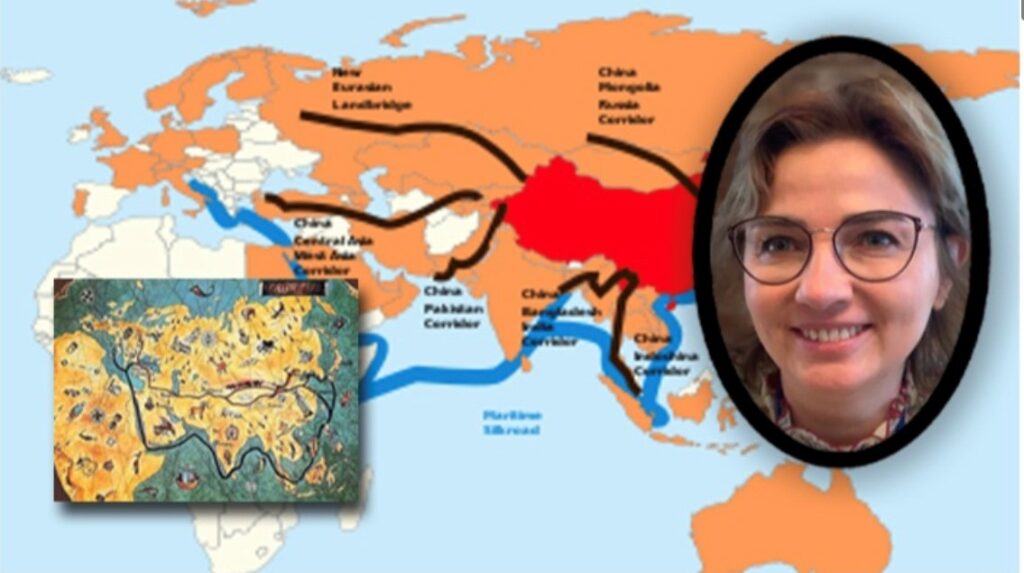
Following the dissolution of the Soviet Union, the newly independent countries of Kazakhstan, Kyrgyzstan and Tajikistan found talks with China on their agenda in the early 1990s, with the aim of resolving the long-standing problems over the demarcation of the border between the People’s Republic of China and the Soviet Union and of defining the borders that had emerged under the new political situation. To put an end to these problems, a process of negotiations and confidence-building measures was launched among the states concerned within a multilateral framework. Since the Central Asian countries and China were aware of the role and influence of the Russian Federation in the region, Moscow too was invited to these negotiations.
“China, regarding the Central Asian Republics on the matter of border disputes: – The five nations should deepen cooperation on national and regional security and stability; – Bilateral and multilateral cooperation should be developed in economic and trade matters; – Coordination among the five countries in the international arena should be strengthened; – Within the framework of the Shanghai Five, a consultation mechanism should be developed at various levels and in different fields for specific projects.”
With Uzbekistan joining the Shanghai Five, the founding declaration of the Shanghai Cooperation Organization (SCO) was signed in 2001. The aims of the SCO were defined as: – Strengthening mutual trust and good-neighbourliness among member countries; – Promoting effective cooperation among neighbouring countries in political, economic and trade, scientific and technological, cultural, educational, energy, communications, environmental and other fields; – Jointly safeguarding regional peace, security and stability; – Establishing a democratic, just and rational international political and economic order.
The SCO Charter was signed at the meeting of heads of state held in St. Petersburg in 2002, and with its entry into force on 19 September 2003 the Word was handed to its rightful owner, that is, once again to the Spice and Silk Road. And the essence of this word is the gas pipelines laid beneath the consonants.
At the historic meeting held by the Council of Heads of State and Government in Astana on 8-9 June 2017, India and Pakistan were granted full membership status. With India and Pakistan, the SCO became an international organisation covering approximately 23% of the world’s land mass, 45% of the world’s population and 25% of global gross product. The SCO’s observer countries are Afghanistan, Belarus, Iran and Mongolia. The countries that are dialogue partners are Azerbaijan, Armenia, Cambodia, Nepal, Sri Lanka and Türkiye.
The Regional Anti-Terrorist Structure, RATS, created on 15 June 2001 on the basis of issues such as terrorism, extremism and separatism, which the SCO defines as the region’s “three evil forces”, has been stationed in Bishkek, Kyrgyzstan. RATS carries out its activities in accordance with the principles of the SCO Charter and the Shanghai Convention on Combating Terrorism, Separatism and Extremism. RATS consists of two bodies. The first is a council made up of the ministers responsible for counter-terrorism efforts in the member countries concerned, which meets regularly to determine the general course and agenda of activities. The second is a permanent executive committee responsible for implementing the agenda set by the Council. The Committee is located in Tashkent, the capital of Uzbekistan.
The struggle against the threat that is active in the region and is called the “three evil forces” has, since its foundation, formed the mainstay of cooperation within the SCO. The SCO is an international organisation whose members include all the countries that will have an influence on, a contribution to and an interest in the revival of the Silk Road along the north-south line. In the SCO, where the People’s Republic of China and Russia come to the fore, Kazakhstan, Kyrgyzstan, Tajikistan and Uzbekistan are founding members, while Pakistan, India and Iran are observer members. Afghanistan, for its part, although neither a member nor an observer of the SCO, has been invited as a guest to all the summits in accordance with a tradition that has continued since 2005. At the 10th summit of the SCO, held on 15 June 2011 in Astana, the capital of Kazakhstan, President Karzai of Afghanistan had announced his wish to join the organisation as an observer.
For the SCO, which aims at a joint struggle against terrorism, separatism and extremism, which it describes as the three evils, and which has created structures such as the Regional Anti-Terrorism Centre, the stability of Afghanistan was also one of its permanent agenda items. The fact that all SCO members except Russia and India are neighbours of Afghanistan directly linked the stability of Afghanistan with the security of the member countries. At the Tenth Summit held in Astana, too, Afghanistan was foremost among the issues that came to the fore. President Karimov of Uzbekistan stated that they would see Afghanistan in the future as a country developing in a stable manner and posing no threat to surrounding countries.
The organisation’s admission of Iran as an observer member at the Astana summit, and the demand made at that summit that the USA vacate the Khanabad Base in Uzbekistan, further reinforced the anti-American character of the SCO. There are also not a few who say that the SCO, which may be described as a partnership initiative of Russia and the People’s Republic of China against the USA’s attempts to establish dominance in Central Asia, is an anti-Türkiye union that blocks Türkiye’s entry into Central Asia.
After the USA and the coalition forces began to withdraw from Afghanistan, the role and importance of the SCO for Afghanistan grew even further. The Russian expert Yuliya Kudryashova says that there can be no moderate Taliban and that no compromise can be reached with the Taliban, and puts forward her proposal that the SCO take on a role in ensuring security in Afghanistan under the UN umbrella. Kudryashova’s proposal was also in line with the cooperation between the UN and the SCO that had been increasing since 2009. On the other hand, it seems difficult for the SCO, whose annual budget is 4 million dollars, to assume a role beyond providing a common platform for the Afghanistan problem to be discussed by all parties.
The most important project that will make Afghanistan a transit country and a trade hub is the Trans-Afghan Pipeline Project, TAPI (Turkmenistan, Afghanistan, Pakistan and India), which aims to carry Turkmenistan’s natural gas to the Indian Ocean. At first glance, the TAPI project was seen as one of the projects for delivering the energy resources of the Caspian basin to world markets. Yet this project ought to have been called the Modern Silk Road Project, one that would produce many important results such as ensuring stability in Afghanistan, laying the foundations of friendly relations between Pakistan and India, and uniting Central Asia with South Asia.
The project first came onto the agenda in 1991, and the Asian Development Bank had begun to finance the project’s feasibility studies. Within the scope of this project, the most striking item was the signing in 1995 of the agreement on natural gas between Turkmenistan and Pakistan. After the Taliban seized control of 80% of Afghanistan from 1996 onwards, Turkmenistan, in the hope of being able to bring the project to life, appeared to have succeeded in maintaining close relations with the Taliban regime. The construction of a pipeline through the areas of Afghanistan controlled by the Taliban was envisaged, but the project could not be realised in this period. After the Taliban regime was removed from power in Afghanistan as a result of the military intervention of the coalition forces led by the USA, Turkmenistan, Afghanistan and Pakistan agreed in 2002 to sign yet another new agreement on the TAPI project. However, India’s participation was also deemed necessary for the project to become profitable. In 2003 India was invited to be included in the project.
According to the feasibility report prepared by the Asian Development Bank, the cost of the pipeline, 735 kilometres of which will pass through Afghanistan and 800 kilometres through Pakistan, with a total length of approximately 2,000 kilometres, is calculated at 7.6 billion dollars. It is planned to carry 33 billion cubic metres of natural gas a year through this line. Turkmenistan currently extracts 70 billion cubic metres of natural gas a year and sells 10 billion cubic metres of this to Russia and 12 billion cubic metres to the People’s Republic of China and Iran. Iran ranks second after Russia among the countries importing natural gas from Turkmenistan. Turkmenistan, which ranks fourth in the world in terms of natural gas reserves, had aimed to raise its natural gas production to 230 billion cubic metres in 2020. In this case, with the TAPI project, the South Asian market and, via the Indian Ocean, the European market are important for Turkmenistan.
Keywords: China Silk Road Russia
Translated from the Turkish original.