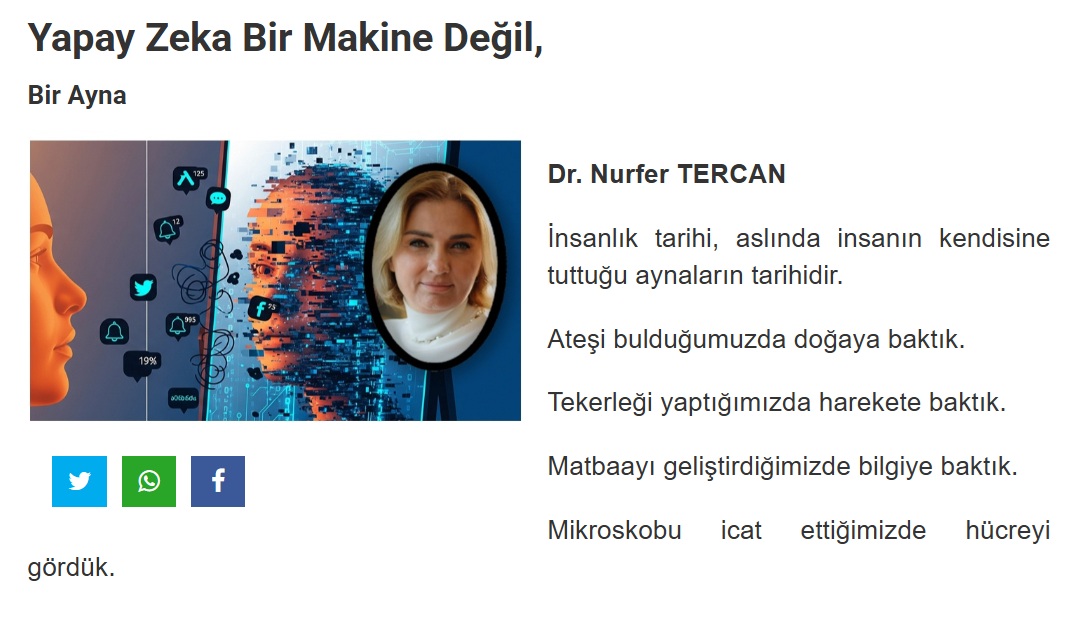
A Mirror
Dr. Nurfer TERCAN
The history of humanity is, in truth, the history of the mirrors that human beings have held up to themselves.
When we discovered fire, we looked at nature.
When we made the wheel, we looked at motion.
When we developed the printing press, we looked at knowledge.
When we invented the microscope, we saw the cell.
When we turned the telescope to the sky, we discovered the universe.
And now, for the first time, we are looking at our own mind.
This is exactly why artificial intelligence is not merely a new technology.
It is the human intellect beginning to think about itself.
Perhaps for the first time in history, the human being is asking the question “How do I think?” anew, thanks to a machine.
For this reason the debates on artificial intelligence have long ceased to be a technical matter.
The issue is no longer algorithms alone.
The issue is consciousness.
The issue is will.
The issue is meaning.
The issue is being human.
For centuries philosophers circled around the same questions.
Plato asked what truth is.
Aristotle investigated the limits of reason.
Al-Farabi reflected on the principles upon which the virtuous society would rise.
Ibn Sina described the way in which knowledge turns into wisdom.
Kant pointed to the human being’s courageous use of his own reason, and Heidegger to the fact that technology is not merely a tool but changes the relationship the human being establishes with the world.
Today all of their questions confront us once again.
But this time the interlocutor before us is not a human being.
It is an algorithm.
Perhaps our greatest mistake is to keep asking artificial intelligence this question:
“How intelligent can it become?”
Yet the real question is this:
“How well does the human being know his own intelligence?”
Because as artificial intelligence advances, we learn more not about the machine, but about the human being.
It does not surprise us when an algorithm makes a mistake.
But it disturbs us to see that our own prejudices have been carried into the algorithms.
What matters is not that a model makes a wrong decision, but which values we have loaded into that model.
This is exactly where ethics begins.
For many years education systems aimed at transmitting knowledge.
Then they aimed at developing skills.
And now we are moving into a third stage.
From now on the fundamental task of education will not be merely to give knowledge or impart skills.
It will be to protect human judgement.
Because as the cost of accessing information approaches zero, the value of being able to make the right decision increases exponentially.
Perhaps the most important subject of the future will be not mathematics or software, but judgement.
Because without judgement, knowledge is not power.
Without judgement, technology is not progress.
Without judgement, freedom too cannot stay standing for long.
A hundred years from now, how shall we describe today to our children?
By saying, “We built great computers”?
Or…
By saying, “We began to think again about what it means to be human”?
The second sentence seems more accurate.
Because the real revolution of the age of artificial intelligence lies not in the machines, but in the human being becoming acquainted with himself again.
Perhaps the beginning of the new Renaissance will be not the day the first supercomputer is produced, but the day a teacher asks the pupils in a classroom this question:
“Is it more important to know, or to know what knowledge is to be used for?”
On that day the difference between technology and civilisation will be understood.
And perhaps humanity will, thanks to artificial intelligence, rediscover itself for the first time.
Because what will determine the future will be not the countries that own the largest data centres, but the societies that can go on asking the deepest questions.
Civilisation is not merely producing new tools.
Civilisation is being able to build the reason and the conscience that will ensure every tool produced is used for a purpose that strengthens human dignity, justice and the common good.
Perhaps the greatest invention of the age of artificial intelligence will not be a new machine.
The greatest invention will be the human being understanding himself once again.
Now is exactly the time to think!
Notes from the Blue of the Windy City
https://www.5gvirusnews.com/yazarlar/yapay-zeka-bir-makine-degil-h1910.html
Translated from the Turkish original.