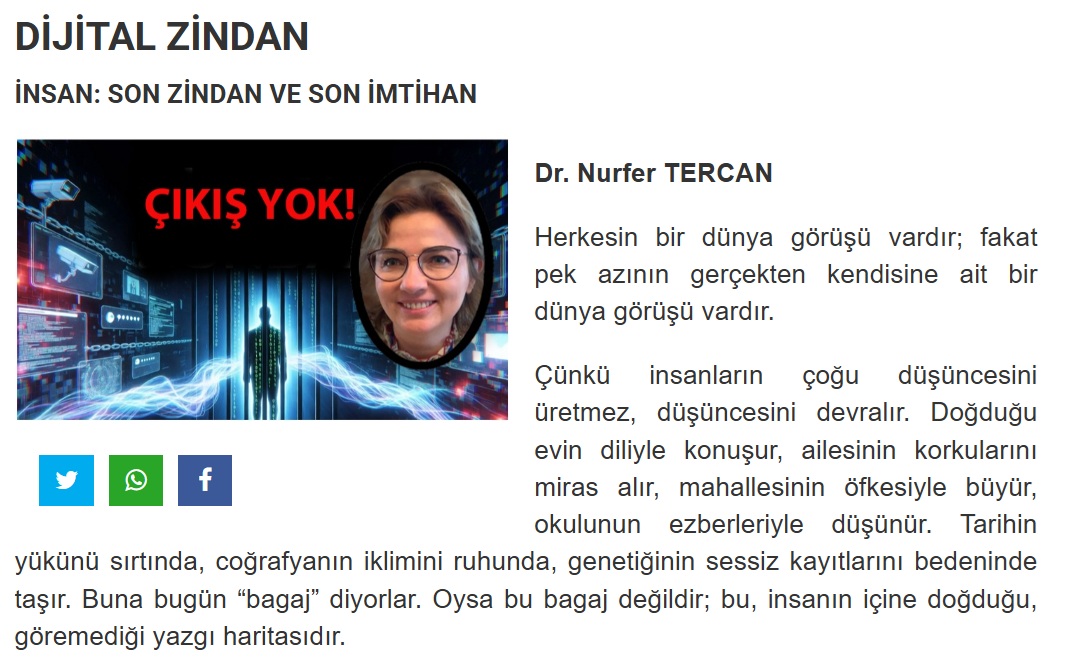
THE HUMAN BEING: THE LAST DUNGEON AND THE LAST TRIAL
Dr. Nurfer TERCAN
Everyone has a worldview; but very few have a worldview that is truly their own.
Because most people do not produce their thought; they inherit it. They speak in the language of the house they were born into, inherit their family’s fears, grow up with the anger of their neighbourhood, think with the rote learning of their school. They carry the burden of history on their backs, the climate of geography in their souls, the silent records of their genetics in their bodies. Today they call this “baggage”. But it is not baggage; it is the map of destiny, unseen, into which a person is born.
The real question begins right here.
Who, really, is the human being?
Let us ask more sharply: is the human being himself, or the sum of all the determinations loaded onto him? Perhaps this is philosophy’s oldest and most unanswered question.
Every human being is a model of the society he lives in, made small enough to fit in the palm of a hand. If society is a giant mirror, the human being is its reduced reflection.
Read a single individual carefully; you will find an entire civilisation within. In his words you read his history, in his anger his politics, in his fears his family, in his desires his economy, and in his silence his age.
Because the “I” does not belong to me alone. I am the common sentence of my family, my society, my history, my geography and my biology.
But precisely for this reason a burning question arises: if I am merely the sum of these, where is freedom?
For centuries Aristotle’s famous definition has been repeated: “Man is the animal that can think.”
No. This definition no longer explains the human being.
Because today there are machines that think. There are algorithms that process data, artificial intelligences that can reason. If we define the human being only as “the being that can think (that has the faculty)”, tomorrow’s machines will drive us out of our own definition.
This means we are obliged to describe the human being anew.
The human being is the being that not only thinks, but can question its own thought.
Not only the one who knows, but the one who can deny what he knows.
Not only the one who lives, but the one who is aware that he lives.
Not only the one who exists, but the only being that tries to give meaning to its existence.
The human being is the only being that carries the possibility of transcending itself.
He is human to the extent that he transcends his biology.
He is human to the extent that he transcends his society.
He is human to the extent that he transcends his history.
And finally, he is human to the extent that he transcends himself.
That is why Ali Shariati draws a deep line between “bashar” and “human being”.
The bashar is born; the human being is built.
The bashar breathes; the human being is regarded as a conscious being, expressed by the state of being aware of himself, his surroundings and the experiences he lives through.
The bashar consumes; the human being produces.
The bashar lives; the human being questions the life he lives.
The bashar is a biology; the human being is a moral decision.
Therefore no one is born a human being. Everyone comes into the world only as bashar. To become a human being is a lifelong discipline of the will.
Shariati’s four dungeons are more topical today than ever before: nature, history, society and the self.
But our age has added to them an invisible fifth dungeon.
THE DIGITAL DUNGEON
The human being is now the product not only of nature, not only of history, not only of society, but also of the algorithm.
The screen decides what he will think.
The feed decides what he will feel.
Advertising decides what he will like.
The agenda decides what he will be angry about.
The trend decides whom he will love; the data centre decides whom he will regard as an enemy.
The human being is now shaped not only by society, but by code.
And the bars of this new dungeon are not made of iron. Nor of glass. Its bars are invisible. Its name: Algorithmic Comfort. For the first time the human being has been locked in such a cell that, because he loves its walls, he does not want to escape.
But the most terrifying of all these is still the fourth dungeon: the human being’s own self.
Because the enemy that deceives a person most is not outside but within. More often than not, before falling under another’s tyranny, a person is the slave of his own desire.
Fame. Money. Power. Titles. The hunger to be appreciated. The ambition to be constantly visible. The passion to be proved right. The appetite to rise by stepping on others.
The modern age calls all of this “success”. The name Shariati gives it is a single word: captivity.
Today the human being’s chains are not forged from iron. They are forged from CVs, follower counts, brands, luxury consumption, diplomas. And most painful of all: the human being builds his dungeon with his own hands and, what is more, gives this wall the name “freedom”.
The greatest tragedy of today is not ignorance.
Because knowledge is more accessible than in any age of history. Today’s catastrophe is that knowledge no longer produces character.
The human being knows much, thinks little.
Speaks much, understands little.
Sees much, yet can contemplate nothing.
Connected to everywhere, belonging nowhere.
He communicates incessantly, yet cannot make contact even once.
Technology grows, conscience shrinks.
Cities rise, the human being sinks.
Data multiplies, wisdom runs dry.
The real issue is not technology. The real issue is the morality of the human being who uses that technology.
Artificial intelligence does not threaten humanity; what threatens it is the human being making his own soul artificial. The danger is not that the machine will gain consciousness; it is that the human being will lose it.
And the loss of consciousness is the first silence that heralds the collapse of every civilisation.
That is why today we are in need of a new definition of the human being.
The human being is the being that can prefer truth to its comfort.
The human being is the only being that can object to its own self.
The human being is the being that dares to transform itself before attempting to change another.
The human being is the only being that can give birth to itself anew, that can build itself (by itself, in its own world)…..
The task now is not to build new cities, but to build a new human being.
Not to produce a new economy, but to produce a new conscience.
Not to make new technology, but to establish a new morality.
Not to erect new institutions, but to raise new characters.
Because all civilisations first build not their stones but their people. If the human being has decayed, the civilisation has long since collapsed; laws merely postpone that collapse.
AND THE LAST WORD
The world’s greatest crisis today is not the economy. It is not war. It is not energy. It is not the climate.
The world’s greatest crisis is that the human being has forgotten himself.
The person who forgets himself forgets his family, forgets his society, forgets his civilisation, forgets his faith. And in the end he begins to produce machines that resemble him. Because the human being, sooner or later, turns into what he believes in.
So the last question that must be asked is this:
Are we truly free human beings? Or merely modern prisoners who have changed the décor of their dungeon and think themselves free?
The future of humanity is hidden in the answer given to this question.
Because the greatest revolution of our age is not a new technology; it is the courage of the human being who has noticed his own dungeon to reach the awareness that he is human once again.
And perhaps civilisation will begin anew exactly here, on the threshold of this courage.
https://www.5gvirusnews.com/yazarlar/dijital-zindan-h1918.html
Translated from the Turkish original.