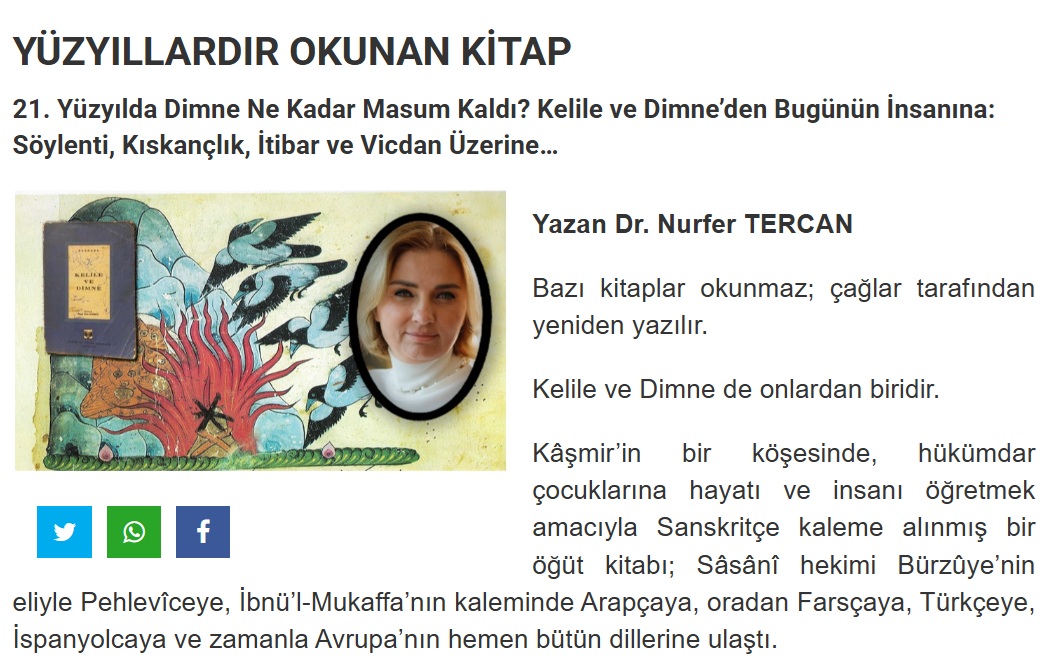
How Innocent Has Dimna Remained in the 21st Century? From Kalila and Dimna to the People of Today: On Rumour, Envy, Reputation and Conscience…
By Dr. Nurfer TERCAN
Some books are not read; they are rewritten by the ages.
Kalila and Dimna is one of them.
A book of counsel written in Sanskrit in a corner of Kashmir, with the aim of teaching the children of a ruler about life and human nature, it reached Pahlavi through the hand of the Sasanian physician Burzoe, Arabic through the pen of Ibn al-Muqaffa, and from there Persian, Turkish, Spanish and, in time, almost every language of Europe.
Centuries passed. States were founded. Cities were destroyed. Borders changed. Languages were transformed.
But Kalila and Dimna did not grow old.
For what it described was more lasting than all of these: the destruction a human being can wreak with the tongue. And in the history of the book there is a bitter symmetry that has not been dwelt upon enough.
Ibn al-Muqaffa, who brought into Arabic this text that tells how words can kill, was himself killed at a young age. A text he had written, and the accusations, suspicions and imputations piled up against him, became part of a process that ultimately went as far as taking his life.
The irony of history is heavy: the life of the man who translated Dimna itself turned into another story showing how destructive words, suspicion and accusation can be.
Perhaps that is why Kalila and Dimna is not merely a classic that has come down to us from the past.
It is a long mirror that shows the human being to the human being.
Within the stories told centuries ago in the language of animals, there was in fact always the human being.
The human being’s fear… Envy… Ambition… Friendship… Weakness…
And above all, the way they use words. One of the most unforgettable characters of those stories was Dimna. Dimna did not have today’s means at his disposal.
He had no screen. He had no social media account. He had no access to a messaging group. He had no network through which he could reach thousands of people at once.
He had only his tongue.
A few sentences.
A little suspicion.
A little insinuation.
A little envy.
And the ability to sense the invisible weaknesses people carry towards one another. But human history shows us that sometimes nothing more than this is needed to change a life.
You say a word.
You pass on half of a sentence.
You interpret a glance.
You load a silence with meaning.
You claim to know what one person thinks about another. Then you step back. People’s minds complete the rest.
Right here a disturbing question arises:
How innocent has Dimna remained in the 21st century?
For what Dimna did was limited to words circulating among a few people. Today we can reach hundreds, thousands of people within seconds.
Dimna produced rumour.
We can multiply rumour.
Dimna made one person suspicious of another.
We can form an opinion about a person without knowing them at all.
In Dimna’s world, words circulated. In our world, words are recorded; they turn into screenshots, are cut, selected, shared, reinterpreted and sometimes attain a second life independent of their owner.
So the issue is not only how wicked Dimna was.
The real issue is this: how ordinary have we made Dimna’s methods?
One Sentence About a Person
Perhaps the most fragile side of human relationships is trust. Trust takes a long time to form.
A friendship is built over years. A working relationship is shaped through effort. A person’s reputation is sometimes the sum of decades of conduct. Yet a single sentence is sometimes enough to shake all of this.
“You don’t know what is being said about him.”
“I think you should be a little careful.”
“You didn’t hear it from me, but…”
“Still, you had better be cautious.”
“I have been told a few things as well.”
What familiar sentences. If one looks closely, none of them contains any clear and testable information. But there is one feeling they all produce in common: Suspicion!
And once suspicion has settled in a person’s mind, they may begin to read even the most ordinary behaviour of the other person differently. What they previously saw as silence, they count as arrogance. They interpret busyness as indifference.
They take a remark for an insinuation.
They see a delay as intent.
They take coincidence for a plan.
They may read distance as hostility.
Thus the distance between fact and interpretation steadily closes.
After a while, a person begins to react not to the other’s behaviour but to the story they have formed about that person in their own mind. Perhaps Dimna’s real power lay precisely here: not so much in telling lies as in filling the gaps in people’s minds with suspicion.
Why Is Gossip So Powerful?
Gossip is not merely a way of speaking. It is also a form of social relationship. People sometimes talk about a third person in order to grow closer to one another. Criticising a common person can create a temporary closeness between two people.
“I trust you; I am telling this only to you.”
This sentence gives the listener the feeling of being special.
A secret has been shared.
A circle has been formed.
One person is inside, another outside.
But there is a strange paradox here: someone who carries another person’s secret to you may one day carry your secret to someone else. Yet, with the sense of privilege conferred by the private information confided to them, people mostly do not question this. For there is not only curiosity in gossip. There is also belonging!
A person sometimes feels that they are part of a group while talking about someone outside it. This is where one of the most dangerous thresholds of social relationships begins. When togetherness begins to be built upon the exclusion of a third person, what exists there is a temporary partnership rather than friendship. The person who talks with you about someone else today may talk with someone else about you tomorrow.
Dimna changes.
The chair changes.
The table changes.
The names change.
But the pattern of behaviour remains the same.
“I Only Said It”
This is one of the easiest refuges of our age:
“I only said it.”
Then other sentences follow:
“That is what I heard too.”
“Everyone knows it anyway.”
“I made no comment, did I?”
“I only passed it on.”
But is there really such an innocent act as “only passing it on”? When you carry a piece of information about a person whose truth you do not know, can you say that you are entirely independent of its consequences? You may not have produced the sentence that damages a person’s reputation. But you may have multiplied it. This is where the moral responsibility of the modern age begins: a person is responsible not only for the words they speak but also for the words they carry. For some words grow as they travel.
The first person says:
“I suppose…”
The second person passes it on:
“I have heard…”
The third person says:
“Apparently he knows…”
By the time it reaches the fourth person, the sentence is now this:
“Everyone knows it anyway.”
Thus possibility turns into opinion, opinion into information, and information into supposed certainty.
And the source disappears.
The suspicion remains.
And the person being talked about is, more often than not, the last to learn of the story built upon their own life. This is one of the invisible forms of violence of our age. For sometimes, while forced to defend themselves, a person does not even know exactly what they are accused of. There is no particular person facing them.
There is a sentence.
There is a rumour.
There is “everyone”.
But who that everyone is remains unknown.
Why Do People Believe Bad News More Easily?
Here it is easy to blame only the teller. But the listener also bears responsibility. For any rumour to survive, a listener is needed as much as a narrator. So why do we believe certain bad claims so quickly? Because the human mind is not impartial. When we hear something bad about someone we do not like, we ask for less evidence. When we hear the same thing about someone we like, we look for more evidence. We accept more easily the information that agrees with our prejudice. We adopt more quickly the story that confirms our own opinion. For this reason, a person sometimes believes not only because they have been deceived. They are also deceived because they want to believe.
Perhaps this was where Dimna’s skill lay.
Not so much in planting a new feeling inside a person as in using the feeling already there. Placing a few words on top of envy. Adding a small insinuation on top of distrust. Giving prejudice a small story. Then stepping back. And allowing the person’s own mind to complete the rest.
The Human Being in the Face of Success
To read Dimna’s story through gossip alone would also be incomplete. For in his behaviour there is another feeling as old as humanity:
Envy.
When a person succeeds, why do we sometimes find it hard to accept their success as it is?
Why is it sometimes not enough for us to say “they worked and they succeeded”?
Instead we produce other explanations:
“Somebody must have helped.”
“They were lucky.”
“They knew the right people.”
“Their circumstances were favourable anyway.”
Some of these may be true from time to time. But the matter lies deeper than that: why does belittling another person’s success give one a temporary relief? Perhaps because another’s success reminds us of what we ourselves could not do.
Here a person can choose one of two paths: to improve themselves.
Or to belittle the other.
The second is easier.
But it does not make us grow.
Dimming another’s light does not increase our own.
Diminishing another’s worth does not make us more worthy.
Devaluing another’s success does not eliminate our own shortcomings.
Perhaps true maturity begins right here: being able to remain undiminished in the face of another’s good.
Not seeing another’s success as our own defeat.
Not turning another’s happiness into proof of our own unhappiness.
Being able to walk our own path without being disturbed by another’s light.
This is not only personal maturity.
It is a society’s capacity to live together.
Reputation Is an Invisible Trust
One of the most valuable possessions a person has is their reputation. Money can be lost and earned again. An object breaks, and a new one can be bought. But reputation is different. It is built over years.
Through a person’s fidelity to their word.
Through their work.
Through their bearing.
Through how they treat people.
Through how they behave in hard times.
Through how they look after what has been entrusted to them.
Then one day a single sentence begins to circulate.
Perhaps it is true. Perhaps it is half true. Perhaps it is entirely false.
But it settles in people’s minds. Here we are faced with a very important social problem: how careless are we about people’s reputations?
Taking someone’s property without permission seems wrong to us.
Taking their money seems wrong.
Appropriating their labour seems wrong.
But why is tearing away a piece of the reputation that same person built over decades, with a few sentences, not regarded with the same gravity? Because the wound to reputation is invisible. But being invisible does not mean being small. Sometimes a person carries for years the effect of a single remark made about them. What is more, most of the time they cannot even find out who first uttered it. Perhaps we should add a new concept to our everyday ethics of human rights: the right to reputation. A person’s worth, which must be protected even in their absence.
The Digital Age Has Sped Dimna Up
Rumour used to have geographical limits.
A neighbourhood.
A workplace.
A circle of friends.
A family.
A table.
Now there are no limits.
A screenshot can reach dozens of groups within seconds.
A sentence can be torn from its context.
A few seconds of a person’s behaviour can be presented as proof of their entire character. And our age is steadily developing a strange talent: holding very firm opinions about people we do not know.
We watch a one-minute video and carry out a character analysis.
We see a photograph and interpret a life.
We read a sentence and think we know the intention.
We see a tiny part of an event and pass judgement as if we had understood the whole.
Yet a human being is larger than an image.
A life does not fit into a few seconds.
A character does not consist of a single mistake.
A person’s whole story cannot be read from a single act.
And every image has a before, an after and a context. The real problem of the 21st century is not merely the proliferation of false information. It is the spread of the habit of passing complete judgement on incomplete information. Perhaps this is the fundamental delusion of our age: we take the growth of information for the growth of understanding. Yet seeing more is not always understanding better.
We Can All Become a Little Like Dimna
It is easy to look for Dimna outside.
“There is the bad person,” we say.
In this way we place ourselves on the good side of the story.
But the real power of ancient stories is not to comfort us but to disturb us.
Perhaps Dimna is not a person.
He is a pattern of behaviour.
And from time to time all of us may pass along the edge of that behaviour.
When we hear a remark and pass it on without checking…
When we belittle a person’s success…
When we magnify one friend’s resentment towards another friend…
When we increase the distance between two people instead of reducing it…
When we tell someone’s secret to “just one person”…
When we share a screenshot without knowing its context…
When, in a person’s absence, we utter a sentence we could not say in their presence…
Dimna is no longer in the book of fables.
He is in the behaviour.
And perhaps that is why the real issue is not to identify bad people, but to notice through which doors bad behaviour can enter within ourselves.
And Who Is Shatraba?
Perhaps we need to think again about the most silent figure of the story.
Shatraba…
The one who is talked about but not listened to. The person turned into a character in a story told by someone else. The one who is judged without being asked for a defence.
Today Shatraba is sometimes our friend.
Sometimes our colleague.
Sometimes a member of the family.
Sometimes a teacher.
Sometimes a student.
Sometimes someone we do not know at all.
And sometimes it is us.
For almost all of us have had this experience to some degree: one day you realise that people think you said something you did not say. An act you did not commit has been attributed to you.
Your intention has been interpreted.
Your silence has been explained.
A story has been constructed.
And without your knowledge you have been placed inside that story.
Perhaps this too is one of the great lonelinesses of modern man: trying to catch up with the narrative about us before we have told our own. Sometimes a person no longer tells their own story. They try to correct someone else’s story that has been built about them. This is one of the most exhausting sides of social relationships.
Where Does the Quality of a Society Show?
The development of a society cannot be measured only by its roads, its buildings, its technology, its universities or its economic indicators. It is also measured by how people talk about one another.
In the conversation that begins behind a person’s back when they leave the room…
When a friend’s secret is entrusted…
When someone’s success is heard of…
When a mistake is seen…
When a person is in no position to defend themselves…
That is where culture becomes visible. For it is easy to be courteous to a person’s face. True civilisation is being able to protect a person’s rights even where they are not present. Perhaps this is the most advanced form of social courtesy.
Not merely listening in silence when someone is spoken ill of behind their back.
Being able to ask, “Have you said this to them?”
Being able to say, “Are we sure this is true?”
Being able to say, “Perhaps there is a side to it we do not know.”
And, when necessary:
Being able to say, “It is not right for us to talk about this.”
Sometimes civilisation begins not in grand sentences but in precisely these small objections. For protecting a person’s rights where they are not present is a virtue for which you will not even receive thanks in return.
Perhaps this is also the measure of true morality: how we behave where no one sees.
The New Virtue of the 21st Century: Being Able to Pause
Perhaps one of the virtues we need most today is being able to pause. To stop, take a breath, sit down and think.
To pause before sending.
To pause before sharing.
To pause before telling.
To pause before believing.
To pause before getting angry.
To pause before passing judgement on a person.
And to ask ourselves a few simple but difficult questions: Do I really know this?
Or did someone tell me?
Have I listened to the other side?
Is it really necessary for me to share this information?
Will these words solve a problem, or will they merely diminish a person?
And perhaps most important of all: if this person were here right now, would I still say the same sentence?
This single question can place a powerful filter of conscience on one’s tongue. For sometimes morality is not knowing what to say; it is knowing which words we should not say.
Must the Truth Always Be Told? Here lies a harder matter.
Is it moral to tell every truth?
No.
Because sometimes information is true but need not be shared.
A mistake in a person’s private life may be real. A story from their past may be real.
A vulnerability of theirs may be true. A failure of theirs may really have happened. But truth does not automatically give us the right to spread it. That is why morality is not only refraining from lying. It is also knowing where, when, for what purpose and with what consequence we tell the truth.
Sometimes keeping silent is not cowardice.
It is delicacy.
Sometimes not speaking is not ignorance.
It is good manners.
Sometimes covering a person’s fault is not denying the truth.
It is refusing to reduce them to a single mistake.
For a human being is greater than the worst thing they have done.
Greater than a mistake in their past.
Greater than their failure.
And perhaps humanity is possible to the extent that we can grant one another this greatness.
If Dimna Were Among Us Today
Perhaps if Dimna lived today he would be astonished at his own story. For some of his actions that were regarded as great intrigue have today turned into the ordinary habits of everyday life.
In messaging groups.
In workplaces.
At tables among friends.
At family gatherings.
On social media.
Talking about a person mostly comes more easily than talking with that person. Instead of trying to understand someone, we interpret them.
Instead of asking, we guess.
Instead of listening, we talk about them.
Then we are surprised that relationships break down.
Perhaps the problem is not a lack of communication.
It is an excess of the wrong communication. For people increasingly talk about one another before talking with one another. And sometimes the real relationship between two people begins to be governed by the words of third parties circulating between them.
This is exactly where Dimna is born again.
Not in the body of a person.
In a form of relationship.
The Real Question Is Not “Who Is Dimna?”
Perhaps we should now stop asking “Who is Dimna?” For this question keeps leading us to look outward.
We look for a name.
We look for a culprit.
We point at others.
Yet the mirror the ancient text holds up to us may be more disturbing than that. The real question should be this:
With which of my behaviours do I draw near to Dimna?
What do I do with what I hear about a person?
What do I do within myself when I am envious?
How do I behave when one friend of mine talks about another friend of mine?
Can I truly rejoice at someone’s success?
Do I turn a person’s mistake into their entire character?
Can I keep the word that has been entrusted to me?
And most important of all: can I protect a person’s rights in their absence?
The answers to these questions perhaps say far more about us than how many books we have read, how many diplomas we hold, what titles we possess or how beautifully we speak. For a person’s true upbringing mostly reveals itself where no one sees.
How Innocent Has Dimna Remained in the 21st Century?
Now let us ask the question again: how innocent has Dimna remained?
Perhaps Dimna was never innocent.
But we have magnified his methods.
He carried a sentence.
We carry screenshots.
He planted suspicion between two people.
We can produce doubt even about people we do not know at all.
He started a rumour.
We multiply it.
He could reach a few people.
We can reach thousands.
Then we all take shelter behind the same sentences:
“I only heard it.”
“I only said it.”
“I only shared it.”
Perhaps the new morality of our age will begin precisely with learning not to hide behind this word “only”.
For no word is only a word.
Sometimes it changes a friendship.
Sometimes a person’s self-confidence.
Sometimes a family relationship.
Sometimes a working environment.
Sometimes a reputation built over years.
And sometimes the trust a person has in themselves.
That is why Kalila and Dimna is perhaps telling us something extremely simple but weighty today:
Do not carry everything you hear.
Do not interpret everything you see.
Do not tell everything you know.
Do not take every suspicion for truth.
Do not come to know a person from a story told by someone else.
And most important of all: in a person’s absence, do not utter the sentence you could not say in their presence. For civilisation sometimes begins not in great structures but in the care one person shows for the reputation of another.
In the quality of the conversation that begins when a person leaves the room…
In your silence before the word entrusted to you…
In the sincere joy you are able to show at another’s success…
In the moment you refuse to carry a rumour…
And when you are left alone with your conscience where no one sees.
Perhaps if Bidpai lived today, he would not add a new story to the end of Kalila and Dimna.
He would simply turn to us and say two sentences:
“I introduced Dimna to you.
So why have you multiplied him so much?”
And the disturbing answer is perhaps this:
Dimna is no longer merely the hero of a fable.
He is a possibility of behaviour that reappears wherever a person silences their own conscience.
For this reason the issue is not to find Dimna.
The issue is to be able to look at ourselves enough to notice where Dimna might begin in us.
Notes from the Blue of the Windy City
https://www.5gvirusnews.com/yazarlar/yuzyillardir-okunan-kitap-h1949.html
Translated from the Turkish original.