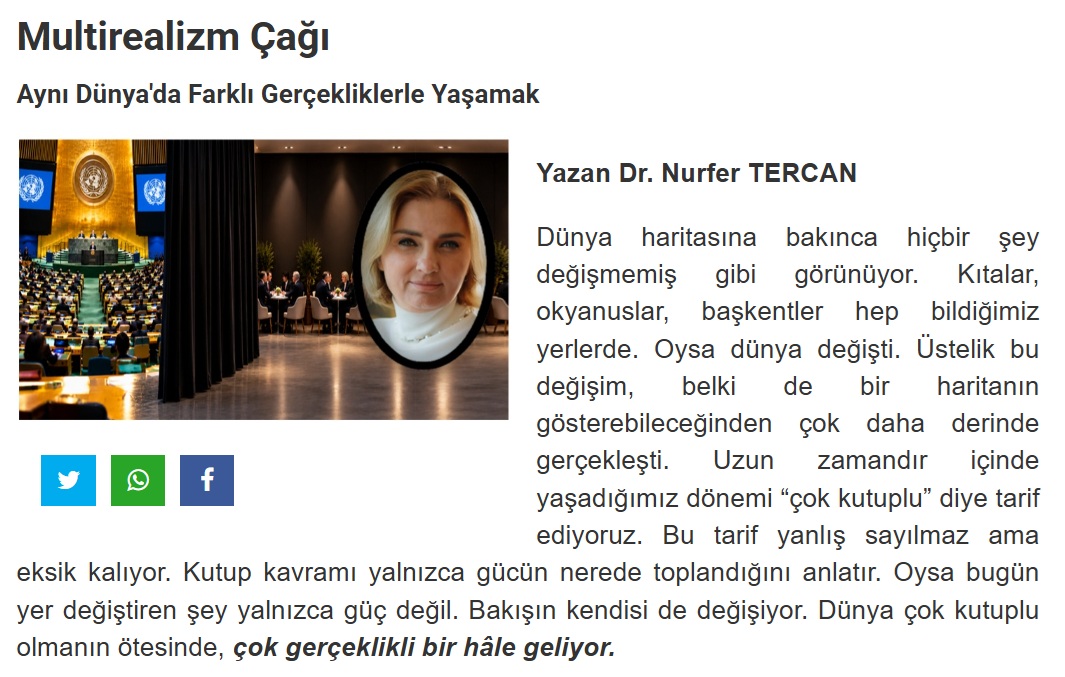
Living with Different Realities in the Same World
By Dr. Nurfer TERCAN
Looking at the world map, nothing seems to have changed. The continents, the oceans, the capitals are all where we have always known them to be. Yet the world has changed. What is more, this change has perhaps taken place far deeper than any map could show. For a long time we have described the period we live in as “multipolar”. That description is not wrong, but it falls short. The concept of a pole tells us only where power is concentrated. Yet what is shifting today is not power alone. The gaze itself is changing too. Beyond being multipolar, the world is becoming multi-real.
If this situation is to be pointed to with a single concept, that concept may be multirealism. Why, then, should we not in this essay consider the period we are entering as an age of multirealism? What is meant here is not that truth is relative. It is that the people and societies sharing the same planet increasingly experience that planet from within separate realities. Truth may be “one”. But the windows opening onto it have never been so many, and those windows have never looked at one another so little. In recent months, and especially in the New York of this September, developments bearing the first signs of this new age have appeared one after another.
A Table in New York
On 21 September 2026, right on the margins of the 81st session of the United Nations General Assembly, a remarkable table was set. At the summit hosted by the President of the European Council António Costa, the President of Kenya William Ruto and the Prime Minister of Canada Mark Carney, the European Union, Australia, Barbados, Brazil, Canada, India and Kenya launched the initiative “Partners for Multilateralism”. The founding seven were soon joined by sixteen more signatories. Türkiye too is among these twenty-three parties that signed the declaration.
Looking at who is at the table says enough. A union on the scale of a continent, a Caribbean island state, two great voices of the Global South, an African country and a country from the far end of the Pacific meet beneath the same text. This table was not set up as a military alliance, nor as a new bloc. It defines itself as a flexible platform for cooperation, open to partners from every part of the world. The declaration covers international law, climate, artificial intelligence, global health, resilient supply chains and a fairer international financial architecture. What these issues have in common is that no country can solve them alone. In the initiative’s own words, the aim is not to replace the existing system with a new one, but to make it more representative, more legitimate and more trustworthy. The twentieth century left us the world of alliances. The twenty-first century is quietly weaving the world of networks.
Arendt’s table
In The Human Condition, Hannah Arendt likens the common world to a table around which people sit. The table both relates people to one another and separates them. It stands between them. It keeps them from falling over each other, yet it does not allow them to break apart from one another either. For Arendt, what makes mass society strange and frightening is that one day this table disappears. People sitting opposite each other in the same room realise that nothing remains between them to bring them together.
“The common world is like a table around which we sit: it both relates us to one another and separates us from one another.” The Human Condition / Hannah Arendt
Should we now read the tables being set in different corners of the world through this lens, I wonder? These are not merely diplomatic meetings. They are efforts made so that a common world does not vanish. They are not set so that everyone may be the same. They are set so that those who are different may remain at the same table.
Two floors of the same apartment building
In those same days another table was being set in New York. The subject of this table was not borders or weapons, but inequality.
The International Panel on Inequality initiative, shaped under the leadership of South Africa, Brazil, Spain and Norway, aims to establish a permanent mechanism that will scientifically monitor income and wealth inequality in the world and assess the evidence on policy options. The initiative was presented to the world on 23 September at a high-level meeting on the margins of the General Assembly. The African Union and UN Secretary-General António Guterres are also among its supporters. At the centre of the idea is the Nobel laureate economist Joseph Stiglitz. At the request of South African President Cyril Ramaphosa, Stiglitz chaired the committee of independent experts that prepared the global inequality report for the G20, and it was this committee that proposed the creation of such a panel.
Behind the call stand more than 1,500 economists and academics from more than a hundred countries. Daron Acemoğlu, Thomas Piketty, Mariana Mazzucato, Jayati Ghosh and former US Treasury Secretary Janet Yellen are only a few of these names. What brings people from such different traditions of thought together in the same text is a simple but shattering observation: we live on the same planet, but we no longer live in the same economic reality.
On one side there is a world in which wealth multiplies of its own accord from generation to generation; on the other, a world in which making it to the end of the month is a struggle that must be won anew every month. These two worlds sometimes live side by side in the same city, on the same street, even on two different floors of the same apartment building. The distance between them is a few steps, yet the worlds the two see bear no resemblance to each other.
It is precisely at this point that multirealism ceases to be a philosophical concept and blends into the fabric of everyday life. It seeps first into the economy, then into society, and then into the way people look at one another.
An elephant in the dark
In the Masnavi, Rumi tells of an elephant brought into a dark house. People who have never seen an elephant feel it with their hands in the dark in order to know it. The one who touches its trunk says the elephant resembles a water spout. The one who touches its ear likens it to a fan, the one who touches its leg to a pillar, the one who touches its back to a throne. Each is right about what he touched, but none has been able to see the whole elephant. Rumi concludes the story thus: had each of them held a candle in his hand, the difference between their words would have disappeared.
Its meaning, in short: “My window opens onto the world; but the world does not consist of my window.”
It feels as though this sentence needs to be said today not only to individuals but to societies and states as well… One of humanity’s oldest errors is to take what is seen from one’s own window for the whole of the world. The East has one horizon, the West another. The North’s vision of development and the needs of the South cannot be told in the same sentence. What Gadamer called the “fusion of horizons” is not these horizons erasing one another, but their widening by touching one another.
Globalisation left us an interesting legacy. It connected the world, but it did not make the worlds resemble one another. Our telephones, our airports, our coffee cups came to resemble one another. Our lives, however, did not. For being connected did not mean being equal, nor did it mean agreeing.
The silent map of the algorithms
In recent years a new layer has been added to this picture: algorithmic reality.
Two people may live in the same city, speak the same language, step out onto the same street on the same morning. But the moment they look at the screen in their hands, they enter two separate universes. The news that one sees constantly, the other never sees. The worry that confronts one every day does not exist at all in the other’s world. The issue of which one says “everyone thinks this way” has never entered the other’s agenda. Exactly a century ago Walter Lippmann spoke of the distance between the world outside and “the pictures in our heads”. Today it is no longer only we who draw those pictures. There is an invisible architecture that selects, ranks and multiplies them for us. People used to think differently about the same reality. Now they increasingly think inside different realities. This is no small difference; it is perhaps one of the deepest sociological ruptures of our age. When common reality wears thin, common language wears thin too. When common language wears thin, negotiation becomes harder. And where there is no negotiation, only the language of force remains.
From bloc to network
Other quests seen on the international stage this year also show different faces of the same transformation.
In May of this year, at the Copenhagen Democracy Summit, former NATO Secretary General Anders Fogh Rasmussen proposed a coordination format under the name “Democracies-7” (D7) among Australia, Canada, the European Union, Japan, New Zealand, South Korea and the United Kingdom. It is not yet an established structure. It is an idea aimed at enabling mid-sized democracies to work more closely in areas such as trade, technology, critical raw materials, defence and economic security.
The most striking aspect of the proposal is the principle, called the “Economic Article 5”, which envisages a joint response to economic pressure directed at one of the members. And in September, on the very day that Partners for Multilateralism was founded in New York, India and the Visegrád countries came together for the first time at the level of foreign ministers. India’s External Affairs Minister S. Jaishankar and the ministers of Slovakia, which holds the rotating presidency, as well as of Poland, Czechia and Hungary, discussed in this new format bearing the name “V4+India” a broad agenda ranging from trade and investment to technology, from resilient supply chains to defence and security, from education to people-to-people ties. The renewal of the multilateral system and issues of concern to developing countries were also on the table.
It is possible to read these as news items independent of one another. But when one steps back a little and looks, another pattern appears. Countries no longer ask only “Which bloc am I in?”; increasingly they ask “On which issue can I walk the road with whom?” In the world of blocs, identity determined the relationship. In the world of networks, the issue determines the relationship. A country can stand side by side with one group on climate, with another group on trade, and with entirely different partners on technology. This may look like an inconsistency, but the fabric of the new world may be exactly like this.
Searching for new words
Perhaps the real difficulty lies in our trying to understand the new world with the words (the concepts) of the old world. East and West, North and South, centre and periphery, developed and developing, ally and rival… These dichotomies once made it easier for us to read the world. Today the world is overflowing from between these dichotomies.
A Caribbean island state and a union on the scale of a continent can put their signatures under the same text. India can, on the one hand, carry the voice of the Global South while, on the other, setting new tables with Central Europe. Brazil can, on one side, be among the pioneers of a new global mechanism on inequality while, on the other, being among the founders of the table set for the renewal of the multilateral system.
Ortega y Gasset used to say that every view is a view from somewhere, and that truth can be approached only through the sum of these views. The new world may not be built around a single centre. It may take shape as a network in which many centres, stories and realities touch one another.
And yet this picture has a shadow. Multiple reality can give birth to pluralism, but it can also give birth to fragmentation. If every society shuts itself up in its own narrative alone, if every actor counts only its own view as truth, if every person believes only in the world shown by his own screen, multirealism will lead us not to a rich plurality but to islands of reality that never touch one another. The more the islands multiply, the wider the sea between them grows.
That is why multilateralism does not look like merely a method of diplomacy. It is increasingly turning into a question of civilisation. The point is not that everyone should think the same. The point is that those who think differently should not rise from the same table, and should be able to protect together the minimum ethics of sharing the same world.
The same sky
Perhaps humanity is remembering anew a very old piece of knowledge. Does a river belong only to the country through which it flows? An epidemic does not ask for a passport. The atmosphere has no customs gate. The consequences of an artificial intelligence developed in one laboratory spread to all continents. Economic shocks pay no heed to the lines on the map. And when inequality deepens in a society, it does not remain a matter only for those who suffer deprivation. It affects trust, social peace and, ultimately, the very ground of common life.
We do not know how many of the tables being set today will last. Some will turn into institutions, some will be forgotten, some will remain only in a single photograph. But behind all of them stands the same silent question: can people and societies living in realities so different from one another carry together the responsibility for the same world?
I think this is the great question of our age. The coming years will be shaped not only by who is stronger, but also by whose reality is seen, whose voice is heard and for whom room is made at the table.
The people in Rumi’s dark house could not have reached the whole elephant by persuading one another. What they needed was not to silence one another, but to set a candle in their midst and be enlightened!
And what, after all, was civilisation? “It was kindness… It was friendship… It was labour… Civilisation was not everyone looking through the same window. Civilisation was those who look through different windows not forgetting that they live beneath the same sky.”
Notes in the Blue of the Windy City
https://www.5gvirusnews.com/yazarlar/multirealizm-cagi-h1974.html
Translated from the Turkish original.