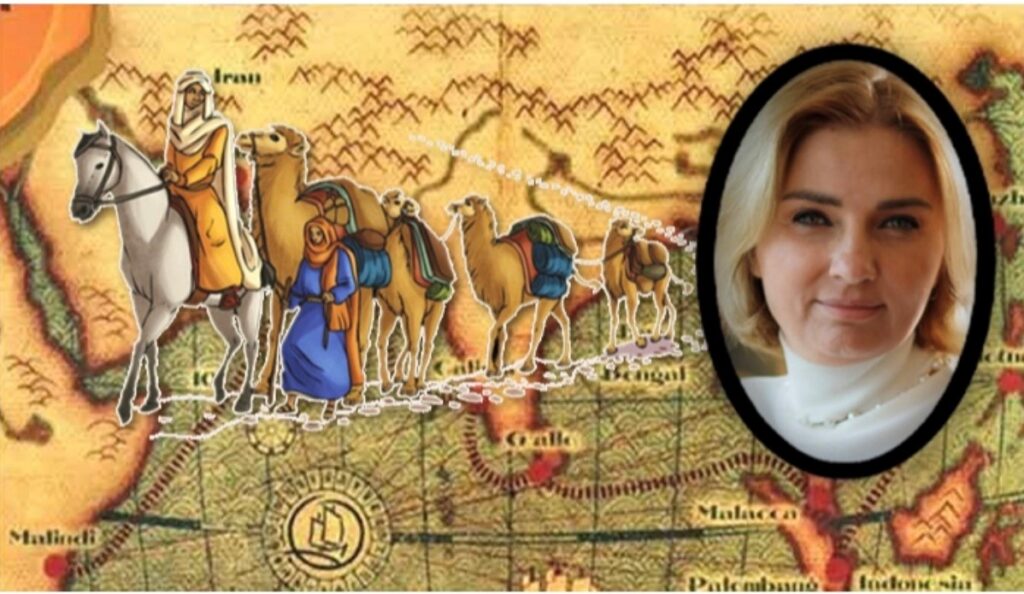
One of the oldest structures in the history of humanity and of the economy, and perhaps the most important of them, is the first intercontinental trade route: the Silk Road.
Roads are the story of humankind. They are the story of life itself, in which knowledge, ideas, beliefs and values are bound to one another along with trade. They tell us about living together. Like every language, the language of life has an alphabet, a structure and rules of its own.
It is high time to reassess the “Belt and Road Project” in the light of information, the building block of the universe.
The SILK ROAD, which seeps deep into us with Kitaro’s music… The connective wholeness of a “Road” that has made great cultural contributions to our roots. One side of humanity strives, throughout its life, to hand on the legacy it received by leaving the world a better and more beautiful place than we found it, while the other side is bent on severing every bond, on burning and destroying!
As is well known, the Turkic World is one of the oldest, most deeply rooted, most widespread, most influential and most decisive elements of the geography of people, societies, cultures and countries of our Blue Planet, the Earth. In Eurasia, the largest part of our world, it has a historical and cultural past of some four to five thousand years in terms of its first known concrete roots and distinct origins. According to the knowledge and findings at hand, the Turkic World has been able to sustain its existence, development, change and transformation from some four to five thousand years ago down to the present day. It is a historical fact, accepted also by scholars who are able to approach the “Turkic phenomenon” free of every kind of prejudice, that “the roles of the Turks in the adventure of humanity have been of a fundamental nature. For this reason it is almost impossible to (understand and) recount the adventure of humanity without allotting a large place to the Turks. Today’s Turkic World consists of a human community of some 200–250 million people of Turkic origin who, across an area of about 10 million square kilometres in today’s Eurasia, speak Turkic as their mother tongue, live in Turkic, and hear, think, move and sense in Turkic; of the culture of this community; and of the countries and regions in which this culture is lived.”
In the depths of history, from the earliest periods when the Turks appeared on the stage of history in Central Asia and began to play an active role, various axes of culture, art and music took shape in different directions, together with their opening, orientation, advance and spread from the heart of Asia towards the East, the West, the North and the South. With the initial movement out of Central Asia, each of which gained existence, function and effect in particular periods, it is the oldest, most deeply rooted, most lasting, most influential of these axes, and the most continuous and most decisive down to our day. It is defined as the “Central Asia–Anatolia axis”. This “main axis”, which took shape step by step and strengthened its roots especially within the last two thousand five hundred years of the Turkic World, carries this value today, as in the past, by gaining extreme importance. This importance and value are expected to continue and grow even further in the future with the full realisation of the “Belt and Road” New Silk Road project.
The Silk Road, while taking on the appearance of a road that connects the Turkic communities to one another, is also acquiring a geographical wholeness. It can also be seen that the Silk Road basin covers, to a significant extent, the political geography aimed at by the Turkic Union.
There are sixty-five countries in total on the new route of the Silk Road, which is planned to be brought back to life. If we are to describe these sixty-five countries in detail: in Central Asia, Kazakhstan, Tajikistan, Uzbekistan, Kyrgyzstan, Turkmenistan. In East Asia, Mongolia, China. In South Asia, India, Bangladesh, Pakistan, Nepal, Bhutan, Afghanistan, the Maldives, Sri Lanka. In Southeast Asia, Myanmar, Timor-Leste, Singapore, Brunei, Vietnam, Laos, Thailand, Malaysia, the Philippines, Cambodia, Indonesia. In the Middle East and North Africa, the United Arab Emirates, Yemen, Palestine, Iran, Iraq, Israel, Kuwait, Lebanon, Oman, Saudi Arabia, Syria, Egypt, Bahrain, Jordan, Qatar. In Europe, Türkiye, Georgia, Ukraine, Azerbaijan, Russia, Albania, Hungary, Poland, Belarus, Bosnia and Herzegovina, Croatia, Montenegro, Czechia, Estonia, Slovakia, Latvia, Lithuania, Macedonia, Moldova, Serbia, Slovenia, Armenia. The Modern Silk Road Project covers a very wide area. When it is also borne in mind that the countries in this project make up an economic size of about twenty-one trillion dollars, it becomes clear that the project holds serious economic potential. With the completion of this road, which will connect China to Europe via Central Asia, the aim is to ensure harmony in land, sea and rail transport, to diversify global trade routes, and to reduce costs by shortening transport times. The Modern Silk Road project will bring with it important opportunities for Türkiye to reach its future economic goals. Within the scope of this project Türkiye is in a strategically important position. For example, for Iranian goods to reach the West they must pass through Türkiye, and for Turkish goods to reach the East they must likewise pass through Iran. This mutual bond increases the importance of the Silk Road project still further. The new Silk Road project launched by China under the name “Belt and Road” is expected to cause global balances to shift in the coming years, both economically and geopolitically. China’s investment of hundreds of billions of dollars in the countries within the scope of the project for the building of infrastructure is a sign of the importance attached to this project. The wish to gain easier access to Europe, the Middle East and Africa along the Silk Road route is among China’s goals. Countries drawing closer to one another in their trade relations has a leading role in the formation of broad markets.
If we wish to understand the Belt and Road project better and make sense of it, we can turn to the maps that describe in fine detail Türkiye’s place in the global energy market, owing to its geostrategic position, and its oil and natural gas pipelines. These maps also explain the reason for and the importance of the agreements made, in particular, with QATAR, one of the 65 countries in the New Silk Road project.
In relations between Türkiye and China, the Silk Road is an important initiative aimed at completing “win-win” cooperation and the strategic partnership dimension of the relationship.
Türkiye’s taking part in this initiative gains value in terms of promoting balance in bilateral trade, increasing infrastructure cooperation and investment, and deepening financial cooperation. As Xi Jinping has also put it: “The New Silk Road initiative (One Belt One Road) should be regarded not as China’s solo performance but as a chorus in which all the countries in the project take part.” This initiative, which envisages the participation of some 65 countries, will be able to succeed together with the participating countries. Türkiye’s central position will also increase its value in the initiative.
While Azerbaijan–Türkiye relations are conducted on the basis of the “one nation, two states” discourse, within the framework of the concrete projects shown above we have lived through, with Azerbaijan’s victories, the move of the friendly relations between the two countries from the level of discourse to the stage of action, and we shall go on living it; it is not over yet! In Georgia–Türkiye relations, for its part, making Georgia’s bond with the West permanent through Türkiye, on the basis of its Westernisation policy, has reached the level of strategic partnership. If we recall that the passage from bilateral to trilateral relations among Azerbaijan, Türkiye and Georgia was formally secured on 8 June 2012 with the adoption of the Trabzon Declaration as the outcome of the Trabzon summit, attended by the Foreign Ministers of all three countries, we can understand today (2020) and tomorrow (2023) far better.
The Kars–Iğdır–Nakhchivan railway, planned to be built later as an addition to the Baku–Tbilisi–Kars railway, connects to the Nakhchivan–Tabriz–Tehran–Zahedan railway and extends as far as Islamabad. The construction of this line creates an alternative to the Sivas–Van–Tabriz line, reaching from Istanbul–Sivas–Erzurum–Kars all the way to Islamabad. In this way, together with being a component of the East–West Transport Corridor, it also makes it possible to become a North and South Transport Corridor via Iran. If our target projects in these somewhat complicated-looking sentences are managed in the best way and brought to life, they can make us completely forget the crisis we are living through these days. In short, the one we hear of most among these projects, the Baku–Tbilisi–Kars railway project, besides creating a foundation like that of Baku–Tbilisi–Ceyhan in the field of energy, assumes a central role in opening regional projects out to the world. Now let us look at Türkiye again from this angle and assess the steps taken in this way.
The ancient Silk Road is reawakening in all its aspects, with its energy, railway and other trade lines. Let us assess this awakening by looking at it from two of the most important gates in history that unite East and West! Turkestan, the sacred gate of Turkic Unity, and the Van Kapıköy Border Gate, which links Van, on the Historic Silk Road, with the Iranian city of Khoy!
The story of two gates as the symbol of one road needs to be written into history anew! Without forgetting our responsibilities towards future generations…
Keywords: Silk Road Qatar Turkic World
Translated from the Turkish original.