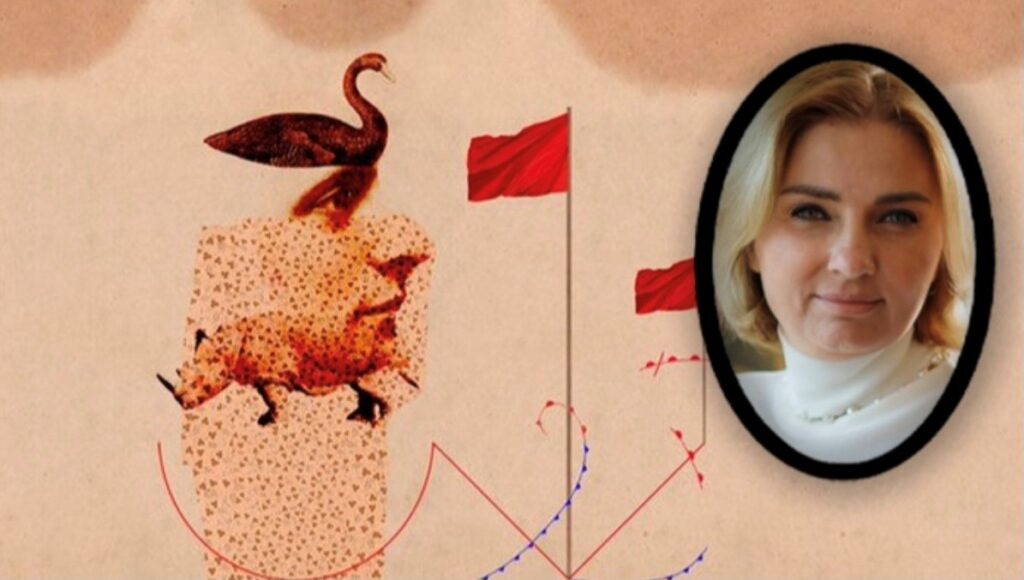
In the April of Twenty Twenty, when our faculties of thinking, comprehending and perceiving were masked with the blackest of black, when our feet were swept off the ground, we were watching the programmes of the New Order of Uncertainty projected onto the walls of our caves. The Black Swan of far-off lands and the Grey Rhino of the Far East had brought news of the uncertainty of the new order. The headline of the news was: “The rulings and decisions on our new way of life that they have determined in the new-order uncertainty of the Flat World”. State officials all over the world were informing us of these decisions with a single slogan, at the same hour, from a single text. “From now on, nothing will be as it used to be! Get used to the new normal! Stay at home! We are enough for ourselves…” This was news in the colour of the fact that the emotion which brings about the states of being unable to live is fear. The colour of the centralist slave empire, the herald of the very darkest of the medieval days that had no daytime… Because these were our first days we could not understand, nor could we have understood, because we were masked, and we were listening to this news through the sooty voices of the shadow theatre.
You may say there is no use in recalling those days, in going back to the past. But this is not a recollection. We are still in the uncertain hours of days that are the continuation of those days and in which we await a solution… And with the unknown of this waiting we passed into yet another uncertain year in the same way.
Yesterday the blue bird brought back, between the two halves of its beak, a past article from The Economist. The title of the piece:
“The World in 2021! Was the pandemic a grey rhino or a black swan? Let us read together the meaning of another sentence, on the line right below, written in smaller type and making one say ‘GOD WILLING, LET IT BE FOR THE GOOD!’: “There is in fact even more that is being kept from your notice, far beyond your estimates!”
The message of the first paragraph, in summary, points to how the lessons drawn from the COVID-19 pandemic are not all that great, to how very high the importance and value of the pandemic we are living through is, to how the coming of Wednesday was announced by red Thursday at the top of its voice, and to the level of stupidity of those who nevertheless turned a blind eye to the fact that the probability of this coming was high and that it would have the darkest of effects. That over the years many governments had uttered countless convincing words about the world being unprepared for a pandemic, and what is more, that when the new coronavirus emerged in China many countries chose to remain without comment in the face of this situation – this was not implied but written plainly by Michele WUCKER, analyst and author of the book THE GRAY RHINO.
Michele Wucker founded a consultancy firm under the name “gray rhino” to make things easier for leaders, organizations and communities in the age of the risk society. With her speech at the Annual Meeting of the World Economic Forum in Davos on 26 January 2013, she conveyed what the concept carried by the grey rhino was meant to express. It must have drawn considerable interest from leaders and the business world, for the WEF speech turned into experiences, and the experiences into a book in 2016. In her 2019 TED talk, Wucker mentioned that the Chinese leader Xi Jinping had given this book a place in the library in his office.
Let us return to the message sent with the blue bird by the famous Oracle The Economist, which is about to complete its second century and takes its joy of life from chaos.
“In 2021, take every precaution regarding the global economy, the financial markets and the stock exchanges. I am giving you notice now that job losses, bankruptcies and defaults are highly likely,” it says; I am just putting it on record. Then it warned sternly: “Do not say, ‘Oh, I did not hear, nobody told me, The Economist did not write its prophecy, the blue bird did not fly, it fled’ – I will have no part in it.”
Our famous oracle magazine, guessing that we would once again say deep down “GOOD HEAVENS! Is there no remedy?”, wrote out its report and its prescription in advance.
“You can only see black swans in the rear-view mirror,” it said. It underlined the necessity for us to focus on the Grey Rhinos ahead of us in 2021. As far as we understand why we should focus on the Grey Rhino, it conveyed that “Wednesday will collapse and be reset, that this can be foreseen with the grey rhino, and that Thursday, in the mask it has let fall, will show openly the reasons why the coming Wednesday will collapse and be wrapped in zero”. It also attached, somewhere at the end of the article, a one-sentence note: “If you do not READ these words of mine, that is up to you, I will have no part in it.” The message the note gives between the lines: “This article appeared in the ‘Aftershocks’ section of the print edition of The World in 2021 under the headline ‘A black swan’? No!”
So, why no to the Black Swan?
It reminded us that the saying of Iunius Iuvenalis, one of our ancient scholars assumed to have lived in the first century AD – ‘a rare bird in the lands, very much like a black swan…) – was used a great deal in the Middle Ages, as if so that he would not be forgotten. Since the existence of a black swan had never been witnessed until that day, the direct inference can be made that it described negative probabilities or improbabilities. Throughout the Middle Ages this saying of Iuvenalis was used to characterize events never encountered, until the first black swan was identified in Western Australia by Willem de Vlamingh in 1697…
The use of the Black Swan metaphor on a different axis today, in the world of economics and finance, comes about with the work Economic Philosophy written by Joan Robinson in 1962. Years later, the ‘Black Swan’ announced itself to the whole world when the book by the Lebanese-born American writer and economist Nassim Nicholas Taleb was published in the USA in 2007 and quickly became a bestseller. In the foreword of the book Nassim Nicholas Taleb says: “All swans are white… until Australia is discovered.” He dedicated this saying to Joan Robinson. The black swan metaphor: the author N. Taleb uses it for events that occur to no one, that no one even considers possible. It points to events that are accepted as improbable and cannot be predicted, but that, if they happen, are tremendous through a compound effect. He defines them as events whose impact is great enough to cause changes and for which, once they have happened, we produce certain explanations that make them less random. He claims that variables which are mostly ignored or thought to have a low probability of occurring, and these changes, are also what shape the history of civilization.
Characteristics of Black Swan Events: Unpredictability – producing severe and far-reaching consequences – events to which, after they have occurred, we lend predictability by drawing a logical framework with elements whose importance we understand only afterwards. And it also describes those other events in which, instead of drawing lessons from what has been lived through, comment is piled on comment until it turns into gossip with a flavour of analysis, and we are crushed beneath the aftershocks.
Now let us get to know the choice made by our oracle The Economist in its proposal, which has the character of a warning: the “GREY RHINO”.
The author Michele Wucker, at the World Economic Forum (WEF) in 2013, had used the concept of the Gray Rhino to describe the Greek Financial Crisis that took place in 2012 and the situation that followed. She explained in an interview why she gave this concept the name “Grey Rhino”. There are white swans and, though few, black swans. But for the rhinos, which she thought of using in order to emphasize risk in terms of visibility and impact, her statement is as follows: “Since neither the black ones are entirely black nor the white ones entirely white, it was thought that defining all of them as ‘grey’, in the sense of an in-between tone, would attract attention. Consequently, risks that have a potential impact great enough to upset the markets, that are highly probable and that you see coming, but by which one is caught completely unprepared, have been defined by the Grey Rhino theory.
As for the Stages of the Risk Foresight Process with the Grey Rhino, the “Gray Rhino”:
“Denying or ignoring the risk. – Noticing the problem but brushing it aside with excuses. – Diagnosis! This is the most important stage. Making realistic plans aimed at solving the problem. – No Panic! A phase that can be got through with a correct diagnosis process. This stage is at the same time like a double-edged knife. If this stage is set up correctly, one can move on to the last stage, action, with the right action. However, failing to make the right determinations at this stage may also lead to being steered towards wrong actions.”
In fact, our red Thursday had for many years been trying, report after report, to make the footsteps of the corona Virus heard until it turned Pitch-Black, and nobody took an interest. What Thursday wanted to announce was this: ‘Though not of a magnitude whose severity would rival the 19 of Covid, it was the ancestry and the past of the family elders of a generation ago and of the other generations that came in their turn.’ It was the fact that the SARS virus in 2004, H1N1 in 2009 and EBOLA in 2015 left behind enough fame to have themselves written into history. In conclusion, the pandemic of Twenty Twenty had long since boarded the ship of the darkening Thursday and arrived.
The Oracle The Economist says: “These epidemics, inflicted by generation after generation of viruses, appeared; when they showed themselves with the quality of being a ‘Grey Rhino’, nobody cared, nobody reflected on it… And what then! What is more, although the first Covid 19 cases in China were heard of, the reports that it was a virus of the most severe kind went unquestioned… O you who run after the Black Swan…” – wishing in this way to voice its most cautionary words.
What we tried to express in our previous article, as the Risk Society, was that ‘the danger in which society finds itself today is risk and uncertainty that feed on darkness’. The possible dangers and threats, the insecurity, uncertainty and fear arising from situations of risk, which are divided into natural risks and manufactured risks, are changing our entire way of life and continue to add ever newer Ab-normalities on top of it. The ‘Normal’ that is claimed to have been renewed is the Ab-Normal, in which order is steered towards the irrational and which secures its continuity by destroying society’s faculty of perception.
If we do not lend an ear to the oracle The Economist and go after the black swan instead, alas, how great the woe that will befall us! There is no longer even ‘a Trump, guilty on account of his Yellow Hair’, whom we could call to account for the risks manufactured specially for 2021 and for their aftershocks!
It is exactly the time to think! Keywords:FarThe EconomistCOVID19
Translated from the Turkish original.