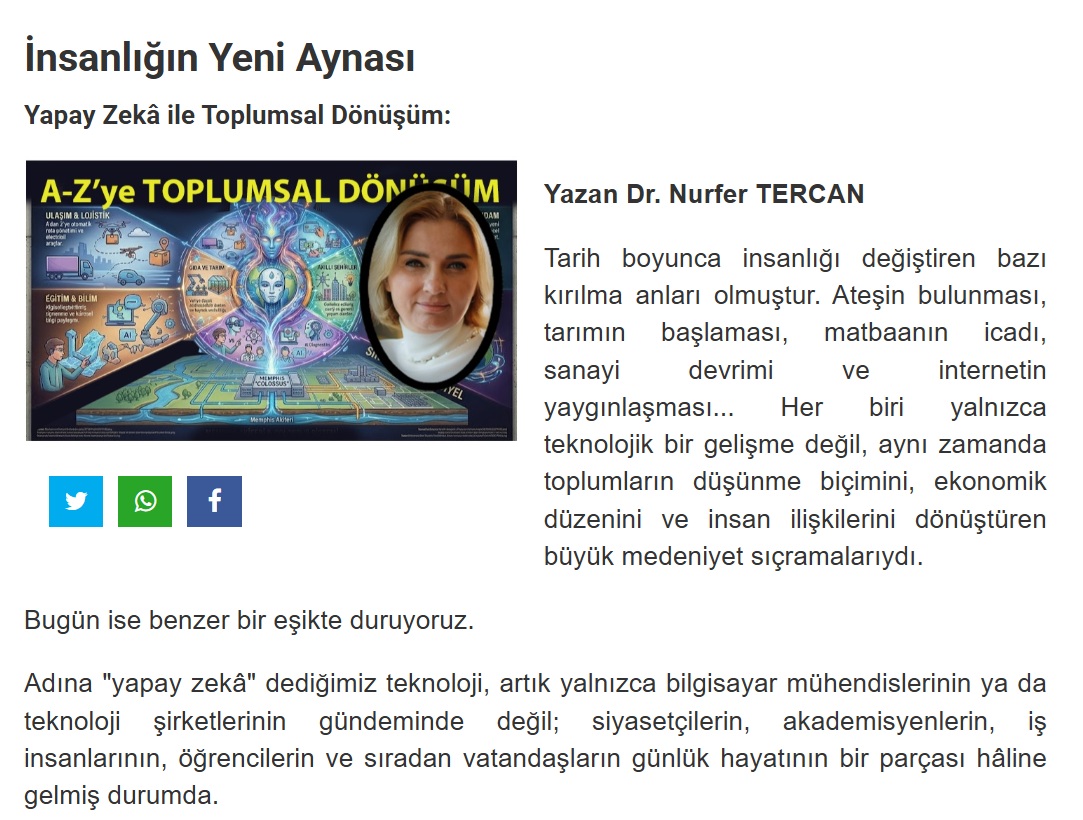
By Dr. Nurfer TERCAN
Throughout history there have been certain turning points that changed humanity. The discovery of fire, the beginning of agriculture, the invention of the printing press, the industrial revolution and the spread of the internet… Each was not merely a technological development, but also a great civilisational leap that transformed the way societies think, their economic order and human relations.
Today we stand at a similar threshold.
The technology we call “artificial intelligence” is no longer only on the agenda of computer engineers or technology companies; it has become a part of the daily lives of politicians, academics, business people, students and ordinary citizens.
The real question now is this:
Will artificial intelligence enter our lives?
No.
Because it already has.
The real question is how this transformation will change societies.
Not Those Who Produce Information, but Those Who Manage It, Will Win
In the industrial age, power was determined by factories.
In the information age, by data.
In the age of artificial intelligence, those who can make sense of data will come to the fore.
When we look at the world’s largest companies today, we see that they have become global powers not because they own oil wells, mines or gigantic factories, but because they are able to process data.
This holds true for states as well.
The new arena of competition in the 21st century is not only energy corridors or trade routes. Data security, the capacity to develop algorithms and artificial intelligence ecosystems are now among the fundamental elements determining the strategic power of countries.
For this reason, in the future the difference between countries will be determined not by the size of their population but by their pool of digital talent.
Not Jobs, but Professions Are Being Transformed
The concern most frequently heard in debates on artificial intelligence is that unemployment will rise.
Yet history tells us something different.
Every great technological revolution, while eliminating some professions, has brought forth new ones.
Today accountants, lawyers, teachers, journalists, doctors and engineers have to learn to work together with artificial intelligence.
The successful person of the future will be not merely the one who possesses knowledge, but the one who can put the right questions to knowledge.
Perhaps the most valuable skills of the coming years will be “critical thinking” and “human judgement”.
Because artificial intelligence can produce answers.
But it is still the human being who decides which question needs to be asked.
The Greatest Transformation Will Take Place in the Cultural Sphere!
Most of the debates about artificial intelligence are centred on the economy.
Yet the real transformation will take place in the cultural sphere.
People will now read the news through algorithms, receive their education from personalised systems, and even make many of their decisions in line with the recommendations of digital advisers.
This holds serious risks as much as great opportunities.
Because algorithms do not produce information alone; they also produce perception.
What a society will talk about, what it will care about and what it will react to is increasingly being steered by digital systems.
Consequently, the most important issue of the future will be not so much developing technology as the values on which we will build it.
Where Does the Turkic World Stand in This Process?
Today, within the Organization of Turkic States, digitalisation, technology partnerships and joint innovation ecosystems are increasingly coming onto the agenda.
Türkiye, Azerbaijan, Kazakhstan, Uzbekistan, Kyrgyzstan and the other Turkic states possess significant potential with their young populations, vast geographies and growing technology investments.
However, for this potential to turn into real power, joint artificial intelligence centres, common data policies, large language models working in the Turkic languages and joint technology funds must be established.
Because in the competition of the future, possessing energy resources alone will not be enough.
It will also be necessary to possess digital sovereignty.
In Lieu of a Conclusion
Sometimes the greatest revolutions take place in silence.
Artificial intelligence is like that too.
There are neither tanks in the streets nor crowds in the squares…
Yet humanity is passing through a radical transformation in every field, from its way of thinking to working life, from education to politics.
In this process, to look at artificial intelligence only as a technology falls short.
It is at the same time a mirror reflecting the choices societies make about the future.
And what appears in that mirror is in fact not machines but humanity itself.
Because what will determine the future is not how powerful artificial intelligence is, but how wise humanity is able to remain.
Notes from the Blue of the Windy City
Translated from the Turkish original.