The New Test Before the Organization of Turkic States:
By Dr. Nurfer TERCAN
Throughout history, states defended their borders in order to preserve their independence. They raised armies, built fortresses, developed alliances. Because when sovereignty was mentioned, what came to mind first was territorial integrity.
In the 21st century, however, the concept of sovereignty has gained a new dimension. Protecting borders alone is no longer enough. Data must be protected. Digital infrastructures must be protected. Information must be protected.
In short, states face a new test: digital sovereignty.
The Invisible Borders of the New Age
New borders are forming that do not appear on maps but directly affect our lives. These borders are drawn neither by mountains nor by rivers; they are drawn by data flows.
Today the search engine, social media platform, payment system or artificial intelligence application a citizen uses is most often managed from centres far beyond the country’s borders. While this provides technological convenience, it also creates a strategic dependency.
Because in the digital world, as dependency grows, decision-making capacity becomes more open to external influences.
The New Element of Sovereignty: Data
In the past, countries gained power through their gold reserves. Then energy resources came to the fore. Today, data is becoming the new strategic resource.
Citizens’ economic preferences, educational habits, health data, communication networks and digital behaviour are regarded as among the most valuable capital of the future.
For this reason, data security is no longer merely a technical matter. It is at the same time a question of national security, economic development and cultural independence.
A Historic Opportunity for the Turkic World
In recent years the Organization of Turkic States has taken concrete steps in the fields of transport, energy, education and culture; the “Turkic World Vision 2040” document adopted at the 2021 Istanbul Summit set a common direction for this cooperation. Yet one of the most critical items of the coming period will be digital cooperation.
Because the Turkic world, with its population exceeding 170 million, its young human resources, its vast geography and its growing technology ecosystem, holds a remarkable potential.
When Türkiye’s capacity for technology production, Kazakhstan’s experience of digital transformation, Uzbekistan’s young population, Azerbaijan’s strategic vision, and the rising human resources of Kyrgyzstan and the other brotherly states come together, a power may emerge that can be influential not only on a regional but on a global scale.
Common Language, Common Data, Common Future
One of the greatest advantages of the Turkic world is its shared cultural memory. But in the digital age this advantage needs to be transformed into technology.
Today a significant portion of the world’s large artificial intelligence models are trained on English-language data; the Turkic languages are still not sufficiently represented. Yet common digital data pools covering Turkish, Kazakh, Uzbek, Kyrgyz, Azerbaijani Turkish and the other Turkic languages can be created. Common dictionaries and joint artificial intelligence laboratories can be established; powerful models that understand and generate the Turkic languages can be developed.
Moreover, this is no longer merely a wish. With the Common Alphabet Commission it established in 2022, the Organization reached agreement on a common Latin-based alphabet. More importantly still, within the framework of the artificial intelligence action plan it recently announced, Türkiye declared that a joint “Turkic Languages Large Language Model” covering the Oghuz, Kipchak and Karluk language groups will be developed together with the Organization of Turkic States. In other words, the call of this article is the name of a goal that has already begun to take its first steps.
Because in the digital age, societies that cannot protect their language begin in time to lose their space of thought as well.
From Cybersecurity to Artificial Intelligence
The threats of the future will not target physical borders alone. Cyberattacks, data manipulation, algorithmic steering, disinformation campaigns and AI-assisted information operations will become increasingly decisive.
For this reason it seems inevitable that the Organization of Turkic States will in future develop common mechanisms not only in the economic field but also in that of digital security. Just as common understandings of defence were formed in the past, so in the future common cybersecurity reflexes will also have to be developed.
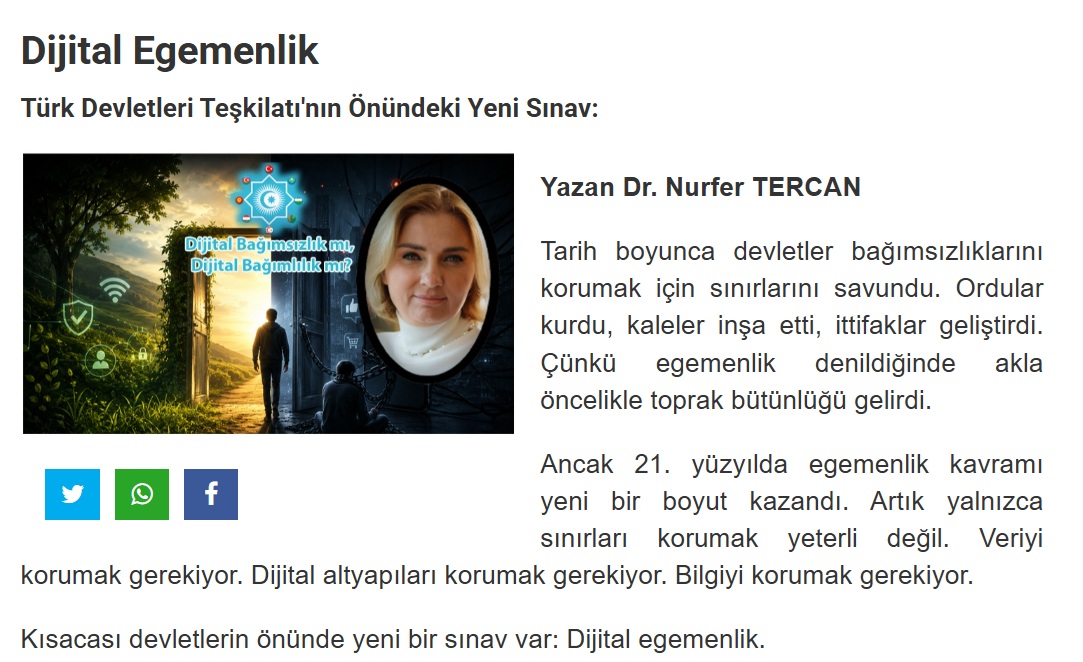
Digital Independence or Digital Dependence?
Today many countries use technology; but very few produce it. The difference emerges exactly here.
Those who use technology may be consumers. Those who produce technology shape the future.
This, too, is the fundamental choice before the Turkic world: a digital future dependent on systems developed by others; or a future that builds its own capacity, manages its own data and develops its own technological vision?
In Lieu of a Conclusion
Throughout history, the price of independence has always been preparedness. Today the situation is no different. But the field of struggle is changing.
Borders are now protected not only on land but also in digital networks. Sovereignty is measured not only by the flag but also by data. Power is shaped not only by armies but also by algorithms.
One of the greatest tests before the Organization of Turkic States is to be able to read this very transformation correctly. Because in the world of the future, independence will mean not only being able to protect the land, but being able to protect data, produce knowledge, develop technology and determine one’s own digital destiny.
Perhaps at the end of the 21st century, when historians tell of today, they will write that the most important issue determining the destiny of the Turkic world was not energy corridors but the struggle for digital sovereignty.
Notes from the Blue of the Windy City
https://www.5gvirusnews.com/yazarlar/dijital-egemenlik-h1898.html
Translated from the Turkish original.