“A society remains human to the extent that it protects the rights of its orphans.”
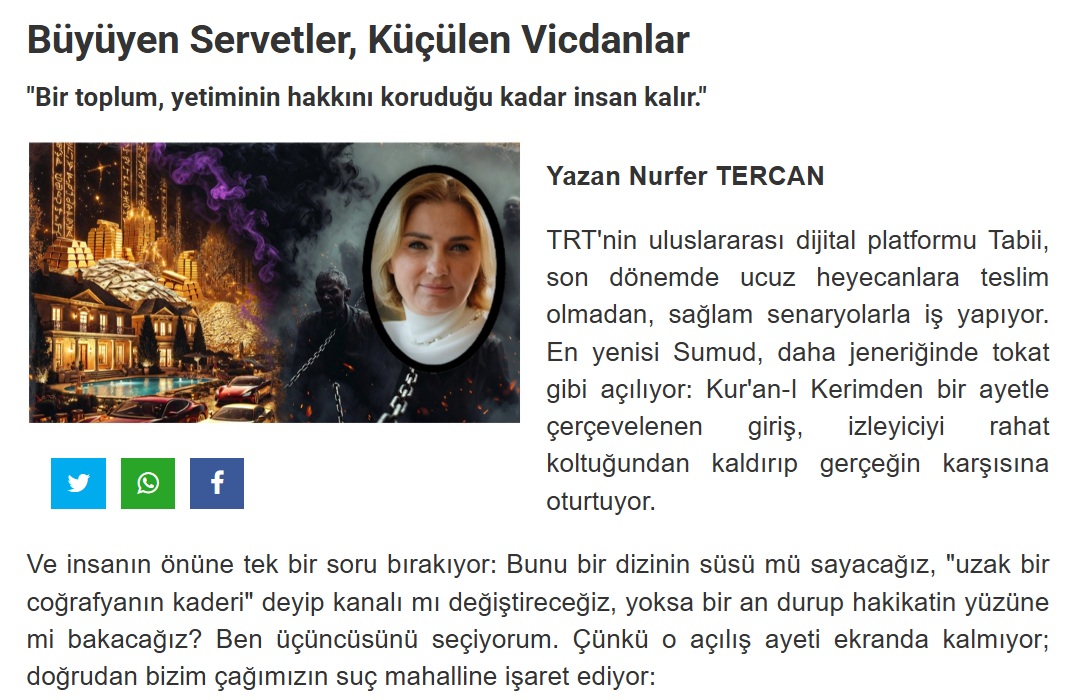
By Nurfer TERCAN
Tabii, TRT’s international digital platform, has lately been producing work built on solid scripts, without surrendering to cheap thrills. The newest of these, Sumud, opens like a slap in the face from its very title sequence: an opening framed by a verse from the Holy Qur’an lifts the viewer out of a comfortable armchair and seats them face to face with reality.
And it leaves a single question before us: are we to regard this as the ornament of a series, are we to say “the fate of a distant land” and change the channel, or are we to pause for a moment and look truth in the face? I choose the third. Because that opening verse does not stay on the screen; it points directly to the crime scene of our own age:
“Those who unjustly consume the property of orphans are surely filling their bellies with nothing but fire. And they will enter a blazing fire.” (An-Nisa, 10)
Some verses speak not to one period but to all ages. Fourteen centuries have passed; yet human ambition, greed, and the habit of currying favour with the strong while crushing the weak have not changed one iota. The tenth verse of Surah An-Nisa shows this unchanging face so nakedly that at every reading it seems as if it had landed in today’s headlines.
Those Who Fill Their Bellies with Fire
At first glance, the verse is thought to speak of those who lay hands on the property of orphans. Yet the matter is far greater than a child’s inheritance. The verse declares usurping the right of one who cannot defend himself to be the basest crime of humanity. And throughout history this crime has always been committed by the same people, always with the same shamelessness.
Because the “orphan” is not only a child without parents. The orphan is the one who has no power. The one whose voice is stifled. Everyone who is not invited to the table, whose decisions are made by others, who has been deprived of the means to seek their rights.
This is why this verse cannot be squeezed into a few pages of inheritance law and passed over. Because consuming the orphan’s property is not merely seizing the inheritance left by a dead father. Consuming the orphan’s property means stealing a young person’s dreams, exploiting the sweat of a worker’s brow, pouring the common wealth of a nation into the coffers of a few. Consuming the future of a generation at today’s tables of unearned profit is this too. So is turning public property into personal gain. So is handing the right of the poor to the powerful as a favour. So is turning war into trade, human suffering into tenders, and blood into profit…
The guises have changed, the methods have changed, the signboards have changed; but the crime is the same. There is no moral difference whatsoever between those who emptied the orphan’s purse yesterday and those who plunder society’s future today. For both set their sights on the right of one who cannot defend himself. And, to put it in the language of the Holy Qur’an, they are not merely amassing wealth; whether they are aware of it or not, they are filling their bellies with fire.
The image the Qur’an chooses makes one’s hair stand on end: “They fill their bellies with fire.” A person eats bread, drinks water, is nourished. But unjust gain is not food; it is a live ember. The man thinks he is amassing wealth; yet within himself he is feeding the blaze that will one day reduce everything he has to ashes.
This is precisely the great lie of the modern world. We measure success by looking at titles: we ask how much someone has earned, not how they earned it. We applaud how much they have grown, and ignore whom they crushed in order to grow. We admire their power, and never ask on the corpses of which rights that power was built.
Yet history speaks clearly: no order built on injustice has remained standing. Rome, the Soviets, the colonial empires and the inflated financial bubbles alike, while looking like giants from the outside, collapsed from the fire within them. Because the work of fire is to burn. First it burns the conscience, then the institutions, then society, and finally the state of those who worship that power.
That inequality has become an abyss today, that the distribution of income has rotted, that societies have been set against one another is not a coincidence but a matter of choice. The concentration of the world’s wealth in a minority small enough to fit in the palm of a hand, and billions left in need of bread: this is today’s name for the moral decay on which the verse puts its finger.
Technology is soaring, artificial intelligence is speaking, vehicles are going into space. But if on the same planet millions of children go to bed hungry, if millions of young people have lost hope in their tomorrow, if millions of people cannot receive the reward of their labour, what we have is not a brilliant civilisation but a moral wreckage wearing make-up.
Al-Farabi’s virtuous city is not the one where wealth accumulates in a few hands; it is the city where justice is shared among all. Aristotle’s politics is the struggle not to hold on to power but to realise the common good. And the judgement of the Qur’an is clear: a society’s claim to civilisation carries meaning to the extent that it can protect the right of the weak. If the rights of the orphan, the poor, the worker and the forsaken are trampled, then the rising buildings, the growing figures and the gleaming shop windows are nothing more than curtains covering not a civilisation but a great moral collapse.
The greatness of a society is measured not by the height of its skyscrapers, but by how safe its orphans, its poor and its most defenceless members are. The true might of a state, too, lies not only in its economic figures, the splendour of its institutions or the grandeur of its offices; it lies in its ability to deliver justice all the way to its most helpless citizen and to show respect for the labour of those who produce knowledge beneficial to society.
Because morality is not only the responsibility of protecting the powerless; it is also the virtue of being able to render a right to its rightful owner. The person who usurps the right of the one who produces knowledge, who makes labour invisible, or who turns another’s idea into a step towards his own office is also among those who upset the scales of justice.
In the end, a person’s worth is determined neither by the size of his wealth nor by the splendour of his titles. His true value emerges in his stance towards virtue, in his sincerity before the truth and in the respect he shows for the rights of others. What is decisive is whether he acts by using knowledge like a ladder, to add office to his office and fame to his fame; or whether he possesses a conscience that will render labour and right to their owner.
For a person’s truth is seen most of all in how much his hand trembles when it reaches for another’s right.
This shattering judgement of Surah An-Nisa is not a threat hurled at the future; it is a profound diagnosis of human nature. Injustice at first glance looks like gain; it brings wealth, confers influence, gathers applause. But every usurped right, every stolen labour and every trampled justice leaves within a person a fire that has turned to embers. Time may cover that fire with ash; but it cannot extinguish it. Because fire has an unchanging justice of its own: in the end it burns most of all the one who lit it.
Notes from the Blue of the Windy City
Note: Sumud (صمود) is a word of Arabic origin, etymologically derived from the root “s-m-d” (ص-م-د). In its literal sense it means to resist, resoluteness, perseverance and unshakeable determination.
https://www.5gvirusnews.com/yazarlar/buyuyen-servetler-kuculen-vicdanlar-h1899.html
Translated from the Turkish original.