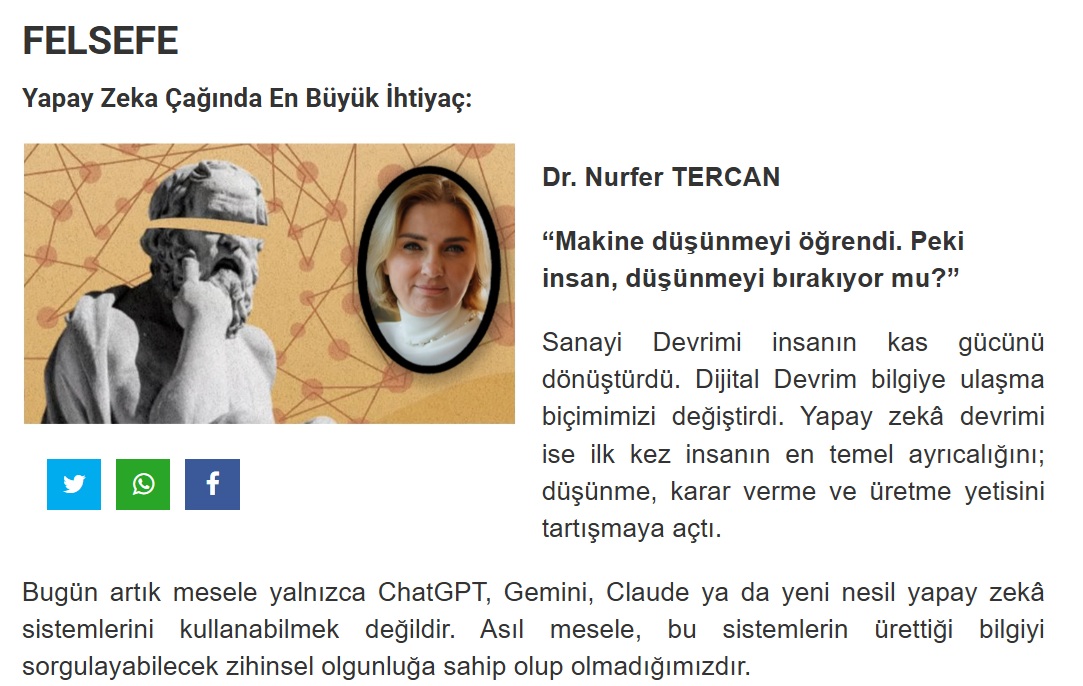
The Greatest Need in the Age of Artificial Intelligence:
Dr. Nurfer TERCAN
“The machine has learned to think. But is the human being giving up thinking?”
The Industrial Revolution transformed human muscle power. The Digital Revolution changed the way we reach information. The artificial intelligence revolution, however, has for the first time opened to debate the most fundamental privilege of the human being: the capacity to think, to decide and to create.
Today the issue is no longer merely being able to use ChatGPT, Gemini, Claude or the new generation of artificial intelligence systems. The real issue is whether we possess the intellectual maturity to question the information these systems produce.
For precisely this reason, the most strategic subject of the twenty-first century may be not computing but philosophy.
Because artificial intelligence produces answers.
Philosophy, on the other hand, teaches the right question.
The difference between the two is great enough to determine the future of humanity.
Today the world’s largest technology companies are spending billions of dollars to develop more powerful algorithms. In contrast, UNESCO and international educational organisations emphasise that artificial intelligence literacy cannot consist of technical skills alone; that it must be supported by ethics, critical thinking and human-centred education. The artificial intelligence competency frameworks prepared for teachers and students are built on exactly this understanding. (see)
Because algorithms can process information.
But they cannot construct meaning.
An artificial intelligence can read millions of books.
Yet it cannot give a definitive answer to the questions “What is justice?”, “How is a good life possible?”, “Does free will really exist?”
These are still the questions of Aristotle, of al-Farabi, of Kant and of humanity’s shared heritage of thought.
It is exactly here that law, sociology and philosophy are returning to centre stage.
Artificial intelligence is in fact turning us not towards machines but back towards ourselves.
Because for the first time the human being is able to watch the limits of his own intelligence from the outside.
Perhaps for the first time in history, people will have to learn anew “what thinking is”.
Today, in many university departments, philosophy is still regarded as an elective course.
Yet in a few years the situation may be completely reversed.
Engineers will have to learn ethics.
Doctors will question algorithmic decisions.
Judges will evaluate legal analyses produced by artificial intelligence.
Journalists will try to tell reality from simulation.
And teachers will turn into guides who teach thinking rather than transmit information.
Because information is no longer scarce. Judgement is scarce.
Memorisation is not scarce. Wisdom is scarce.
Data is not scarce. Meaning is scarce.
Artificial intelligence can give us information within seconds.
But only the human being can decide which information is true, which is just, and which is beneficial for humanity.
That is why the most valuable profession of the future will perhaps be “the person who can think well”.
A comprehensive report recently prepared within the United Nations showed that inequalities in the field of artificial intelligence cannot be resolved by access to technology alone; that societies need to develop their capacity for critical thinking, artificial intelligence literacy and ethical governance. Otherwise technology may deepen inequalities of power rather than produce knowledge. (see)
Perhaps the time has now come to add a new core course to our education system:
“Philosophy and Artificial Intelligence.”
This course will not teach students algorithms alone; it will teach the human being behind the algorithms.
Because what will write the future will not be machines that run faster, but human beings who can think more deeply.
And perhaps the most powerful artificial intelligence of the future will never go beyond being the best assistant of a human mind raised on philosophy.
Now is exactly the time to think!
Notes from the Blue of the Windy City
https://www.5gvirusnews.com/yazarlar/felsefe-h1906.html
Translated from the Turkish original.