The New Power Doctrine of the 21st Century: The Language of Civilisation That Anatolia Offers the World
By Dr. Nurfer TERCAN
Throughout history, great states have shown their power to the world through different instruments.
Some spoke with the sword.
Some ruled the seas.
Some controlled the trade routes.
Some led the industrial revolution.
Some produced technology.
Today, however, the world stands before a new threshold.
Because power is no longer merely military superiority.
Economic size alone is not enough either.
Nor can digital technology by itself create a lasting impact.
The real competition of the twenty-first century is the competition to win humanity’s trust.
That is why international relations are in need of a new concept.
And this concept is now being defined as gastropolitics!
Gastropolitics is the civilisational approach that regards a nation’s soil, agriculture, cuisine, cultural heritage, understanding of hospitality and culture of living together as a strategic power for diplomacy, trust-building and international cooperation.
At the centre of this definition there is no food.
There is the human being!
Because food is the visible face of culture.
The real issue is culture.
The real issue is producing trust…
This is exactly why Anatolia is not merely a geopolitical crossroads.
It is at the same time a geocultural centre.
This geography where Asia and Europe meet has, for thousands of years, been not merely a passage through which goods circulated.
It became a school in which ideas circulated.
It became a kitchen in which flavours circulated.
It became a conscience in which faiths conversed.
It became a great arena of civilisation in which people hosted one another.
Today the world talks about energy corridors.
It talks about logistics corridors.
It talks about digital corridors.
All of these are important.
But the most powerful corridor of the future will be the culture corridor.
Because energy grows the economy.
Technology accelerates production.
But culture produces trust.
And trust is the most precious capital of the international order.
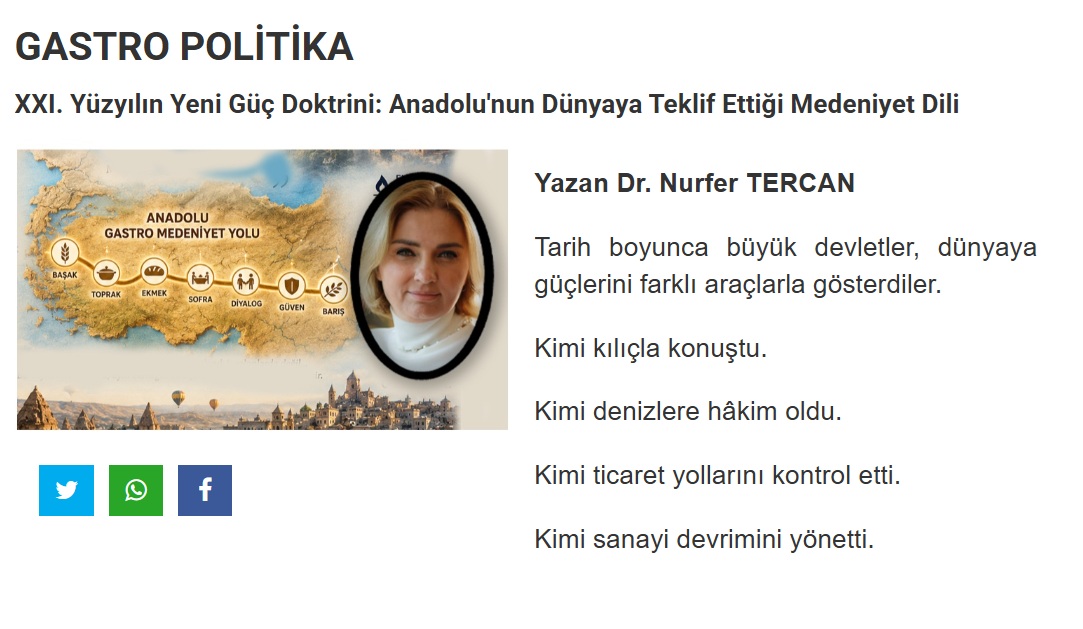
This is precisely why the Anatolian Gastro-Civilisation Road is no ordinary gastronomy route.
It is a corridor of civilisation that turns soil into culture, culture into dialogue, and dialogue into trust.
The first stop on this road is the ear of wheat.
Its last stop is peace.
Because the ear of wheat is the symbol of production.
Bread is the symbol of sharing.
The table is the symbol of trust.
And civilisation is the institutionalised form of all these symbols.
Today security platforms such as NATO, legal institutions such as the Council of Europe and global structures such as the United Nations are working to strengthen the international order in different fields.
But security cannot be explained by deterrence alone.
Societies getting to know one another…
Cultures understanding one another…
People being able to come together around shared values…
These too are indispensable parts of security.
It is here that Anatolia’s tradition of hospitality can become a complementary language of modern diplomacy.
Hospitality is not weakness.
It is self-confidence.
Societies that can open their doors are societies that trust their identity.
Societies that can share their bread are societies strong enough to share their future.
For this reason Anatolia’s culture of the table is not mere folklore.
It is strategic cultural capital.
Perhaps in the 21st century countries will place not only their defence industries…
But their seed banks…
Their local cuisines…
Their gastronomy academies…
Their cultural heritage networks…
And their gastro-diplomacy institutes at the centre of their national strategies.
Because in the world of the future it is not only the states that protect their borders…
But also the states that contribute to humanity’s common memory that will be leaders.
It is here that Anatolia’s historical experience takes on a new meaning.
This geography reminds us of a truth:
Civilisation is not merely the accumulation of power.
Civilisation is the accumulation of trust.
And trust, more often than not, sprouts not in the halls where treaties are signed…
But around a table, in the quiet moments when the same bread is shared.
Perhaps the real geopolitics of the 21st century is not to redraw the maps.
It is to be able to set humanity’s common table once again.
This is the vision that the Anatolian Gastro-Civilisation Road offers the world.
A road…
But not one that merely connects cities to one another…
A road that brings consciences closer to one another.
A route…
But not one that merely grows trade…
A route that grows culture, trust and a shared future.
And perhaps humanity, after a long time, will once again remember this truth:
Weapons can protect borders.
The economy can produce prosperity.
Technology can make life easier.
But what keeps civilisation alive are the people who can go on trusting one another at the same table.
Because the world’s strongest alliance is not merely the alliance formed against common threats.
The strongest alliance is the alliance of a humanity that can share common bread, common labour and a common future.
And Anatolia, with its memory of thousands of years, is an ancient geography of civilisation that still has something to say to this alliance.
Notes from the Blue of the Windy City
https://www.5gvirusnews.com/yazarlar/gastro-politika-h1912.html
Translated from the Turkish original.