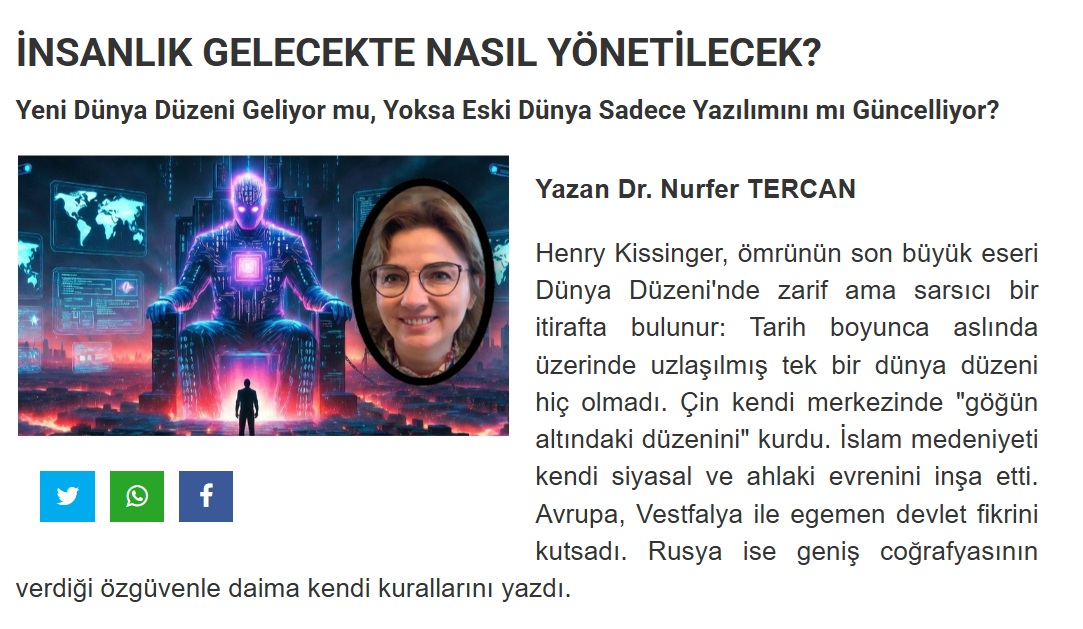
Is a New World Order Coming, or Is the Old World Merely Updating Its Software?
By Dr. Nurfer TERCAN
Henry Kissinger, in World Order, the last great work of his life, makes an elegant but unsettling admission: throughout history there has in fact never been a single world order that everyone agreed upon. China built its own order “under heaven” around its own centre. Islamic civilisation constructed its own political and moral universe. Europe, with Westphalia, sanctified the idea of the sovereign state. Russia, with the self-confidence its vast geography bestowed, always wrote its own rules.
The real point is that these orders are now sitting at the same table for the first time.
What is more, we live in an age in which no one sits at the head of that table.
This was precisely Kissinger’s concern: there is no common arbiter, no common constitution, and the common conscience is growing ever weaker. That is why the old diplomat proposed a prescription that, unromantic as it may seem, was realistic: powers must balance one another. For power, left to itself, does not produce morality; it produces only more power.
While the book sat on the shelves, an entirely different discipline began to answer the same question.
Astrologers.
On social media it is being proclaimed with great enthusiasm that August 2026 is “the beginning of the new world order”. The planets are aligning, the old age is closing, a new energy is beginning, or so we are told.
I am not brave enough to entrust geopolitics to Mercury retrograde.
But this is exactly where the irony of our age begins.
On one side, Kissinger with half a century of diplomatic experience…
On the other, a colourful animation of the sky spinning on a phone screen…
And both are uttering the same sentence:
“The world you know is ending.”
One says it with footnotes.
The other with emojis.
And then a small but loud piece of news arrives from Nicaragua.
President Daniel Ortega announces that elections will no longer be held in the country.
It must have been discovered that the most expensive cost of democracy is elections.
Once you remove the ballot box, the election result is guaranteed as well.
From the standpoint of statistical science, an extremely successful method.
Moreover, Ortega’s story is in itself an irony of history.
Once a revolutionary who took to the mountains against dictatorship…
Today a head of state who runs power with the care one gives a family company.
His wife is “co-president”.
The term of office has been extended.
Elections have been removed from the calendar.
And democracy has been consigned to the museum.
History’s sense of humour is truly formidable.
Because sometimes revolutions change only the surname of those in power.
Yet to see Ortega as an exotic exception would be comforting but misleading.
Today, in many parts of the world, the ballot boxes are still there.
Posters are put up.
Rallies are held.
Campaigns are run.
Results are announced.
But the real question now is this:
Is there an election, or is there only the appearance of one?
Perhaps the greatest invention of the 21st century is not abolishing elections…
It is keeping the elections and reducing the competition.
The institutions remain in place.
The constitutions are on the shelves.
The courts are open.
The parliaments are at work.
Only their contents have been updated.
Like the “interface has changed” notice on our computers.
Sometimes democracy is not abolished.
It is quietly updated.
The equation Kissinger called the “balance of power” is being rewritten today with other actors.
Once, states competed.
Now algorithms compete too.
Once, borders were protected.
Today, data is protected.
Once, oil was the strategic resource.
Today, attention span is more valuable.
Once, spies gathered information.
Now people hand over information for free.
Perhaps the most powerful army of the new age is made up not of tanks but of servers.
Data centres are rising beside the arms factories.
Maps are being replaced by network maps.
Wars are sought to be won on screens before they begin on the front lines.
So where is the world really heading?
Perhaps not from a unipolar world to a multipolar one…
But to a multi-layered world.
There are states.
There are corporations.
There is artificial intelligence.
There are global financial networks.
There are social media platforms.
There are influencers.
There are crypto communities.
And in the midst of all this, there is the increasingly lonely individual.
It is no longer only countries that compete with one another.
Our relationship with reality is in competition too.
We are making an invisible choice between truth and the algorithm.
Every day.
Without realising it.
Perhaps the greatest problem of the future will not be democracy.
It will be reality.
Because dozens of different truths can be produced for the same event.
What is called a coup in one country is called a revolution in another.
What is presented as freedom in one place is described as chaos in another.
It is no longer only borders…
Truth itself is fragmenting too.
And what is fragmenting is not merely information; it is our shared reason.
That is why the new world order will perhaps not be a giant system governed from a single centre.
Rather, it will be an enormous waiting room in which powers that do not trust one another watch each other constantly.
A long interim period in which no one fully wins…
No one fully loses…
But everyone suspects everyone else.
Perhaps historians will one day call it “the age of uncertainty”.
Then we turn and look at Nicaragua again.
In truth, the issue is not Ortega.
The real issue is that his sentence no longer surprises people as much as it once did.
As much as a leader saying “there will be no more elections”, the silence of a world that hears it, shrugs and carries on with its daily life is also worth pondering.
Perhaps this is exactly what the new world order is.
Not an order in which freedom vanishes overnight…
But one to which people slowly grow accustomed.
Kissinger was searching for balance.
The astrologers promise a new age.
And Ortega removes the ballot box.
Perhaps, amid all these voices, the question that truly needs to be heard is still the same:
How will humanity be governed in the future?
By the gun?
By the algorithm?
By data?
Or still by a public reason built by law, institutions and a shared conscience?
Because the future will be the story not only of technology or geopolitics, but also of how much human beings continue to value freedom.
And the oldest lesson history has taught us still holds true:
Before a society loses its elections, it most often loses its capacity to be surprised.
Notes from the Blue of the Windy City
https://www.5gvirusnews.com/yazarlar/insanlik-gelecekte-nasil-yonetilecek-h1919.html
Translated from the Turkish original.