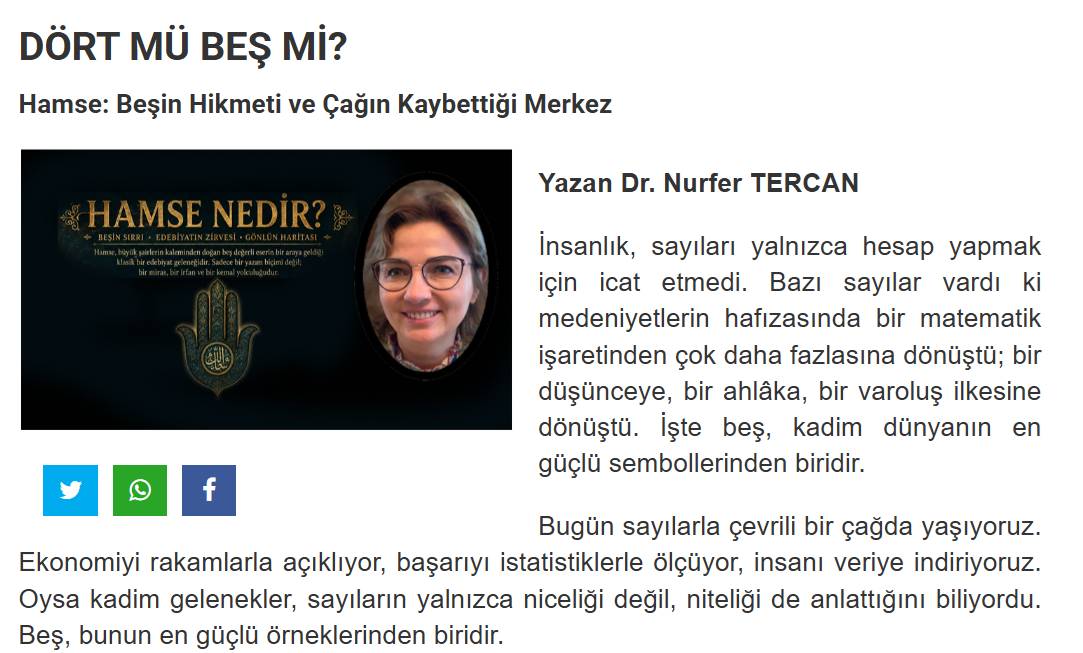
Khamsa: The Wisdom of Five and the Centre Our Age Has Lost
By Dr. Nurfer TERCAN
Humanity did not invent numbers merely to count. Some numbers became, in the memory of civilisations, far more than a mathematical sign; they turned into an idea, an ethic, a principle of existence. Five is one of the most powerful symbols of the ancient world.
Today we live in an age surrounded by numbers. We explain the economy with figures, measure success with statistics and reduce the human being to data. Yet the ancient traditions knew that numbers speak not only of quantity but also of quality. Five is one of the strongest examples of this.
Four is the order of the world. Four directions, four seasons, four elements… Earth, water, air and fire build the material frame of existence. But ancient wisdom does not stop there, because a universe made of matter alone is incomplete. It is precisely here that the fifth element appears: spirit, essence, breath, ether… Whatever its name, it is the invisible substance that joins lifeless order with living meaning.
Perhaps the greatest crisis of our age begins exactly here. We are building the world, but we cannot give it a soul. Cities grow, buildings rise, technology accelerates; yet the inner world of the human being does not deepen to the same degree. Civilisation advances, while the human being all too often loses his centre.
That is why five is not merely a number; it is a warning.
In Islamic thought, five is the rhythm of worship, discipline and responsibility. In Sufism it symbolises the human journey towards one’s own truth. In Anatolia’s tradition of the “Hand of Hamsa” it becomes a protective sign; in classical Ottoman (divan) literature it becomes the name of a journey of wisdom.
At this point “Khamsa” (Hamse) is not only a word meaning “five”. It is also the name of a literary corpus made up of five great works: the immortal Khamsa of Nizami Ganjavi, followed by the works of Ali-Shir Nava’i and Taşlıcalı Yahya… The five here is not the sum of unrelated books. Each work represents a stage in the human journey towards truth. Parts that appear separate become the pillars of a single architecture of wisdom.
Perhaps this is exactly what we need to learn again today.
The modern world teaches us to fragment. The human being is divided into a profession, divided into an identity; he becomes a consumer, a voter, a user, a target audience. The ancient world, by contrast, integrated. For it knew that fragmented knowledge may multiply, but a fragmented human being cannot grow.
This is the truth the Khamsa really reminds us of: a human being is whole only to the extent that he can bring his parts together.
Today we train “experts” in every field, yet we struggle to raise people of wisdom. We increase knowledge but neglect meaning. We live in the age of data, yet we drift ever further from the age of wisdom. The result is not more technology; it is more loneliness, more alienation and a greater loss of direction.
Perhaps it is time to remember this ancient sentence once again:
Four elements build the world; the fifth element gives it a soul. Four directions form space; the fifth point is the centre of the human being.
The issue is not to rebuild the world. The issue is to be able to place the human being back at the centre of the world, and conscience, wisdom and meaning back at the centre of the human being.
For civilisation does not rise on stone, steel and technology alone. Civilisation stands through people who have not lost their soul.
And perhaps this is why the Khamsa is not a literary tradition left in the past, but one of the strongest calls to civilisation reaching into the future. For sometimes the truth is hidden in just five letters: Hamse.
Notes from the Blue of the Windy City
https://www.5gvirusnews.com/yazarlar/dort-mu-bes-mi-h1930.html
Translated from the Turkish original.