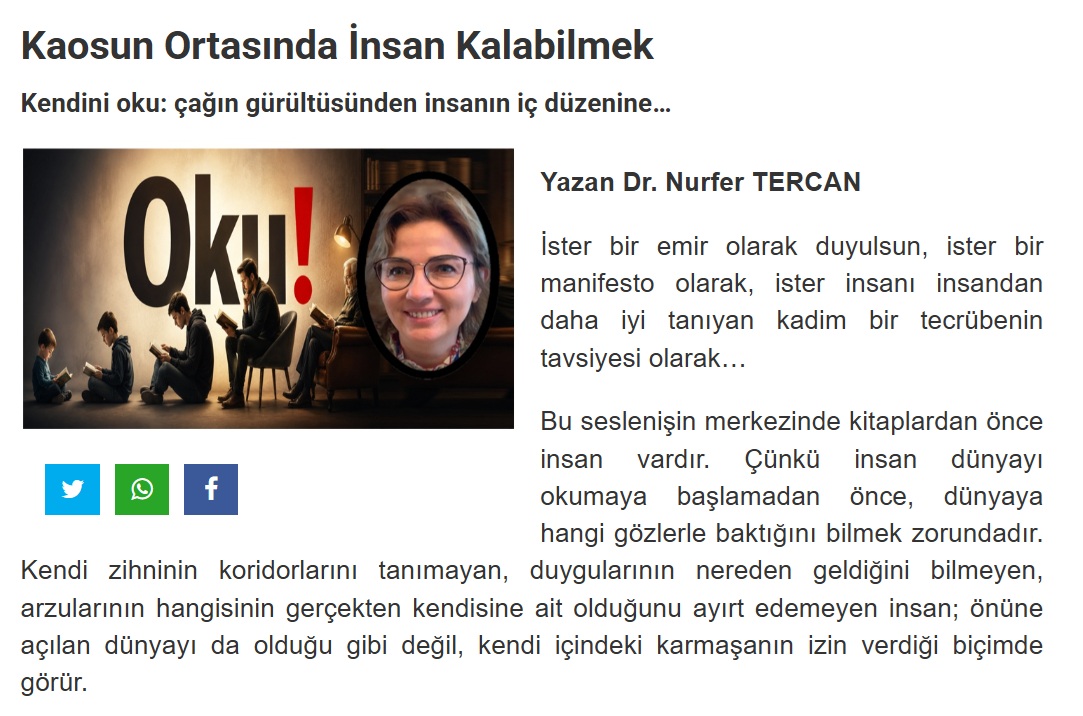
Read yourself: from the noise of the age to the inner order of the human being…
By Dr. Nurfer TERCAN
Whether it is heard as a command, as a manifesto, or as the counsel of an ancient experience that knows the human being better than the human being does…
At the centre of this call, before books, stands the human being. For before beginning to read the world, a person must know through which eyes he looks at the world. A person who does not know the corridors of his own mind, who does not know where his emotions come from, who cannot tell which of his desires truly belongs to him, sees the world that opens before him not as it is but in the way the confusion within him permits.
For this reason perhaps the opening sentence of all reading is this: Read yourself. Then the world close to you. Then the whole world. And finally the universe.
Yet the text a person finds hardest to read is still himself. A book lies quietly before us; a person reading himself, however, comes face to face with his own fears, his passions, his arrogance, the feelings he has suppressed and the illusions he has for years taken for truth.
Is the Chaos Outside or Inside?
Today we often speak of the world being chaotic. Politics is chaotic. The economy is chaotic. Society is chaotic. Relationships are chaotic.
Yet perhaps we need to ask a harder question: What if the chaos is not only outside? What if part of the disorder we see outside is the inner world of the human being spilling over into the social sphere?
A person who has not been able to establish his inner order begins, in time, to accept disorder as normal. Calm feels foreign to him. He grows bored of peace. Silence disturbs him, because it will leave him alone with his own inner voice. If there is no crisis, he produces one. If there is no quarrel, he starts one. When one problem begins to be solved, he finds another.
For some people chaos is no longer a condition they experience but a way of existing.
The storm inside spills outward. And instead of noticing the disorder within himself, a person begins to disrupt the order of the people around him. After a while it is not only he who grows weary; he wearies every environment he is in. The family. The workplace. The street. Society. For unrest is as contagious as peace.
The Human Being in the Age of Labels
More dangerous still is the merging of this inner disorder with the relations of power and interest of our age. When a person begins to explain who he is not by his character but by the labels he possesses, another fracture appears.
Position. Title. Money. Connections. Belonging. “Those who are one of us” and “those who are not one of us”…
When a person begins to build his own worth on these, he hands the scales within him over to the outside. What is right is no longer right because it is truly right; it is right because our people say so. What is wrong is not wrong because it is truly wrong; it is wrong because the others do it.
This is where freedom of mind is lost.
A person surrenders his thoughts. He surrenders his conscience. He surrenders his ability to choose. Then, while supposing that he is choosing, he actually begins to wander among options that have been chosen for him. He does not think for himself; he repeats the thought of his group. He does not grow angry by himself; he grows angry at what he is shown. He does not hate by himself; the people he is to hate are placed before him.
Thus the human being gradually ceases to be the subject of his own mind. And as the crowds grow, the human being shrinks.
This Is How Decay Begins
Social decay does not begin with great catastrophes. Most often it begins with small acquiescences.
With seeing the lack of merit and staying silent. With turning a blind eye to an injustice because the one who commits it is “one of us”. With money becoming more valuable than character. With esteem going not to knowledge but to the loud voice. With caring more about whom a person stands beside than about who that person is.
Then society slowly changes its words. In place of conscience comes interest. In place of merit, loyalty. In place of truth, perception.
In place of character, status.
And one day everyone begins to use the same word: decay. Yet the decay did not begin that day. We have merely begun to smell it that day.
Nawabit: The Shoots of the Decayed City
But this is not the whole story of the age. Another type of human being is also becoming distinct: the person who is tired of the noise, who does not want to carry angers that are not his own, who realises that he does not have to join every argument or answer every remark.
Al-Farabi gave the name nawabit to the weeds that spring up of their own accord within the virtuous city; those that sprout though they were not sown, those that do not fit the city’s common measure. For him this was a flaw. But Ibn Bajja, a few centuries later, turned the same concept on its head: when the city is corrupted, the one who does not fit the order is no longer a flaw. The person who goes on thinking rightly within a decayed order is that shoot which springs up of its own accord.
Today’s nawabit does not withdraw to the mountains. He can protect his own soil even in the middle of the crowd.
By silencing his phone. By not answering every argument. By not consuming every piece of news. By not buying every anger offered to him. By understanding that he does not have to be part of every group. By not constantly trying to display himself. And most importantly, by turning inward from time to time.
This is not giving up on the world. It is objecting to the world’s taking over the human mind entirely.
The last geography of the human being that must be protected is his own mind.
When that too is occupied, all that remains is a being that is alive only biologically but does not know what it thinks or why. For this reason one of the greatest struggles for freedom of our age may now be taking place not in the street but in the human mind.
Reading Oneself
The call to “read yourself” regains its meaning exactly here. To read oneself is not to keep proving oneself right. On the contrary, it is to show the courage to be able to see one’s own mistakes.
Why do I get angry? Why do I take sides so easily? Why does another person’s success disturb me? Why do I bow before position? Why do my values change in the face of money? Why do I constantly want to be approved? Why am I able to defend my group’s wrong? Why, instead of listening to the person in front of me, do I think about which box to put him in?
Real reading begins here. A person who cannot read himself, even if you place all the books of the world before him, will only go on reading his own prejudices.
Read the World Close to You
Then comes the second circle. Read the society you live in. Read the street. Read the young. Read the silence of the old. Read the anxiety of the children.
Read the transformation of the family. Read why the cities have lost their soul. Read how everyone talks but no one listens to anyone.
What we call society is not an abstract structure. Society is millions of inner worlds coming side by side.
When inner worlds are corrupted, institutions are corrupted too. When the human being is corrupted, the city is corrupted. When the measure is corrupted, justice is corrupted. When language is corrupted, thought is corrupted. And when thought is corrupted, however magnificent the façade of civilisation may be, the load-bearing columns inside begin to crack.
Read the Whole World
But our own world is not enough either. Read other people. Other societies. Other cultures. Other ideas. The one who does not resemble you.
The one who does not think like you.
For a person who reads only his own neighbourhood begins after a while to take his neighbourhood for the world. Yet truth is larger than our own circle. The world was not built according to our assumptions. Humanity does not consist of our group.
Perhaps one of the most important signs of maturity is a person’s learning not to be disturbed by the existence of someone who does not resemble him.
Read the Universe
And finally: read the sky, the soil, the water, the seasons, birth, death, time. The silent measure of nature. A tree’s growing without haste. A river’s flowing around the stone in its path without breaking it. Night’s making room for day, winter’s for spring…
When a person looks at the universe he sees a very simple but weighty truth:
The universe does not shout. The sun does not try to prove itself.
The tree does not wait for applause. The ocean bears no title.
The soil does not ask about rank.
Life carries on its own great order outside all the artificial hierarchies that man has built. Perhaps what the human being needs to learn again is exactly this: Order is not noise. Power is not domination. Worth is not visibility. Silence is not weakness.
The Great Divide of the Age
In the years ahead the most important divide in societies may appear, before political and economic divides, somewhere else: between those who feed on chaos and those who try to establish their inner order.
On one side, the person who constantly wants more noise, more anger, more show, more belonging and more power. On the other, the nawabit who tries to open for himself a small but genuine space for living.
The first wants to take over the world. The second tries, first of all, not to lose himself.
And perhaps the true founders of the civilisation of the future will not be those who speak in the loudest voice, but those who spring up of their own accord within this great noise, those who can protect their mind, their conscience and their measure.
For humanity today is living through a crisis far deeper than a crisis of knowledge: the crisis of being unable to read oneself.
Read. But not only the text in front of you.
Read yourself. Read the world close to you.
Read the whole world. Read the universe.
And after reading all of these, turn once more to yourself. For at the end of all great journeys the same question again confronts a person: Within this whole world, who are you?
Perhaps the greatest revolution of our age will not begin with the claim of changing the world. Perhaps it will begin in a much quieter place: in a person’s own mind, in his own conscience, in his own inner order.
For sometimes the most powerful thing that can be done against the decay of a society is not to try to fix the world with more noise; it is not to let the decay begin within oneself.
And sometimes civilisation is exactly this: remaining human in the midst of chaos.
https://www.5gvirusnews.com/yazarlar/kaosun-ortasinda-insan-kalabilmek-h1936.html
Translated from the Turkish original.