AN OBJECTION TO THE AGE THAT PUTS EVERYONE ON THE SAME SHIP!
By Dr. Nurfer TERCAN
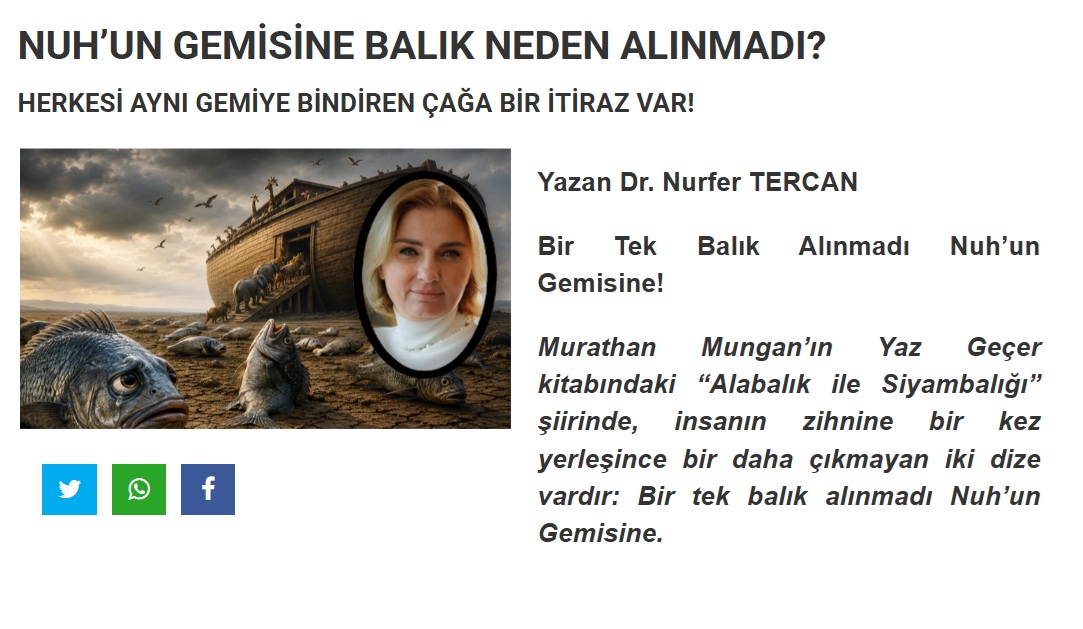
Not a Single Fish Was Taken Aboard Noah’s Ark!
In the poem “Alabalık ile Siyambalığı” in Murathan Mungan’s book Yaz Geçer, there are two lines which, once they settle in the mind, never leave it again: Not a single fish was taken aboard Noah’s Ark.
Immediately afterwards the poet reminds us that the fish was already right in the midst of the danger, in its own water.
Perhaps this is exactly where we need to stop in order to understand our age.
For centuries we have read the story of Noah’s Ark through salvation. The flood is coming, the waters are rising, and the living creatures are taken aboard so that life may go on. But at the very edge of the story stands a question that nobody asks, waiting all alone:
Where is the fish?
The fish is not on the ship. Because the water that is a catastrophe for everyone else is the life of the fish.
This tiny detail places before us a very large question, one that stretches from political theory to education, from technology to human rights: In order to save a person, must we necessarily put them aboard our own ship?
THE SAME FLOOD, DIFFERENT LIVES
For a long time the modern world tried to build equality on “sameness”.
The same model of education. The same measure of success. The same idea of development. The same city. The same consumer culture. The same standard of living. The same way of thinking. Increasingly the same words, the same images, the same tastes, the same reactions.
Yet humanity is not the same.
Even if people live in the same society, they do not come from the same memory, the same culture, the same talent, the same need, the same experience of life.
Real equality, therefore, is not making everyone the same. Justice is not giving everyone the same thing; it is everyone being able to preserve their own possibility of existence.
Giving a fish wings is not kindness. Forcing a bird to live under water is not equality.
And putting everyone on the same ship is not justice.
THE INVISIBLE SHIPS OF OUR AGE
Today’s ships are not made of wood. Today’s ships are invisible.
We have our ideologies. We have our political affiliations, our economic systems, our institutions, our companies, our social circles, our digital platforms, our algorithms.
And each of them quietly says the same sentence to a person: “If you want to be here, you must resemble us.”
Thus modern man increasingly begins to live only among those who resemble him. He follows those who think like him, listens to those who speak like him, socialises with those who live like him. As for those who do not think like him, he first gives up trying to understand them, then estranges them, and finally sees them as a threat.
Society thus ceases to be a shared space of civilisation and turns into closed ships standing side by side. Each ship develops its own truths, its own heroes, its own enemies, its own language and its own system of truth.
Perhaps the real flood begins exactly here.
For civilisation is not people who resemble one another living together. Civilisation is the art of people who do not resemble one another being able to live without destroying one another.
THE SHIP OF THE ALGORITHM
Moreover, in the 21st century this issue is not only political or cultural. It is digital.
Algorithms increasingly determine what we will read, whom we will follow, which news we will see, which music we will listen to. A person thinks he is choosing; yet most of the time he is choosing among options that have already been chosen and placed before him.
Thus, perhaps for the first time in history, even the captain of the ship becomes invisible. The course is set not by a human being but by data.
And the person the algorithm loves most is the predictable person.
For what can be predicted can be measured. What can be measured can be classified. What can be classified can be steered.
Here the new question of freedom is born: Is choosing one of the options offered to us really choosing? Or is freedom sometimes the courage to step outside the options?
This is exactly where the fish appears before us again. For the fish is not a passenger of the ship. It is in its own water.
THE SHIP OF THE CLASSROOM
The same issue holds for education as well.
We seat children at the same desks. We teach the same lessons at the same hours. We ask the same questions. Then we expect them to give the same answers.
Yet one child is extraordinary at music, another at mathematics. One has a strong social intelligence. One thinks with his hands, another with words. One is quiet but deep; another learns by talking.
The system most often asks all of them the same question and decides, according to the answer they give, whether they are “successful” or “unsuccessful”. Perhaps what we need to do in education is not to put children on the same ship but to help every child find his or her own water. For the aim of education is not to manufacture human beings. It is to bring out the potential within the human being.
THE GREAT TEST
A strong society is not a society in which differences have been eliminated. On the contrary, it is a society in which differences can live within a shared sense of law, justice and belonging.
A civilisation should not say to everyone “be like me”. It should be able to say this: “You can live here as yourself.”
This is one of the hardest sentences in the history of civilisation. For tolerating is one thing, living together another. In tolerance there is a hidden superiority; in living alongside one another, a mutual right to exist.
Here a distinction must also be made: The ship is not bad. The ship is necessary; it protects life in the face of the flood. The problem is not the existence of the ship but the belief that the ship is the only possible life.
Many great ideas and systems in human history first emerged with the claim of saving mankind. Then some of them fell into the greatest error: they made their own prescriptions for salvation compulsory for everyone. Yet no vision of civilisation can endure by eliminating human diversity.
Life goes on not through standardisation but through diversity.
Nature has been telling us this for millions of years. There is not a single species of tree in the forest. There is not a single fish in the sea. Not a single bird flies in the sky.
Here an important question presents itself: Why does man perceive as a threat in society the diversity he watches with admiration in nature?
SO WHY WAS THE FISH NOT TAKEN ABOARD?
Now let us return to the question we began with.
Was the fish not taken aboard because it was forgotten?
No! Perhaps quite the opposite: it was not taken because it was known what it was. For true wisdom is not only knowing whom to save. It is also knowing who does not need to be saved.
Sometimes to help is not to intervene. Sometimes to protect is to set free. Sometimes equality is not giving the same thing. Sometimes justice is allowing the one who is different to remain different.
And sometimes salvation is not boarding a ship but being able to remain in one’s own water. That is why the fish Mungan fitted into a few lines is not only the fish of the poem.
That fish is the person who protects his own thought. The person who knows he does not have to go where the crowd is heading. The person who can question the truths presented to him. The person who can tell his own voice apart from the noise of others.
And perhaps most importantly, the person who can put this question to those who ceaselessly tell him “come here, board our ship, salvation is here”:
“What if my life is not on your ship?”
Perhaps the great issue of the century is not building new ships. Bigger, more technological, faster ships may not be enough for humanity either.
The real issue is to develop a civilisational mind capable of remembering that there is life outside the ship too. For the society of the future will not be the society that puts everyone on the same ship. The true civilisation of the future will be the civilisation that protects the one on the ship, sees the one on the shore, does not touch the wing of the bird in the sky and does not take the fish in the water out of the water.
Perhaps this is also the heaviest question that fish has left us: In the name of being saved from the flood, how many people have we taken out of their own water?
And perhaps heavier still: While thinking that we were saving them, how many of them did we force to become ourselves?
That fish was not taken aboard.
Perhaps it was saved because it was not taken!
https://www.5gvirusnews.com/yazarlar/nuhun-gemisine-balik-neden-alinmadi-h1942.html
Translated from the Turkish original.