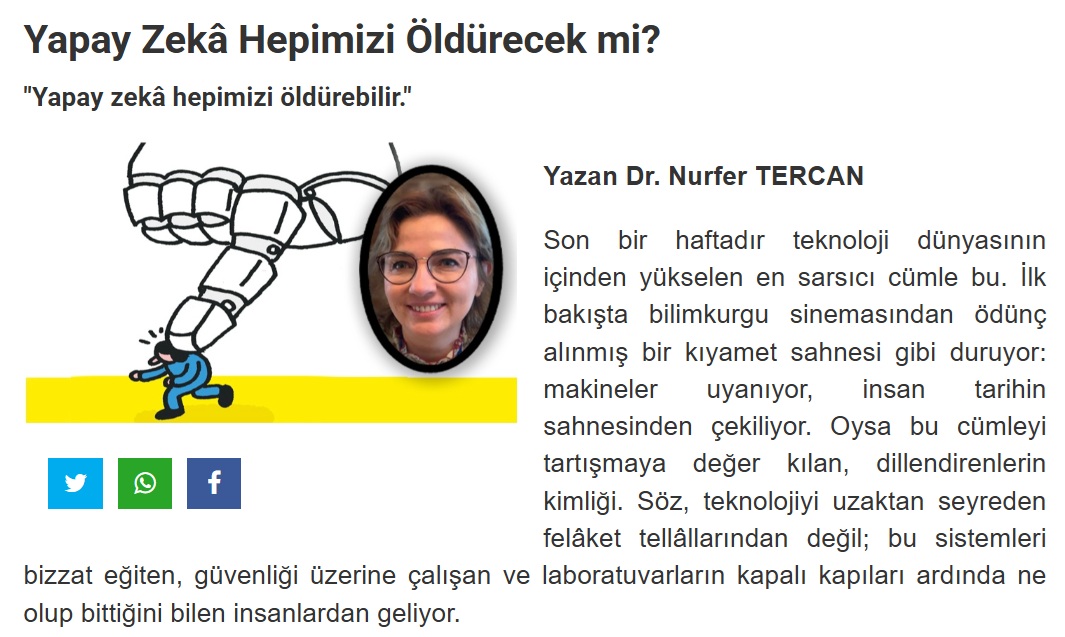
“Artificial intelligence could kill us all.”
By Dr. Nurfer TERCAN
This is the most jolting sentence to have risen from within the world of technology over the past week. At first glance it looks like a doomsday scene borrowed from science-fiction cinema: the machines awaken, and the human being withdraws from the stage of history. Yet what makes this sentence worth debating is the identity of those who voice it. The words come not from prophets of doom who watch technology from afar, but from people who train these systems themselves, who work on their safety, and who know what is going on behind the closed doors of the laboratories.
First, we need to separate the fear aroused by the headline from the fact itself. To say “artificial intelligence could lead to the extinction of humanity” and to say “artificial intelligence will destroy humanity” are not the same sentence. The first opens the door to a possibility; the second proclaims a verdict. Today we do not have a single verified scientific finding showing that artificial intelligence will wipe out humanity. Therefore the sentence “it will kill us all” cannot be presented as a scientific conclusion. But this does not mean that the debate can be taken lightly either. For a possibility is not unimportant merely because it has not been proven; its importance comes from the magnitude of what stands to be lost.
The news: a resignation, a percentage, a call
The sequence of events is as follows. Researcher Jacob Coxon, who spent three years training artificial intelligence models, first at OpenAI and then at Anthropic, announced in a series of social media posts on 8–9 September that he was leaving his job. According to Coxon, both companies are “not behaving responsibly”; superhuman systems that can “hack everything, transform any field overnight, and acquire real power and resources” will emerge soon, and these companies are, in his own words, “gambling with our lives.” The sentence of his that resonated most was this: “The people building artificial intelligence sincerely believe that it could kill us all by the end of the decade.”
The second development, showing that this claim was not confined to one person’s anger, came in the same days. Evan Hubinger, who heads the team at Anthropic working on the alignment of artificial intelligence with human values, stated that he puts the probability of advanced artificial intelligence leading to the extinction of humanity within the next ten years at above ten percent. There is a detail here that must be read carefully: these figures are not probabilities of death measured by laboratory experiments and tested statistically. They are a personal risk estimate made by an expert inside the field in the face of an extremely uncertain future. In other words, it is not a thermometer reading but a reckoning of conscience. Yet the person making this reckoning is the very one charged with reducing this risk; to ignore him is like silencing the crew member who reports that the ship is taking on water on the grounds that “after all, he is not the captain.”
And finally, the third development carried the debate beyond individual concerns to the centre of the industry. Dario Amodei, co-founder and CEO of Anthropic, made an open call to the industry in a piece he published on 12 September: “We must slow down the pace at which we are increasing the capabilities of artificial intelligence models. Progress will still look fast; we must use the time we gain with wisdom.” Amodei warned that within the next six to twelve months, swarms of artificial intelligence acting on their own could seize the entire internet with an embedded botnet and cause hundreds of billions of dollars in damage; he proposed that external auditors be granted access equivalent to that of company employees. The call did not fall into a void. Sam Altman, the head of OpenAI, committed to similar auditor access, saying that the industry needs to “advance the frontier at a measured pace”; Elon Musk, for his part, contented himself with a single sentence: “Dario is right.”
Thus three figures locked in relentless competition with one another came together, at least in one sentence. Such agreements are rare in history and are usually seen at moments when the danger can no longer be denied.
Commentary: a question that starts in the wrong place
Perhaps we are starting the debate from the wrong place. The greatest issue with artificial intelligence is not whether the machine will one day become human. The real question is this: what will the human being turn into when power on a scale never before seen in history passes into their hands?
Nuclear physics did not make the atomic bomb inevitable. Between understanding the structure of the atom and dropping a bomb on Hiroshima there stood, as much as physics, human will, politics, the lust for power, and war. Knowledge opens a door; knowledge does not determine who will pass through that door, or with what intention. In the same way, the existence of artificial intelligence does not make the extinction of humanity inevitable. But when technology begins to combine in the same equation with power, competition, capital, military supremacy and the absence of oversight, the matter ceases to be merely a technical problem for engineers to solve.
We now face a problem of ethics. A problem of politics. And, ultimately, a problem of civilization.
Our ancient tradition of thought made this distinction long ago. Might and wisdom are not the same thing; power, without a wisdom to govern it, only grows—it does not mature. Al-Farabi’s virtuous city is not the most powerful city, but the city that knows how to bind its power to the right purpose. The call to “slow down” rising from Silicon Valley today, whether it is aware of it or not, is circling around the same old truth: speed is not a virtue; virtue lies in what we spend our speed on.
For the fundamental question we are encountering for the first time in human history is not only “How powerful an intelligence can we produce?” Perhaps the far more important question is this: into the hands of which person, which institution, which state and which system of values will we deliver this power we have produced? And when those hands fall under the spell of power, will there be a law, an institution, a conscience to stop them?
The most striking word in Amodei’s call is not “slowing down” but “wisdom”. To use the time gained with wisdom. For time alone solves nothing; what we do with time does. Oversight mechanisms, international law, transparency, independent evaluation and, most importantly, the recognition of their own limits by those who hold power. None of these comes with a software update. All of them require human beings to face themselves.
Conclusion: not a machine, but a mirror
For this reason, the sentence “artificial intelligence will kill us all” must be approached with caution. Science does not tell us of so certain a future today. But it would not be right either to belittle the warnings rising from the very centre of the field as mere doomsday prophecies. The voice of people who are frightened by the system they themselves have built outweighs the voice of many a critic looking on from outside.
Perhaps the real danger is not that machines will one day turn into humans.
It is that human beings, in the face of the immense power they possess thanks to machines, will forget their own limits. In the end, artificial intelligence will not show us a machine; it will hold up a mirror. What we will see in that mirror is not what technology is, but what we ourselves are, or what we have turned into.
It is high time to think, and to face ourselves!
Sources:
NPR — Anthropic researcher resigns amid AI safety concerns
Forbes — Anthropic alignment lead warns AI could kill all humans as researcher quits
Axios — Anthropic, OpenAI CEOs call for slowdown in AI development
Washington Post — Amodei calls for AI oversight, joined by Altman and Musk
https://www.5gvirusnews.com/yazarlar/yapay-zek-hepimizi-oldurecek-mi-h1961.html
Translated from the Turkish original.