By Dr. Nurfer Tercan
From olive oil to “premium olive oil”, from the white francala loaf to “artisan sourdough”… On the way to COP31, perhaps we should first talk not about the climate but about our memory.
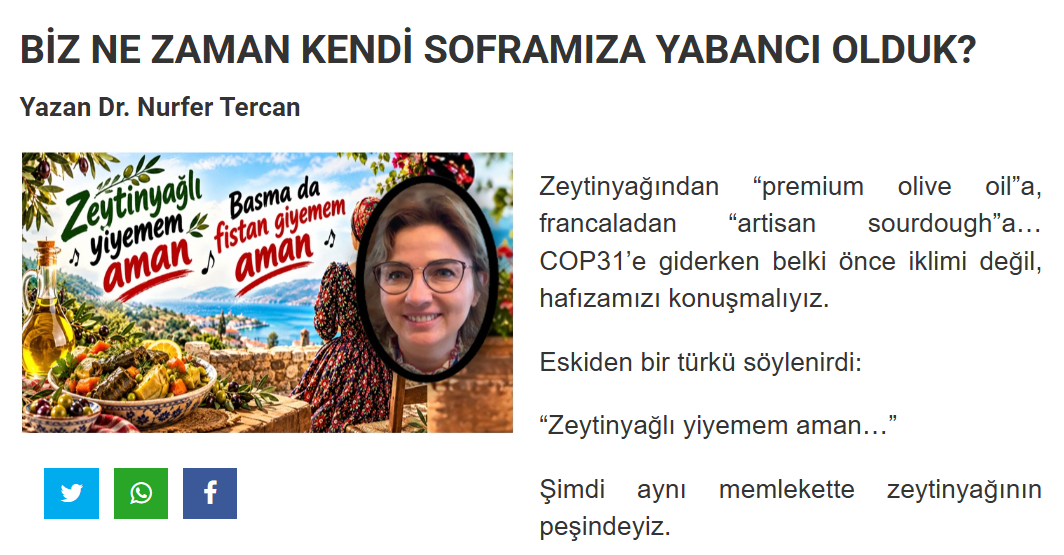
There used to be a folk song that went:
“I can’t eat food cooked in olive oil, oh no…”
Now, in that same country, we are chasing after olive oil.
But not just any olive oil will do any more.
It must be early harvest.
It must be cold pressed.
It must be high in polyphenols.
If possible it must come from a small producer.
Its bottle must be dark.
Its label must state the age of the tree, the altitude of the grove, the variety of the olive.
The olive oil that once stood at the edge of the table now holds pride of place in gourmet shops.
That was not enough.
“Let us protect the olive trees!” we say.
Let us adopt a sapling.
Let us give an olive tree a name.
Let us grow an olive in a pot.
Let us keep the ancient varieties alive.
Very nice. Let us protect them, of course.
But, like it or not, a mischievous question comes to mind:
When exactly did we lose this tree, that we are now finding it again by campaign?
The song goes on:
“And I can’t wear a printed calico dress, oh no…”
Walk up to the window of a fashion brand today.
You may come across a label like this:
“100% natural cotton.”
If it is a slightly higher segment:
“Organic cotton.”
If you go higher still:
“Handwoven natural textile.”
Meaning?
Cotton.
That same cotton from which printed calico dresses were once made.
But when you write a few English words on it and dim the lights of the shop a little, our calico suddenly becomes “sustainable luxury”.
And the price tag, bless it, is as long as the history of civilisations.
So the issue, it turns out, was never the cotton.
It was which story we told about the cotton.
Or rather, which story we forgot.
LET US COME TO BREAD…
Once upon a time there was village bread.
It was sourdough.
It was firm.
It was filling.
It was slow to go stale.
A single slice was sometimes enough for a meal.
Then the city grew, and the tables changed.
We found village bread a little coarse.
We did not like its sour smell.
We took its darkness for poverty and whiteness for prosperity.
And the francala came to the table.
It was snow-white.
It was ever so soft.
It was neat.
It was urban.
It was almost the edible form of modernisation.
While the village bread sat wrapped in cloth, the francala entered the house in its plastic bag. And we took it as a sign partly of urbanisation, partly of growing rich, and partly of “becoming contemporary”.
“I can’t eat sourdough village bread, oh no; I must have my francala, oh no…”
It was as if it were the lost verse of the song.
Then the years went by.
Something happened.
We grew tired of the francala.
We began to question white flour.
We discovered long fermentation.
We remembered the stone mill.
We went in pursuit of heirloom wheats.
We began to talk about the microorganisms of sourdough and the length of fermentation.
And one morning we woke up and village bread had come back.
But its name was no longer village bread: Artisan sourdough bread!
The dough the villager kneaded at night and left until morning had become long fermentation.
The flour ground in the stone mill had become stone-ground flour.
The wheat handed down from grandfather had become ancient grain.
The village oven had become craft bakery.
And the sourdough bread we abandoned yesterday for the sake of the francala, we began today to buy by queuing in front of a stylish bakery.
A little flour was sprinkled on top of the bread.
A few ears of wheat were placed beside it.
It was wrapped in kraft paper.
Two words were written beneath it: Authentic. Artisan.
Its price went up.
Its prestige came back.
One does not know whether to laugh here or to think.
Because the bread had in fact never changed.
What changed was the place from which we looked at it.
What we took yesterday for the bread of poverty had today become the bread of distinction.
And perhaps the bitterest irony of the whole story lies hidden here: first we abandoned village bread for the sake of the francala; then we rediscovered village bread as “artisan”.
Good heavens…
It turns out that even bread had to learn a foreign language in order to climb the social ladder.
WHAT HAPPENED TO US?
Perhaps this is one of the most important questions of our age.
Because modernisation is not only a process of acquiring new things.
Sometimes it is a process of learning to be ashamed of old things.
A person is first ashamed of his own table.
Then of his own cloth.
Of his own village.
His own seed, smell, word, oven, earthenware pot, wooden spoon, market, craftsman begin to look “old” to him.
He puts something new in their place.
A few generations pass.
Then the global market arrives and sells him back the thing he abandoned.
But this time under a new name.
Village life → slow living.
Eating in season → seasonal eating.
Shopping at the market → local sourcing.
Making use of leftovers → zero waste.
Mending the old dress → circular fashion.
Grandmother’s sourdough starter → artisan sourdough culture.
The tomato in the garden → farm to table.
The producer in the neighbourhood → short supply chain.
Consuming little → minimalism.
Being content with what one has → sustainable consumption.
And one looks on in amazement: our grandmothers, it turns out, were the world’s most advanced sustainability experts without knowing it!
They simply had no diplomas.
Nor certificates.
And they did not know the English name for what they were doing.
I am not indulging here in a romantic glorification of the past.
Not everything old was good.
Village life was not always poetry.
There was poverty.
There was the weight of labour.
There was the invisible burden of women.
There was inefficiency.
There were problems of health and hygiene.
Modernisation gave humankind tremendous opportunities.
Science, technology, transport, health, education and productive capacity changed the lives of millions of people.
The problem was not modernising.
The problem was throwing memory in the bin while modernising.
For to develop is one thing; to be ashamed of oneself is another.
SO WHO TOOK OUR WITS AWAY?
Perhaps what is more frightening is this: once we could have asked, “Who took our wits away?”
Now we have forgotten even to ask that question.
Because the greatest achievement of consumer society is not telling a person what to buy.
It is teaching him what he ought to desire.
To go further still: it also teaches him what to find old, what to count as shameful,
what to accept as prestige, what to see as healthy, as contemporary, as distinguished, as “premium”.
And so a person does not buy only a product.
He buys meaning.
He does not buy a bottle of oil; he buys “healthy living”.
He does not buy a cotton shirt; he buys “naturalness”.
He does not buy a loaf of bread; he buys “authenticity”.
He does not stay two nights in a village house; he buys a “slow life experience”.
Perhaps the greatest skill of modern consumer culture appears here:
Being able to sell back to a person, as longing, the very thing he abandoned.
THE QUESTION OF THE MARSHALL PLAN
Right here we come upon a contested narrative of our recent history.
There is a claim that has been repeated in Türkiye for years:
It is said that, in the period of American aid and the Marshall Plan after the Second World War, the channelling of the United States’ agricultural surpluses to new markets also affected Türkiye’s habits of production and consumption; and that the spread of margarine and various vegetable oils was one of the parts of this great transformation.
The sharper form of the narrative even extends to the claim that the United States promoted corn oil and margarine to Türkiye in order to make use of the corn stocks it held.
But where history is concerned, one must be more careful than slogans are.
It would not be right to present this very specific claim as though it were the definite and sole cause that explains the whole transformation. For that, direct and strong archival evidence is needed.
But the broader historical picture matters:
After the war a strong relationship of economic aid was established between Türkiye and the United States; the aid provided under the Marshall Plan had an influence on Türkiye’s development policies, its agricultural mechanisation and its economic choices.
So the matter is not as simple as merely “we were given this oil and made to forget that one”.
The real sociological question is larger: when a society’s palate changes, is it only what it eats that changes?
No.
Agriculture changes.
The producer changes.
The market changes.
Advertising changes.
The markers of status change.
The table changes.
And finally memory changes.
Because tables are the most silent history books of societies.
By looking at what a nation eats you can read not only its cuisine, but its economy, its class transformation, its desire for modernisation and even how it has begun to look at itself.
THEN ONE MORNING WE WOKE UP SAYING “SUSTAINABILITY”
And now we have come to 2026.
The world is talking about climate change.
It is talking about carbon.
It is talking about water.
It is talking about soil.
It is talking about biodiversity.
It is talking about local production.
It is talking about food security.
It is talking about climate-resilient agriculture.
And COP31 will bring all these debates before the world once again.
I think this is exactly where we should ask ourselves another question:
Are we going to COP31 only to talk about our future, or also to remember what we mistakenly threw in the bin from our past?
Because sustainability is not only a solar panel.
It is not an electric car.
It is not carbon accounting.
New technologies are of course indispensable.
But sustainability is at the same time a civilisational way of behaving.
Not throwing a loaf of bread in the bin.
Not using water carelessly.
Eating in season.
Not consuming more than the soil can bear.
Keeping the producer alive.
Protecting a seed.
Not valuing a tree only as much as the fruit it gives.
Passing a craft on to the next generation before its last master dies.
Not wearing a fabric three times and throwing it away.
Accepting a table not only as a place of consumption but as a place of sharing.
How many of these are really new?
Perhaps one of the questions of COP31 should be exactly this:
While trying to invent the future, which truths that it knew in the past has humanity forgotten?
THE OLIVE TREE HAS SOMETHING TO TELL US
Stand in front of an olive tree.
It does not hurry.
It does not follow trends.
It does not change its packaging every season.
It does not bring out a new collection.
It does not declare itself “premium”.
It has no need of an influencer.
It quietly puts down roots beneath the soil.
A hundred years pass.
Two hundred years.
Sometimes more.
People change.
Borders change.
Currencies change.
Brands are born, grow and are forgotten.
The olive tree stands.
Perhaps this is what sustainability teaches before all the books: to live is not to be constantly renewed; it is to know what you must protect.
Sourdough is like that too.
You do not reinvent it every day.
You leave a piece for the next day.
Yesterday’s starter is mixed into today’s bread.
From today’s starter a piece remains for tomorrow.
What a magnificent metaphor for civilisation!
Because culture, too, lives like this.
Not by carrying the whole of the past on its back, but by taking a living piece of it and passing it on to tomorrow.
Perhaps this is exactly what civilisation is.
Neither shutting oneself up in the past nor throwing the past in the bin.
Building the future by being leavened from the past.
DID IT BECOME PRECIOUS ONLY WHEN IT BECAME “ARTISAN”?
Let us admit it: sometimes, for us to understand the worth of a thing, it has to be renamed in a foreign language.
When we say “köy ekmeği” — village bread — it is ordinary.
When we say “artisan sourdough” it is distinguished.
When we say “basma” — printed calico — it is old.
When we say “organic cotton” it is luxury.
When we say “ev yapımı” — home-made — it is plain.
When we say “handcrafted” it is special.
When we say “yerel” it is small.
When we say “local” it is contemporary.
When we say “making use of leftovers” it is necessity.
When we say “zero waste” it is the future.
I have no quarrel here with English words.
My quarrel is with the loss of self-worth behind the words.
Because if you cannot define your own worth yourself, someone will come and redefine your worth for you.
Then they package it.
They write its story.
They turn it into a brand.
And one day they sell it back to you.
And at a high price, too.
PERHAPS WE SHOULD FIRST RESCUE OUR MEMORY
Let us run olive sapling campaigns.
Let us protect heirloom seeds.
Let us keep local wheats alive.
Let us protect sourdough.
Let us protect cotton, soil and water.
Let us support the producer.
Let us keep the craftsmen alive.
But there is one more thing we need to protect: our memory!
Because a society that loses its memory does not lose only its past.
It also loses the ability to determine the worth of what it produces itself.
And the day comes when it cannot recognise its own bread beneath a foreign word.
While the world talks about the future of the climate at COP31, perhaps one of the most meaningful questions we can put on the table is this:
Do we really need to reinvent everything in order to save the world?
Or do we also need to remember a little?
The soil.
The olive.
The wheat.
The cotton.
The leaven.
The season.
Contentment.
Sharing.
The craftsman.
The villager.
The table.
Perhaps the future is not as far ahead as we think.
Perhaps some of the answers we are looking for have already been lived.
We only changed their names.
We did not care for olive oil; when it became “premium extra virgin olive oil” we went chasing after it.
We looked down on calico; when it became “organic cotton” we paid a fortune.
We gave up village bread; we took the francala for modernity.
Then we gave up the francala and went chasing after village bread; this time its name had become “artisan sourdough”.
We took making use of leftovers for poverty; when it became “zero waste” we organised conferences.
We took eating in season for necessity; when it became “seasonal eating” we made it a philosophy of life.
Now we are searching for the ways of sustainable living for the world.
Good.
Let us search.
Let us search with science.
Let us search with technology.
Let us talk at the COPs.
Let us do research in the universities.
Let us develop new models.
But every now and then let us also turn and look into our grandmothers’ kitchens.
Perhaps there was no PowerPoint presentation there.
There was no carbon certificate.
There was no ESG report.
Nor was there a “Zero Waste” sign.
But bread that had gone stale was not thrown in the bin.
Because it was a blessing.
The few morsels left on the table were not merely economic value.
They had a moral meaning.
Perhaps the whole matter begins exactly here.
Because sustainability is not merely a matter of using resources more efficiently.
It is the redefinition of the relationship between human beings and things, between human beings and nature, and between human beings and the blessings given to them.
And perhaps, while searching for new words that would save the world, we lost the meaning of the old words.
Abundance.
Contentment.
Trust.
Waste.
Blessing.
Soil.
Table.
These are not merely old words.
Perhaps they are the most modern words of the future.
So then, on the way to COP31, let us not calculate only our carbon footprint.
Let us also look at the footprint of our memory.
Where did we come from?
What did we leave behind?
What did we look down on?
What did we lose?
And which of the things we lost are we buying again today under another name?
Perhaps the real sustainability report will begin here.
Because the issue is not only olive oil.
The issue is not only calico.
The issue is not the francala.
Nor is it sourdough.
The issue is the eye with which a person looks at his own worth.
And now let us ask again:
What happened to us?
Who took our wits away?
And more importantly still:
When did we forget to ask the question “Who took our wits away?”
Good heavens… God preserve us…
It turns out that some of the things we were seeking as the future were the civilisation that we once called “old” and put out by the door.
And perhaps what needs to be done now is not to go back to the past.
It is to remember anew what we need to carry from the past into the future.
Because the future is not built by imitating the past.
But neither can it be built by losing its memory.
The future sometimes begins not with inventing something new, but with remembering again the thing whose worth we had forgotten.
Notes from the Blue of the Windy City.
https://www.5gvirusnews.com/yazarlar/biz-ne-zaman-kendi-soframiza-yabanci-olduk-h1972.html
Translated from the Turkish original.