What 21 five-star hotels taught me, seven blind spots COP31 has not yet seen, and what Antalya can do about them
Tansel Tercan, PhD · Author of Waste Management in Hospitality (English, Turkish and Russian editions, Detay Publishing, 2022)
In November, the world’s climate negotiators will arrive in Antalya. They will sleep in hotels, eat from hotel buffets and meet in hotel ballrooms. For two weeks, the most important climate conversation on Earth will take place inside the industry I have spent my career running.
We should take that seriously. Türkiye has made zero waste and methane reduction one of the ten themes of the COP31 Action Agenda, and has dedicated 11 November, the day world leaders gather, to Zero Waste. Waste produces roughly a fifth of human-caused methane, most of it from organic matter rotting in landfills. The food service sector alone wasted an estimated 290 million tonnes of food in 2022, 28 percent of all food wasted worldwide. Hotels sit inside that figure.
I did not come to this subject as an activist. I came to it as an operator with a question: what does a five-star hotel actually throw away, why, and what would it take to stop? To answer it, I studied 21 five-star hotels belonging to international chains in Türkiye, the United Arab Emirates, Egypt, Russia and Kazakhstan. I interviewed the managers of purchasing, housekeeping, finance, kitchen, front office, service and bar, and technical departments. The work became my doctoral research and then a book. Here is what I learned, and what I believe COP31 should do with it.
PART I · WHAT 21 HOTELS TAUGHT ME
- THE SAME STARS, VERY DIFFERENT RESULTS
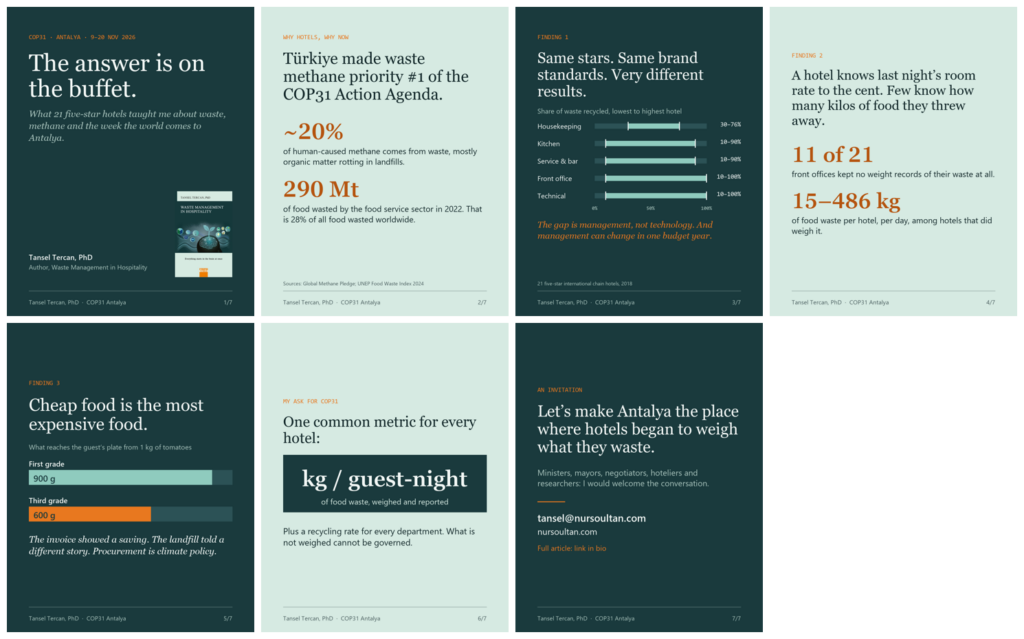
The hotels in my study held comparable star ratings and belonged to international chains with written environmental standards. Their results were nowhere near comparable. In kitchens, the share of waste recycled ranged from 10 percent to 90 percent. In front offices and technical departments it ranged from 10 percent to 100 percent. Two hotels ran their technical departments at zero waste, while others working from similar brand manuals recycled a tenth of theirs.
When the same standards produce a ninefold difference in outcome, the gap is not technology and it is not regulation. It is management. That is good news, because management can change within a single budget year.
- HOTELS DO NOT MEASURE THEIR WASTE
A hotel can tell you last night’s average room rate to the cent. Very few can tell you how many kilograms of food they threw away last night. In my sample, 11 of the 21 front offices kept no weight records of their waste at all, and only 8 housekeeping departments could report a recycling rate. Among the hotels that did weigh food waste, the daily amount ranged from 15 kg to 486 kg per property. Food’s share of total waste ranged from 3 percent to 50 percent.
A spread that wide shows that voluntary guidance has not been enough. Measurement methods for hotels exist, but no country requires hotels to report food waste per guest-night. Without a required common unit, hotels cannot compare themselves, set targets or be held to them.
- THE PREPAID PLATE
The managers I interviewed told me two things about the all-inclusive model that seem to contradict each other, and both are true. Because consumption is predictable, all-inclusive hotels can plan and buy in bulk, which limits waste in the storeroom. But because guests have paid in advance, many take more than they can eat, and the waste moves from the storeroom to the plate. Service and bar managers named the same causes again and again: guests taking more than they can eat, oversized portions, and short shelf life on the buffet.
The purchasing data shows the scale. Tomatoes bought per guest-night ranged from 0.04 kg at a bed-and-breakfast property to 0.77 kg at an ultra-all-inclusive resort, nearly twenty times more. Not all of that difference is waste. But nobody who has watched a breakfast buffet being cleared believes that none of it is.
- CHEAP FOOD IS THE MOST EXPENSIVE FOOD
One finding surprised even experienced purchasing managers. One kilogram of first-grade tomatoes delivered about 900 grams to the guest’s plate. One kilogram of third-grade tomatoes, bought because it looked cheaper, delivered about 600 grams. The rest became trimming loss and waste. The invoice showed a saving. The landfill told a different story.
Procurement is climate policy. A decision made in a purchasing office determines how much methane rises from a landfill years later.
- THE SOLUTIONS ALREADY EXIST INSIDE THE INDUSTRY
None of the answers in my book are speculative. Each one was already working somewhere in my sample. One resort met 20 percent of its water-heating energy with solar power, and another saved 48,000 kg of LNG in one year the same way. Hotels turned retired tablecloths into napkins and cleaning cloths, refilled printer cartridges three or four times, returned packaging to suppliers, and sent kitchen surplus to staff restaurants and licensed animal-feed programmes. Composting machines can turn a hotel’s organic waste into soil conditioner in less than a day. The literature documents a single hotel diverting 12 tonnes of food waste a month from landfill this way. A sensor-based smart-bin pilot in Seoul cut average food waste by a third.
The model I propose in the book treats waste as a revenue line. Recyclable materials are sold to licensed recyclers. Organic waste becomes compost or biogas and goes back to hotel gardens and farms. Every flow is tracked from the room, the kitchen and the garden to its destination. A hotel does not have to choose between profitability and responsibility. Measured properly, they appear on the same ledger.
- WHAT HOTELS CAN DO TOMORROW
Two changes need no summit at all. The first is a redesigned buffet: smaller plates, cook-to-order stations, live demand data and honest communication with guests can bring all-inclusive and open-buffet concepts within reach of real reduction targets, without taking generosity away from the guest. The second is procurement standards that price yield, not only the invoice, and require suppliers to take back packaging. In my research, “suppliers take back empty packaging” scored lowest of all purchasing practices.
PART II · SEVEN BLIND SPOTS COP31 HAS NOT YET SEEN
Tourism accounts for an estimated 8.8 percent of global greenhouse-gas emissions, and those emissions have grown twice as fast as the world economy. Yet climate negotiations have learned to see tourism mainly as a victim. According to UN Tourism’s 2022 review of national climate plans, more than half mention tourism, mostly as a vulnerable sector. The word “tourism” does not appear in the Global Stocktake decision. Hundreds of tourism organisations have signed the Glasgow Declaration since COP26 and committed to halving emissions by 2030, yet none of the twelve thematic days in the COP31 programme is about tourism. In November the whole summit will run on hospitality: more than 17 million visitors came to Antalya in 2025.
Going beyond my book, I reviewed the COP31 agenda, the IPCC methods, carbon-market rules and national regulations, looking for what the climate system still cannot see from the hotel floor. I found seven blind spots. Each comes with a proposal that can be announced in Antalya.
- THE INVISIBLE GUEST: METHANE ACCOUNTS THAT FORGET VISITORS
IPCC guidelines estimate methane from waste by multiplying waste per person by the population whose waste is collected. Visitors are not in that population. A resort coast can host several times its resident population in August, and the methane accounts do not see them. The gap is large. In the Maldives, resorts generate about 7.2 kg of waste per guest per day, compared with 2.48 kg per person in the capital, Malé. The European Union has recognised part of this problem: its 2025 food-waste law asks the Commission to develop a tourism correction factor by 2027. No such correction exists in the global inventory rules.
Waste systems in resort regions also tend to be sized for the annual average, while the load arrives in a few hot months when organic waste decomposes fastest.
Proposal. Invite the IPCC Task Force on National Greenhouse Gas Inventories to develop guidance on a tourist population equivalent (guest-nights divided by 365) for waste-sector inventories. Tourism-dependent countries would report it in their transparency reports and size their organic-waste capacity for the peak month, not the year. Best stage: Zero Waste Day, 11 November, and Science day, 16 November.
- WEIGH THE SUMMIT
Every COP produces a sustainability report. As far as published records show, none has reported how much food was wasted per meal served or per delegate. The COP26 report gives recycling routes and percentages. COP28 set rules for caterers. None of them published a measured figure per meal or per delegate. A conference about emissions still cannot say how much of its own food ended up in the bin.
Proposal. COP31 becomes the first COP to weigh and publish its food waste every day: at the venue and in official delegation hotels, per meal served and per guest-night. The daily figures appear on a public screen in the Blue Zone and the final result is published on Implementation day. This gives the world a real baseline and turns twelve days in Antalya into the largest hospitality measurement pilot ever run. Announce on 11 November; publish on 19 November.
- REQUIRE ONE NUMBER, AND LET TÜRKIYE BE FIRST
Voluntary tools already exist. In 2021, WWF, Greenview and the Sustainable Hospitality Alliance published a hotel waste measurement methodology that includes food waste per occupied room and per guest. What does not exist, as far as I can find, is a country that requires hotels to report food waste per guest-night. Spain requires prevention plans, Japan covers large generators, and Singapore requires segregation, but none of them asks hotels for this number.
Türkiye is unusually well placed. Its Zero Waste Regulation already requires certification for accommodation with 250 or more rooms. Under a ministry circular issued in April 2026, sustainable tourism certification is now mandatory for four- and five-star hotels. Neither includes a measured food-waste criterion. Adding one line to existing certificates would create no new bureaucracy. The business case is proven: in a Champions 12.3 study of 42 hotels in 15 countries, the average hotel saved seven dollars for every dollar invested, cut kitchen food waste by 21 percent in the first year, and more than 70 percent recovered their investment within that year.
Proposal. Türkiye announces in Antalya that measured food waste per guest-night will become a criterion of its Zero Waste and sustainable tourism certificates, and invites other destination countries to follow. Zero Waste Day, 11 November.
- HEAT IS A WASTE MULTIPLIER
Adaptation and mitigation are usually discussed in separate rooms. The buffet brings them together. UNEP’s Food Waste Index found that hotter countries tend to report more household food waste per person. A study of an integrated resort in Macao linked high temperatures to more unserved food. Globally, the lack of refrigeration causes the loss of about 526 million tonnes of food a year, and the resulting food loss and waste produces around one gigatonne of CO₂-equivalent. My own research found short shelf life on the buffet among the main causes of hotel food waste. As summers get hotter, the same buffet will waste more.
Proposal. Recognise food cold chains and heat-safe service design in hotels and restaurants as adaptation measures that are eligible for adaptation finance in tourism destinations, and launch a research programme on heat and food-service waste. Food, Agriculture and Health day, 9 November.
- PAY FOR COMPOST WITH CARBON
The Paris Agreement’s new crediting mechanism under Article 6.4 has so far approved one methodology, for flaring or using landfill gas. It pays to capture methane after organic waste has been buried. There is not yet a methodology that rewards keeping organic waste out of the landfill in the first place, although the old Clean Development Mechanism had one for composting and voluntary standards now cover food-waste prevention. A single hotel is too small to earn credits alone. A destination of hundreds of hotels is not.
Proposal. Ask the Article 6.4 Supervisory Body to prioritise a methodology for organic-waste diversion and prevention, and design it for destinations: a municipality or tourism association aggregates hundreds of hotels in one programme, and the credit revenue finances shared composting and biogas plants. Finance and Trade day, 13 November.
- A WASTE SKILLS PASSPORT FOR SEASONAL WORKERS
In my research, executive chefs said training was what reduced kitchen waste. But in resort regions a large part of the workforce changes every season, so the knowledge leaves in October and has to be rebuilt in April. Europe has a general hospitality skills passport and new green micro-credentials. I have found no portable certificate on waste for seasonal hotel workers.
Proposal. Launch a digital Zero Waste Skills Passport for kitchen, service and housekeeping staff, recognised by hotels across borders and carried by the worker from season to season and country to country. Workers would earn it through short practical modules, and hotels would count it in hiring and pay. Children, Youth, Education and Skills day, 14 November.
- FROM ANTALYA TO THE PACIFIC: A COAST-TO-ISLAND COMPACT
COP31 has two homes: the pre-COP meets in Fiji in October and the conference meets in Antalya in November. Resort coasts and island states share the same problem at different scales. In small island states, as UNEP notes, seasonal tourism puts a heavy burden on waste systems at concentrated times, and landfill space is almost gone. In some Caribbean states, a tourist levy of about 1.50 dollars already funds between 12 and 40 percent of the waste system’s operating revenue.
Proposal. A Coast-to-Island Compact that twins resort destinations in the Mediterranean with island states in the Pacific, Caribbean and Indian Ocean. Partners share proven hotel composting and biogas models and each earmarks a small part of its accommodation taxes for destination waste systems. Ocean, Seas, Nature and Land Use day, 17 November.
WHY A HOTELIER SHOULD SAY THIS
None of these proposals needs a new treaty. Each uses an institution that already exists: the IPCC inventory guidelines, national certification schemes, the Article 6.4 mechanism, the skills systems, the summit’s own catering contracts. What has been missing is the view from the place where the waste is actually produced, the kitchen, the storeroom and the buffet line, at five in the morning in August.
That is the view I have spent my career in, and it is the view I offer to the COP31 Presidency, to negotiators and to every destination that hosts the world.
AN INVITATION
COP31 will be judged on implementation. Hospitality is one of the few sectors where implementation can be seen within a single season, in every kitchen and every guest room, in the country hosting the conference.
To ministers, mayors, negotiators, hotel owners, operators and researchers who want to turn this agenda into measured results: I would be honoured to stand with you as a partner in solving a problem that shapes our shared future. Let us make Antalya the place where the hotel industry began to weigh what it wastes.
We cannot change the past, but we can change the future.
Note on the data: the hotel data in Part I were collected in 2018 through structured interviews and questionnaires with department managers; hotels are anonymised. Sources: UNEP Food Waste Index Report 2024; Global Methane Pledge; Sun et al., Nature Communications (2024); UN Tourism, Glasgow Declaration; COP31 Presidency (thematic days; third Presidency letter); UN Tourism, NDC review (2022); UNFCCC decision 1/CMA.5; IPCC 2006 Guidelines and 2019 Refinement, Vol. 5; Directive (EU) 2025/1892; UNEP SIDS Waste Management Outlook (2019); Hotel Waste Measurement Methodology (WWF, Greenview, Sustainable Hospitality Alliance, 2021); Champions 12.3, The Business Case for Reducing Food Loss and Waste: Hotels (2018); Türkiye Zero Waste Regulation Art. 16 and Ministry of Culture and Tourism circular 2026/2; UNEP Food Waste Index 2024; Lei et al., Journal of Hospitality & Tourism Research (2024); FAO and UNEP, Sustainable Food Cold Chains (2022); UNFCCC Article 6.4 methodology A6.4-AMM-001; Verra VM0046; Arbulú et al., Heliyon (2024); Antalya visitor figures, Ministry of Culture and Tourism (January 2026).
Tansel Tercan, PhD
Author, Waste Management in Hospitality · Ağırlama Sektöründe Atık Yönetimi · Утилизация отходов в гостиничном бизнесе
Chief Operating Officer, Dedeman Hospitality
tansel@nursoultan.com · www.nursoultan.com
#COP31 #Antalya2026 #ZeroWaste #FoodWaste #Methane #SustainableTourism #Hospitality #CircularEconomy