Not Every Legal Right Is Halal!
By Dr. Nurfer TERCAN
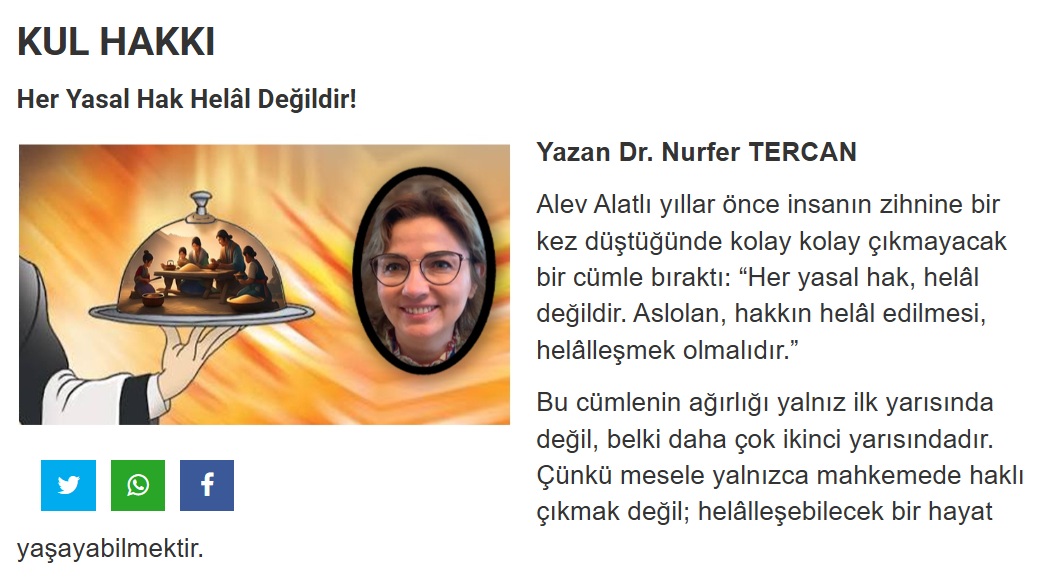
Years ago Alev Alatlı left behind a sentence that, once it has fallen into the mind, does not easily leave: “Not every legal right is halal. What truly matters is that the right be made halal — that we make our peace with one another.”
The weight of this sentence lies not only in its first half but, perhaps even more, in its second. For the point is not merely to be proven right in court; it is to be able to live a life in which one can part from others with their blessing.
How very much a sentence for today…
The law tells us what we may do; conscience, at times, whispers what we ought not to do even though we have the right to do it. Perhaps one of humanity’s oldest questions begins exactly here: in the difference between being able to do something and having the right to do it.
A thing may be possible under the law. It may fit into the small print of a contract. It may slip through a gap in a regulation. It may fall within the powers of an office. A person may even produce reasons that make him appear entirely in the right.
But none of this is enough to make what is done just. For justice does not live only within the boundaries of the law. Sometimes, where the law falls silent, conscience begins to speak. Lately, I think, this is the distinction we are losing most. We struggle to tell halal from haram, right from law, the legitimate from the conscientious. What is more, we have increasingly begun to read people not by what they do but by how they appear.
We look at their office.
We look at their title.
We look at their clothes.
We look at the words they use, the circles they move in, the values they say they belong to.
And we pass our judgment: “No harm will come from this person.”
Then it comes.
And so a person’s wound grows not only from the injustice done, but from the injustice coming from a place he never expected.
“He is honest,” you say.
“He is a believer,” you say.
“At the very least we know he turns to his Lord five times a day,” you say.
Then you look, and the qibla a person turns to and the direction his life turns to may not always be the same. Perhaps this is one of the most bitter reckonings of our age.
For worship is not a certificate of a person’s flawlessness. Office is not a guarantee of morality. Education is not a diploma of conscience. Speaking beautifully does not mean being a beautiful human being.
Form does not guarantee substance. Yet we have been deceived by form so many times that, astonished again and again, we were left dumbfounded. Indeed, where we stood dumbfounded, we froze.
It is as if we no longer have the strength even to be astonished by a new oddity. Our perception has reached saturation. Before the shock of one wrong has passed, the next arrives. Before we can close the account of one disappointment within ourselves, a new one knocks at the door.
But the real danger is not only the great events. Great injustices sooner or later become visible. Their amounts grow, their victims multiply, their voices rise, and darkness can no longer hide them.
But what about the small ones?
Those that remain in rooms no one sees?
Those taken quietly from a person’s labour?
Those built by sitting on top of someone else’s idea?
Those that begin with the forgetting of a promise given?
Those that continue with the careless squandering of someone’s time?
Those carried on by taking a person’s knowledge and never mentioning his name, by exploiting his trust, by mistaking his good will for weakness, by delaying what is due to him, by belittling his labour?
For theft is not only the stealing of money.
Time can be stolen too.
So can labour.
So can an idea.
So can reputation.
So can hope.
So can good will.
Sometimes even the sense of trust a person has built up over years can be stolen. For most of these, no record is kept.
No court is convened.
There is no case number.
They do not make the newspapers.
But there is a record inside the person. Perhaps the real social problem begins here too: we have grown used to recognising evil only when it is large. Yet most great injustices are not born great one morning.
They begin with the crushing of a small right.
Sometimes those who sit in the large chairs of high office do not notice what is left beneath that chair’s small wheels. First, a tiny piece of labour is run over.
One person’s time…
Another’s right…
The other’s dignity…
“What could come of this?” it is said.
Then, as the chair rises, the distance between the person and the ground grows as well.
And the day comes when the polished shoes beneath the impeccably pressed clothes worn for the highest offices begin to tread, this time without any hesitation at all, on those small rights that the wheels of the chair once bruised.
This is where the most dangerous side of what is assumed to be “my legal right” appears: a person first crushes the right; then he begins to take the thing he crushed for a right.
The first time, conscience is uneasy.
The second time, the person finds himself a justification.
The third time, he gets used to it.
And the fourth time, he turns and says: “But I have a right to this.”
Perhaps this is one of the most dangerous sentences of moral collapse. For as long as a person knows he is doing wrong, there is still a court within him.
What should truly be feared is the moment he begins to see the injustice he commits as a right.
Then the name of what he does changes as well.
It becomes interest.
It becomes professionalism.
It becomes necessity.
It becomes authority.
It becomes regulation.
It becomes “That’s just how life is…”
And in the end the words of conscience are translated, one by one, into the words of bureaucracy. Perhaps this is exactly where civilisation is lost. For civilisation is not merely the building of great edifices, institutions, laws and technologies. Civilisation is being able to raise people who have learned not to lay a hand on another’s right even where no one is watching.
This is precisely why what the old world called “kul hakkı” — the right that one human being holds over another — is an extraordinarily deep concept.
It goes beyond the state.
It goes beyond the court.
It goes beyond office.
It goes beyond title.
For it strips a person of all worldly attributes and leaves him alone with his own conscience.
Then it asks a very simple question, yet one that is hard to escape: “What do you carry that does not belong to you?”
Someone’s money?
Someone’s labour?
Someone’s time?
Someone’s idea?
Someone’s reputation?
Or the trust he once placed in your keeping?
Perhaps what our age needs is not to be more visible, but to be a little more accountable. For a person’s true morality is not how he is before the crowd. It is the decision he makes at the moment he thinks no one will ever know.
And here the words Alev Alatlı spoke years ago stand before us once again: “Not every legal right is halal. What truly matters is that the right be made halal — that we make our peace with one another.”
For not everything that is possible is legitimate.
Not everything that is gained is deserved.
Not everything we call “my right” may turn out to be ours on the scales of conscience.
Sometimes a person must not reach out his hand even though nothing stands in his way.
The law may not prevent it.
The contract may allow it.
The office may grant the authority.
No one may see.
No one may call him to account.
But if there is still a pair of scales at work inside a person, a far older verdict rises from there:
“You can take it… But do not! Because it is not yours.”
Perhaps this is what we need to learn anew today: A right is not merely what can be taken. A right is what can be carried once peace has been made over it.
For making one’s peace is not merely saying “forgive me what I owe you.” Making one’s peace is living in such a way as to try not to leave behind wounds that are impossible to forgive.
A person does not grow greater as the chairs rise higher. Sometimes it only becomes harder to see those he has crushed. Perhaps that is why the true measure of civilisation is not how high a person has climbed, but how far he has been able to walk, while rising, without stepping on anyone’s right.
And civilisation begins not where a person does everything he is able to do, but where he can choose not to do it while he has the power to.
Notes from the Blue of the Windy City
https://www.5gvirusnews.com/yazarlar/kul-hakki-h1975.html
Translated from the Turkish original.