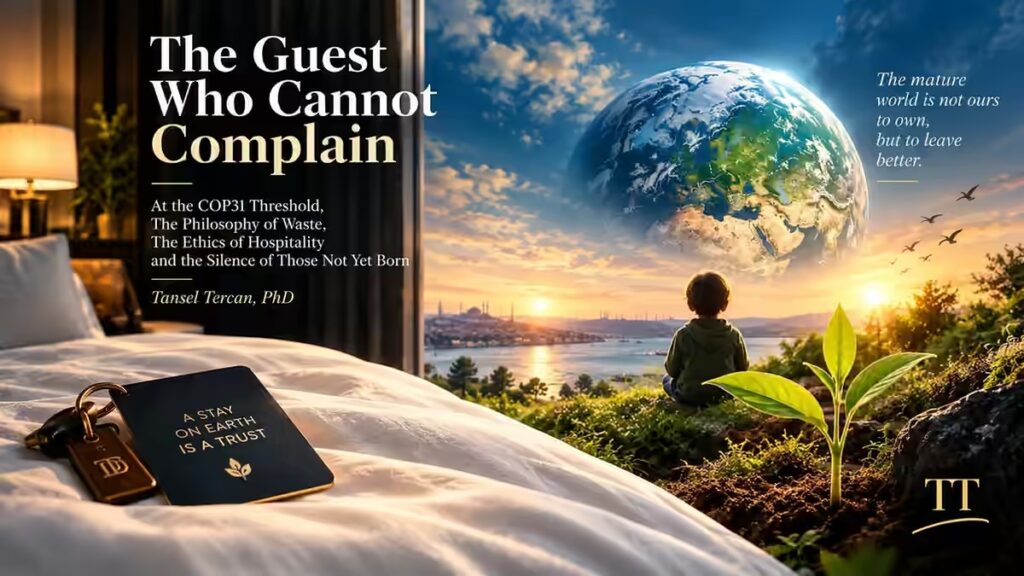
Tansel Tercan, PhD
12 October 2026
When you open the door of a hotel room, the first thing that greets you is that the traces of the life before you have been erased. The bed has been made, the glass cleaned, the curtain straightened. You are not the first to use the room; yet you have been offered a beginning in which you can live there comfortably.
Behind this beginning lies the labour of someone whose face you usually never see. After you leave, the same room will be prepared for another person.
This ordinary scene, repeated every day in hospitality, carries within it one of humanity’s greatest questions: In what state will we leave a world we use for only a short time to those who come after us?
COP31, to be held in Antalya on 9–20 November 2026, will bring together thousands of people to discuss the future of the world. Yet most of those who will talk about the future will first check into a hotel. They will receive a key. They will become the temporary user of a room. Perhaps, before entering the negotiation hall, they should take one more look at the key in their hands.
Because the climate question is, in part, the story of mistaking a temporary right of use for unlimited ownership.
Once something is out of sight, we tend to think it is also out of our lives. We leave the rubbish bag outside the door and close the door. For us, the matter is over. Yet closing the door does not stop the journey of matter. What we throw away goes somewhere. Into soil, into water, into a living creature, into the environment where another person lives… Sometimes into a time so distant that we cannot see it today.
On this planet there is no “outside” where we can leave our responsibility behind.
In Purity and Danger, the anthropologist Mary Douglas explains that dirt is related not only to the nature of matter but also to its place and to the order we build. Soil that counts as fertility in the field and as dirt on the dinner table makes this idea visible.
When we carry this approach over to the environment, a new question arises: Why do we consider a substance we stop using to be outside our responsibility as well?
Which path vegetable peelings take in a kitchen does not depend only on what they are. It also depends on how they are separated, within which system they are handled and what decision the business makes.
Waste, in this sense, is not merely the residue of consumption. It is the material form of our decisions.
It is impossible to reduce the whole climate crisis to the question of waste. But our habit of using the atmosphere as a boundless void is the large scale expression of the same rupture of responsibility. While we collect the benefits of production today, we leave part of its consequences to other geographies and to future generations.
Waste is sometimes not a substance but a cost we pass on to someone else.
The Anatolian saying “the world is an inn” reminds us of the transience of life. But within this saying lies a responsibility we often fail to consider. Being about to leave the inn does not remove the duty to protect it. Transience cannot be an excuse for indifference. Because what we use for a short time will be someone else’s whole life.
For us a river may be a weekend view; for the child living on its bank it means drinking water, livelihood and homeland. In an investment calculation a forest may appear as land; in the language of another life it is shade, nest and continuity. This is where the depth of the idea of trust, of something held in safekeeping, begins.
Trust means knowing, while we use something, that it does not belong to us alone. It means trying not to diminish another’s chance of living while meeting our own needs. That is why being a good guest is not merely arriving quietly and leaving quietly. It is about the care we show to the place where we stay.
That we will leave the world is a truth everyone knows. The real moral question is how we treat the world before we leave. In hospitality, the guest’s complaint is valuable. It makes faltering service visible. The cleanliness of a room, the quality of a meal, whether a promise was kept are all reassessed through the guest’s voice. But some guests cannot complain.
Some of the people who will live with the consequences of today’s decisions have not yet been born. They cannot convey their demands, cannot attend meetings, cannot put their objections on record. The person of the future appears in today’s calculations mostly as a number, not as an interlocutor.
The thought Hans Jonas developed in The Imperative of Responsibility directs our moral attention to this distance: We must also evaluate the consequences of our actions in terms of whether human life can continue in the future. This thought has a very plain counterpart in hospitality.
The room attendant does not know who will sleep in the bed she prepares. She does not know that person’s name, country or story. Most likely she will never hear their thanks either. Still, she straightens the sheet, checks the glass and makes the room ready to live in.
The ethics of her work does not depend on the person she serves being visible.
Responsibility towards the future demands the same kind of attention. Being able to accept the life of a person we have not yet met as being as real as our comfort today… Civilisation is also measured by the care we show for people whose thanks we will never hear.
The modern world loves to build.
New buildings, new facilities, new projects… What is built is visible. It is inaugurated, photographed, a name is written on it. Maintenance, however, keeps a modest time. Checking the same valve, cleaning the same system, protecting the same soil, preventing the same error before it recurs… Maintenance rarely makes the news as a success. Because when it is done well, it looks like the ordinary flow of life.
Yet that ordinary flow does not sustain itself.
A hotel lobby may impress through its design. But what makes the guest’s life safe and comfortable every day are working systems and the people who keep them running. The planet needs similar attention. Alongside great goals: continuity, repair and a culture of maintenance… Yet placing all responsibility on the shoulders of unseen workers is not fair either. The labour of the hand that separates waste must be supported by sound purchasing decisions, adequate infrastructure, clear standards and accountable management.
Climate ethics cannot be built only by asking workers for care. It also requires asking decision makers for responsibility.
Every hotel has a shift logbook.
Which task was completed? Which problem persists? What was promised to whom? What should the next team know? The value of this logbook does not come from its fine sentences. It comes from not hiding the truth. Generations, too, hand over their shifts to one another.
We will leave those who come after us not only roads, buildings and technologies. We will also leave depleted soils, protected waters, solved problems or postponed costs.
This is where the moral meaning of measurement emerges. Keeping records is not only managing a business; it is respecting another’s right to know the truth. The environmental claims of a summit, a country or a hotel must be tested by this honesty. What was consumed? What was prevented? What was recovered? Which problem is still unsolved?
One of the gravest faults against the future is covering the damage we leave behind with the language of success.
The tables to be laid, the rooms to be prepared and the halls to be cleaned in Antalya cannot be seen apart from the thinking of the summit. Hosting is where the principles that are spoken of find their counterpart in daily life. The tourism sector carries an important responsibility in building this counterpart. Because for us, hospitality is not an abstract concept; it is a profession we practise every day. But professional knowledge does not by itself confer moral superiority. It gains meaning to the extent that we apply what we know, measure what we apply and openly acknowledge our shortcomings.
One day we will all hand in the key.
On that day, the world we leave behind will speak more clearly than our intentions. It will describe us through its water, its soil, its air and its capacity to sustain life. The person who will come after us cannot knock on our door today and complain.
This silence is not consent.
To hear today the question “What did you leave me?” that a person not yet born cannot ask is perhaps the most serious test of our humanity.
Tansel Tercan, PhD
This article was first published in Turkish on 5gvirusnews.com.