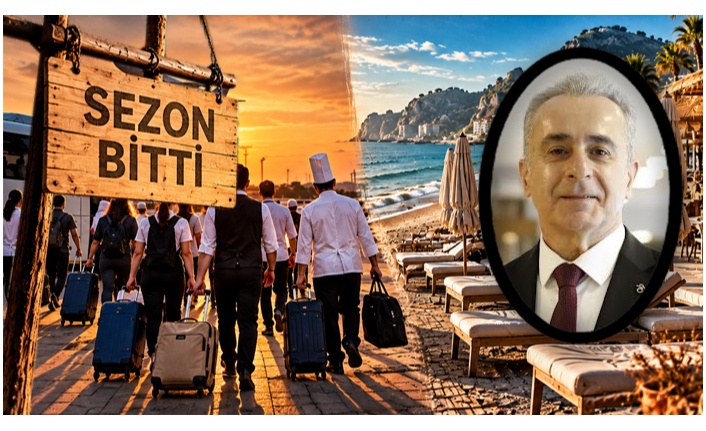
The Labour Scattered Every November, the Craftsman Sought Every April: Tourism’s Silent Story of Migration
By Prof. Dr. Tansel Tercan
Let us call him Mehmet. His name may be different, but his story is the story of thousands of tourism workers. For eight seasons he has worked in the kitchen of the same hotel. This summer he got up at five every morning, prepared breakfast for hundreds of guests and stood at the oven in the August heat. Last week he worked his final service. He folded his apron, emptied his locker and took the staff bus down to the coach station. He has a ticket in his pocket and a single question on his mind: How will I get through the winter?
Today is 1 November. Along Türkiye’s coasts the curtains are coming down one by one. According to a statement by the Alanya Touristic Enterprises Association, in Alanya, one of the largest tourism centres in the Antalya region with about 540 establishments and 160,000 beds, around 80 per cent of hotels close for the season in mid-November. The share of establishments that stay open all year is only around 11 per cent. The pools are drained, the sunloungers are stacked up, and the armchairs in the lobbies are wrapped in white covers.
We know where the guests have gone. But we rarely ask where Mehmet and hundreds of thousands of people like him have gone.
When the hotel’s lights go out, a person’s life plan is put on hold as well.
The figures show the scale of this silence clearly. According to data from the Turkish Statistical Institute (TÜİK), the number of paid employees in the accommodation and food services sector reached 1,503,537 in June 2026, the highest level since the series began in 2009. About 493,000 of them worked directly in accommodation establishments. In January 2026, the number of employees in the same sector was 1,234,506. In other words, there is a gap of about 270,000 people between winter and summer. The August data also show that employment in the sector rose by 3.3 per cent compared with a year earlier.
These 270,000 are not a row in a table. They are 270,000 lives that arrive with the season and leave with the season. 270,000 family budgets, 270,000 rent calculations, 270,000 questions of “Will I come back next year?”
What is more, the other side of this picture is even more striking. Only this June, sector representatives were saying that they were struggling to find staff in tourism regions, and that high rents, the rising cost of living and the job opportunities offered by other sectors were driving workers away from tourism. So every spring we complain that “We cannot find staff”, and every autumn we see the same people off with our own hands.
The very people we search for every spring, we see off with our own hands every autumn.
So where does Mehmet go? Some return to their villages and their families, and get through the winter with the garden, the animals and small jobs. Some take work in the city as couriers, in cargo, retail, call centres, on construction sites or in factories. Some spend this winter waiting for the next season. And some, a few more each year, never return to this profession.
This is where the real question begins: not where the people went, but why they did not come back.
In “Exit, Voice, and Loyalty”, published in 1970, the economist Albert Hirschman gives an answer to this question that still holds true today. According to Hirschman, a person dissatisfied with an institution has two paths: either to raise their voice and try to change the situation, or to leave quietly. What determines the choice is loyalty. Loyalty encourages a person to speak up; without loyalty, only exit remains.
The seasonal worker’s voice is seldom heard in the organisation. Someone who knows they will be gone in six months chooses to put up with problems rather than raise them. And on the day they give up putting up with them, without anyone noticing, without so much as a letter of resignation, they simply do not come to the door next April.
If you do not hear an employee’s voice, you will not hear them leave either.
In “The Corrosion of Character”, published in 1998, the sociologist Richard Sennett sums up the effect of flexible work on the human being in a single phrase: “No long term.” According to Sennett, a working life that is constantly interrupted prevents people from building a meaningful story of their own lives. Those who cannot connect their today to their tomorrow cannot connect to the work they do either.
Zygmunt Bauman describes this world as “liquid modernity”: a world in which jobs, relationships and belonging cannot take on a lasting form. Guy Standing, for his part, gives this new class of insecure workers the name “precariat”. The seasonal tourism worker is one of the most vivid textbook examples of these concepts.
In organisational psychology, Denise Rousseau’s concept of the “psychological contract” makes the matter clearer still. Between every employee and employer there is an unwritten contract of expectations. This contract is either short-term and transactional, or long-term and relational. A person working in a job they know will end in six months naturally forms the first kind of contract: they give their labour, take their pay and leave. To expect commitment to the organisation, ownership of the guest and passion for the work from them would be unfair.
We cannot expect loyalty to a future we do not guarantee.
The worker pays the price of this first, but the bill is ultimately presented to the hotel and the guest. At the start of every season we advertise again, interview again, train again and build a team again. A marked difference emerges between the team that welcomes the guest in May and the team that bids the guest farewell in August. The guest may not be able to measure this difference, but will certainly feel it.
Aristotle explains both virtue and craft through the concept of “hexis”: a disposition acquired through repetition and settled through continuity. The mastery Mehmet has gained over eight years cannot be developed in a single season. Once that mastery is lost, what we put in its place is not merely a staff position, but a journey starting from zero.
Mastery grows not by the calendar, but through continuity.
At the ATF26 International Antalya Tourism Fair, held in Antalya last week, different sides of this issue took the stage. There were those who proposed growing trade-fair tourism to extend the season and thereby stabilise employment; those who drew attention to low tourism revenue per person and the failure to spread activities across the year; and those who announced that about one third of the 2.2 billion dollars’ worth of investment incentive certificates obtained for the 2027–2028 period came from Antalya. The final day of the fair was devoted entirely to young people, new-generation careers and the meeting of generations.
All of these topics lead to the same question: while we talk about new investments, new markets and new-generation careers, are we also talking about where and how the people who keep those hotels standing will live for twelve months of the year? As I stressed in my assessment of ATF26, a solution with no one responsible for it, no date and no measure is only a good wish. For this reason, I would like to describe the road to twelve-month employment in six stops, placing a measure beside each step.
Spreading the product across four seasons. Congresses and meetings, thermal and health tourism, sports camps, gastronomy, cultural routes and long-stay packages for retired European guests who want to spend the winter in the south can extend the calendar of coastal hotels. This year, some hotels in Antalya and Alanya postponed their closing date to the end of November thanks to strong autumn demand, which shows that this is possible. Measure: the number of beds remaining open between November and March.
Extending the season is not a marketing target, but a people policy.
Building a staff bridge between summer and winter hotels. A team that spends the summer on the coast and the winter in the mountains gives its members year-round security and gives the business an experienced workforce. For groups operating in more than one destination, this is the solution that can be implemented most quickly. Measure: the share of staff who continue working throughout the year through rotation.
Turning winter into a season of training. The months when the hotel is closed are the best time for training in foreign languages, kitchen techniques, hygiene, digital skills and leadership. Every month devoted to training in winter comes back to the guest as quality in summer. Measure: winter training hours per employee.
Winter is not tourism’s season of rest, but its season of preparation.
Solving the housing problem. Rent increases in tourism regions are costing us workers before they have even started the job. Staff housing that can be used all year round and is worthy of human dignity is now as decisive as pay. Measure: staff housing capacity as a ratio of total employees.
The shared responsibility of the public sector and the industry. Employer-contribution support for businesses that maintain employment outside the season, incentives for winter training programmes and investment support that gives priority to four-season products can stop seasonal employment from being a fate. The investment incentives of the next two years should be assessed with an understanding that considers the continuity of employment alongside the bed. Measure: the number of businesses and employees benefiting from off-season employment support.
Most important of all: the promise of return. Making valued employees an offer for next season before the season ends; giving them a commitment to return that recognises their seniority, their title and their labour. Not breaking the bond with them during the winter: a phone call, a holiday greeting, an invitation to training. These small steps are the seeds of the loyalty Hirschman speaks of. Measure: the rate of returning employees.
A hotel’s true success lies not in its occupancy rate, but in its rate of returning employees.
None of these steps is free of cost. But when we take into account the price of rehiring every spring, of retraining, of rebuilt teams and of lost mastery, we see that keeping people all year round is in fact the most rational investment.
Let us return to Mehmet. Next April there are two possibilities. Either his phone will ring, and on the line will be a voice calling him by name and saying, “Chef, the kitchen is waiting for you.” Or that April Mehmet will be in the city traffic with a courier bag, and we will once again be complaining that “We cannot find staff.”
Which possibility comes true will be decided not by Mehmet, but by us.
When the season ends, we lock the hotel’s door. But we must not lock the path of the people we leave behind that door. Because the true capital of a tourism country is not its sea, its sun or its buildings; it is the people who give those buildings their soul.
The season ends; people do not.